
DAM trends 2027 share one theme: the adoption debate is over. Most enterprises already run a DAM, so the harder questions now concern governance, volume, regulation, and speed. AI has made each of those questions more urgent, which is why the next planning cycle looks different from the last one.
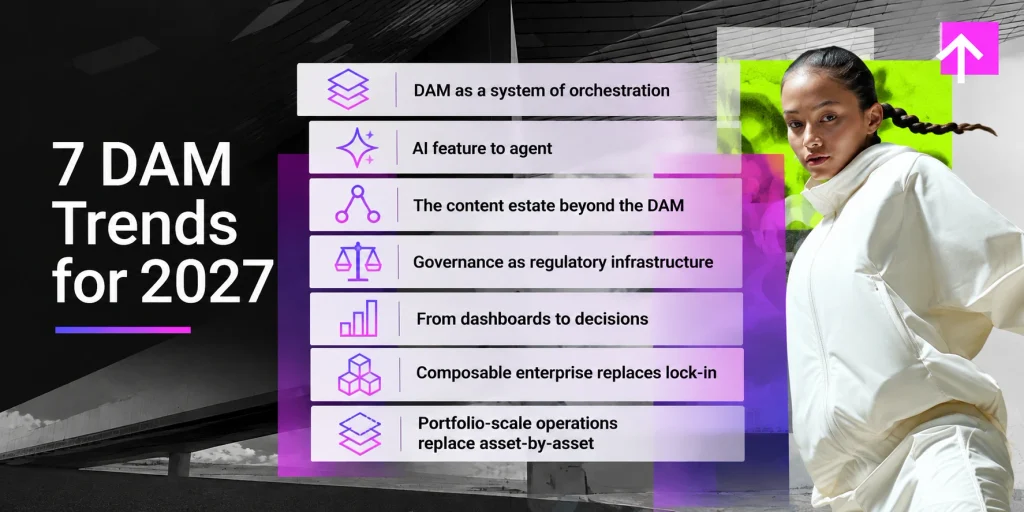
This post walks through seven DAM trends that will shape content operations in 2027. The trends come from Aprimo’s 2027 Top Digital Asset Management Trends report. That report draws on analyst research, survey data, and patterns from live enterprise deployments.
Each trend describes a force already acting on content teams. Some arrive as regulation. Others arrive as new buyer expectations or new technology standards. Together they point to one structural change: the DAM is moving from a system of record to a system of orchestration. Buyers who read the trends as a connected set will plan better than buyers who treat each one as a separate project.
TL;DR
- The DAM is shifting from a repository that stores assets to a layer that coordinates people, agents, and systems.
- AI agents now execute governed content tasks, which changes the question from “what can AI suggest” to “what can AI be trusted to do.”
- Enterprise content lives far beyond the DAM, so governance has to travel with content instead of waiting for it to arrive.
- AI disclosure, accessibility, and green claims rules turn brand governance into a legal obligation.
- Content intelligence, composable architecture, and portfolio-scale operations separate leading teams from teams that only manage files.
- Buyers should evaluate platforms on what they coordinate, not only on what they store.
What do the DAM trends 2027 have in common?
The seven trends share a single cause: AI has made existing content problems impossible to ignore. Volume, distribution complexity, regulatory exposure, and brand governance were always hard. AI generation made each of them harder, while also making better tools available.
Definition: A system of orchestration is a DAM that coordinates the people, agents, and systems behind content production. It does more than store and serve assets.
The report frames the change as a shift in the central question. For years, teams asked how to get an organization to use a DAM. That question is largely answered. The new questions are how to govern content nobody placed in the DAM, how to review volumes no team can read manually, and how to stay compliant with rules that did not exist eighteen months ago.
Forrester research cited in the report found that 66% of DAM decision-makers expect AI for content operations, search, and adaptation to increase significantly over the next two years, according to the 2027 DAM trends report. The same research shows that AI innovation is outpacing customer readiness. Vendors embed AI faster than organizations can govern it or connect it to outcomes.
That gap between capability and confidence is where the important decisions sit. The first trend shows how the DAM itself is changing in response.
Why is the DAM becoming a system of orchestration?
The DAM is becoming a system of orchestration because the valuable question is no longer whether content is in the system. The valuable question is what the system does with content once it arrives, and what it does about content that never arrives.
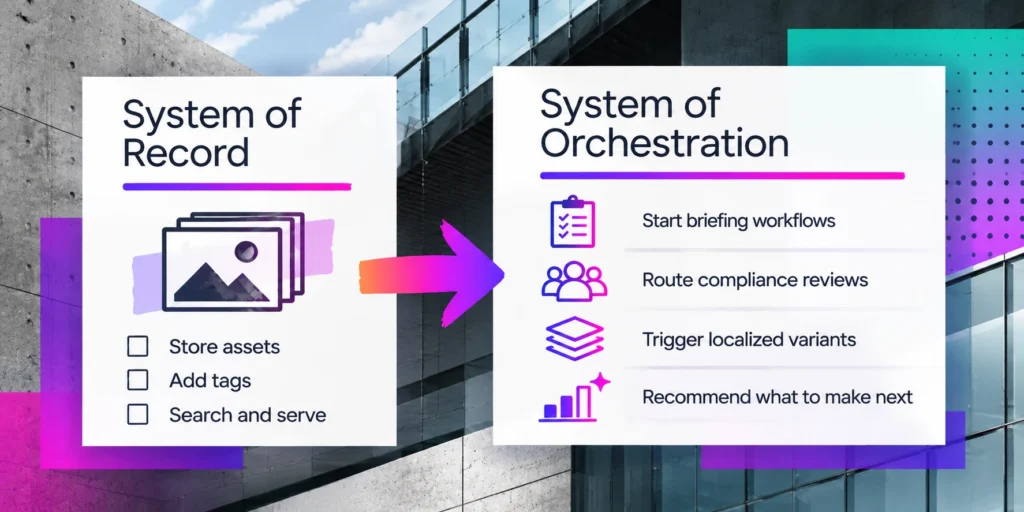
A comparison shows the difference:
- System of record: The DAM stores assets, tags them, and serves them on request. Value comes from finding content faster and distributing it more efficiently.
- System of orchestration: The DAM starts briefing workflows, routes compliance checks, triggers localized variants, and recommends what to make next. Value comes from the work it coordinates.
Forrester’s Wave for digital asset management systems, published in Q1 2026, identified this shift explicitly. Aprimo delivers that connective role through its Content Operations Platform. It described DAM evolving from storage into a connective layer, or “system of action,” at the center of the enterprise content supply chain. Analysts also found that operational impact is becoming a better measure of value than asset volume.
Integration sits at the center of that change. Forrester’s June 2026 report, Digital Asset Management Anchors Modern Content Operations, found that 47% of DAM decision-makers rank integration with adjacent systems as their top priority.
Buyers should look for event-driven automation that reacts to content states and outside signals. They should also look for an integration architecture that makes the DAM an active participant in the content supply chain. A passive endpoint no longer qualifies.
How are AI agents moving from features to autonomous workflows?
AI agents have moved from assisting users to executing tasks inside governance boundaries. In a feature model, a person acts and AI improves the result. In an agent model, the agent acts. Configured policies, confidence thresholds, and human review gates decide when a person steps in.
The report describes five agent categories that cover the content lifecycle:
- Planning agents generate campaign and content briefs.
- Librarian agents classify assets, enrich metadata, and power search.
- Critic agents evaluate quality and tone against defined standards.
- Compliance agents check content for brand, legal, and regulatory risk before release.
- Production agents generate, transform, localize, and distribute content.
Demand is rising quickly. In Forrester’s Q3 2025 survey of 313 global decision-makers, AI agents for task and workflow automation ranked sixth among important DAM capabilities today. Within two years, respondents expected them to rank second, according to the 2027 DAM trends report. Gartner predicts that 40% of enterprise applications will include task-specific AI agents by the end of 2026, up from less than 5% in 2025, according to a Gartner press release.
Production metrics give the clearest signal. The report cites customer environments where project scope creation dropped from 90 minutes to 10, asset reuse improved by 480%, and regulatory approval timelines shrank by 80%. Aprimo reports these figures from live deployments, so buyers should ask for the same evidence from any vendor.
Why has the content estate outgrown the DAM boundary?
The content estate has outgrown the DAM because enterprise content now lives in agency file stores, CMS platforms, dealer networks, social channels, and brand portals. The DAM governs what it contains. Brand and compliance failures pile up in the places content lands after it leaves.
Teams managing distributed operations describe the problem in plain terms. One group in the report could not say what was live across 400 dealer sites. That situation reflects an architecture gap, not a people problem.
Governance strategies that require all content to enter the DAM first will cover a shrinking share of the estate. The alternative is manage-in-place governance. The platform discovers content where it lives, scans it against policy, and reports findings without forcing migration.
Buyers should look for three things:
- Connections to external repositories, dealer sites, and brand portals.
- Portfolio-level views that aggregate governance status across sources.
- Recommendations ranked by risk, so teams act on the worst findings first.
The cost of ignoring this trend is easy to measure. Monotype’s Scaling Creative Operations survey found that 57% of creative professionals spend more than a quarter of their time on non-creative tasks such as version control and file searches, according to Monotype. Scattered content makes that waste worse.
Check a DAM against the 2027 trends
Build a tailored DAM RFI from your own requirements, use cases, and business goals in minutes.
Why is governance now regulatory infrastructure?
Governance is becoming regulatory infrastructure as new requirements reshape how enterprises create, disclose, and distribute content. AI transparency, accessibility, and environmental claims are introducing additional compliance obligations across markets.
The report lists the main obligations:
- EU AI Act Article 50 took effect on August 2, 2026. AI-generated content must be machine-readable, detectable, and disclosed.
- California SB 942 is in motion. It requires AI detection tools and latent disclosures.
- California AB 3030 already requires disclosure on generative AI patient communications.
- The EU Accessibility Act, in force since June 2025, sets accessibility standards for digital content across member states.
- Broad green claims will be banned across the EU under the Empowering Consumers Directive from September 2026.
Human oversight remains essential. In Bynder and Censuswide’s 2025 State of DAM report, nine in ten respondents said human oversight is necessary to protect brand identity in AI-generated content, according to the 2027 DAM trends report. Reviewing every asset by hand no longer works at current volumes.
The answer is AI-assisted governance. Agents flag risk, score confidence, and route to human reviewers only when the risk justifies it. Buyers should look for native AI content detection, C2PA provenance support, compliance agents, accessibility automation, and immutable audit trails.
How does AI tell teams what to make next?
AI tells teams what to make next through content intelligence, which turns performance data into recommended actions. First-generation analytics answered a reporting question about what content did. Content intelligence answers the next question: what to reuse, retire, or produce.
The difference is whether the tool surfaces the next action. Machine learning compares available assets against campaign and audience needs. It then flags gaps, recommends reuse, and shows where new production earns its cost.
This matters because production capacity is the constraint. Reusing a high-performing asset costs less than commissioning a new one. Spotting a gap before launch prevents a last-minute scramble.
Buyers should ask whether a platform delivers recommendations as actions or as data tables. Closed-loop ROI analytics should connect creation cost to engagement. Approval time should link to conversion. The content intelligence and personalization pages describe how Aprimo frames this capability.
How is the composable enterprise replacing platform lock-in?
The composable enterprise replaces platform lock-in because organizations now assemble ecosystems of specialized agents instead of buying one platform for everything. A common governance layer keeps brand and policy rules consistent across every tool.
Model Context Protocol, or MCP, accelerates this shift. A DAM that acts as an MCP server exposes asset search, metadata, and compliance logic as tools that any agent can call. Adoption data supports the momentum. Stacklok’s 2026 research reports that 41% of software organizations run MCP servers in limited or broad production, according to MCP adoption statistics from MCP Manager.
For buyers, the implication is architectural. Vendors that keep content and workflows inside a closed system will govern a shrinking share of the estate. Vendors that act as callable governance layers become the backbone for the whole ecosystem.
Buyers should look for MCP server support, APIs that expose governance logic, and bring-your-own-agent support. Governance has to travel with the content, whichever tool produced it.
Why are portfolio-scale operations replacing asset-by-asset management?
Portfolio-scale operations replace asset-by-asset management because estates with tens of millions of assets cannot be reviewed one file at a time. Teams need to see risk by region, brand, or campaign, then act on classes of content.
Content Portfolio Management extends visibility and governance beyond the repository. It discovers, monitors, and governs content on websites, cloud storage, partner portals, and external systems. Three capabilities define it:
- Visibility across the full estate, including content that never entered the DAM.
- AI-driven prioritization that ranks findings by severity and urgency.
- Coordinated action across thousands of assets through automated policy enforcement.
The questions change as a result. Teams stop asking whether one asset is compliant. They ask for the brand health score across a dealer network and the sites with the highest-risk findings. Continuous monitoring replaces periodic audits.
IBM estimates that 90% of enterprise data is unstructured, according to IBM. Content estates reflect that reality. Platforms built for tidy repositories will struggle with it.
How should teams prioritize the DAM trends 2027 list?
Teams should prioritize by exposure first, then by readiness. The trends depend on each other, so the order matters more than the count.
The report states the dependency chain directly. AI agents need governance infrastructure. Governance infrastructure needs manage-in-place architecture. That architecture needs interoperability, which feeds portfolio visibility and content intelligence. A practical sequence follows:
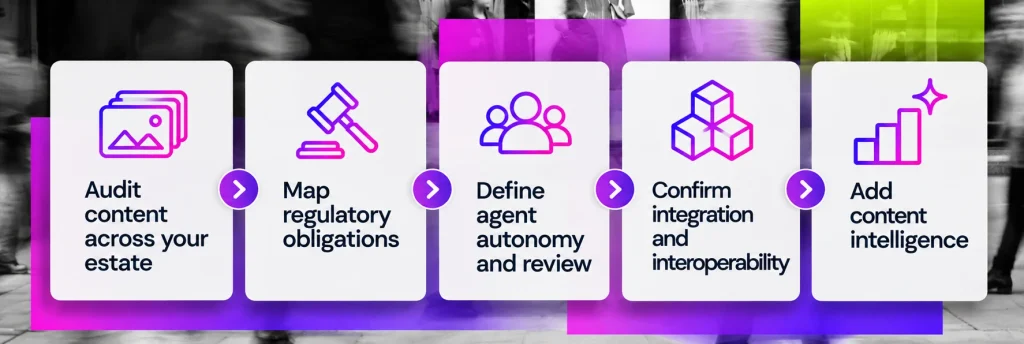
- Audit where content actually lives, including repositories outside the DAM.
- Map regulatory obligations to content types, starting with AI disclosure and accessibility.
- Define agent autonomy levels, confidence thresholds, and human review gates.
- Confirm that integration and interoperability support the target architecture.
- Add content intelligence once the underlying data is trustworthy.
Isolated AI features and disconnected compliance workflows deliver diminishing returns. A unified strategy lets each capability reinforce the others. Buyers who start with the sequence above avoid buying the same capability twice.
Planning around the DAM trends 2027 without chasing every one
The DAM trends 2027 describe a market that has moved past storage. Orchestration, agents, governance, and portfolio visibility now define the category. Organizations that act early help set the standard for enterprise content operations, while those that wait spend years catching up.
The report makes one point clearly: the right sequence depends on where each organization operates today. Teams with strong libraries but weak governance should start with manage-in-place visibility. Teams with strong governance but heavy manual work should start with agents. Teams facing regulatory deadlines should start with disclosure and audit trails.
None of this requires adopting every trend at once. It requires a platform that can grow into each one without a rebuild, which keeps early investments useful as new requirements arrive. That is the test worth applying in every vendor evaluation this year.
Teams that want the full analysis can read the 2027 Top DAM Trends report and then see the platform in a live demo.
FAQ
What is the biggest DAM trend for 2027?
The shift from system of record to system of orchestration frames all the others. It changes what buyers should expect a DAM to do. Storage and retrieval become the baseline. Coordination of workflows, agents, and governance becomes the differentiator.
Do AI agents replace human reviewers in a DAM?
No. Agents act within governed boundaries, and human review gates decide when a person must step in. Compliance and brand teams still own the standards. Agents handle volume so reviewers focus on the cases that carry real risk.
What is manage-in-place governance?
Manage-in-place governance applies brand and compliance checks to content where it already lives. It avoids forcing every asset through a single repository. That makes it practical for dealer networks, agency stores, and partner portals.
Why does MCP matter for DAM buyers?
MCP lets outside AI agents call a DAM’s search, metadata, and compliance logic as tools. This keeps governance consistent when several vendors’ agents touch the same content. It also reduces the cost of changing tools later.
Which regulations affect content teams most in 2027?
EU AI Act Article 50 disclosure rules, California AI disclosure laws, the EU Accessibility Act, and EU limits on broad green claims all reach content workflows. Exact obligations vary by market, so legal teams should confirm applicability for each region.
Where can buyers find the full 2027 DAM trends analysis?
Aprimo’s 2027 Top Digital Asset Management Trends report covers all seven trends with sources. It includes the agent categories, regulatory timeline, and evaluation criteria summarized here.
Related reading: the future of enterprise AI agents in content operations, content governance maturity assessment.