

How to Select the Right DAM Vendor for Your Technology Company
For years, marketing and creative teams have measured success by how much content they could produce. New campaigns meant new assets. New channels meant new formats. New audiences often triggered entirely new content production efforts.
That approach is becoming increasingly unsustainable.
Content demands continue to rise, but budgets, resources, and attention remain limited. At the same time, AI has dramatically lowered the barriers to creating content variations, localized assets, and personalized experiences. The challenge is no longer generating content. The challenge is doing so efficiently.
This is where asset reuse becomes a strategic advantage.
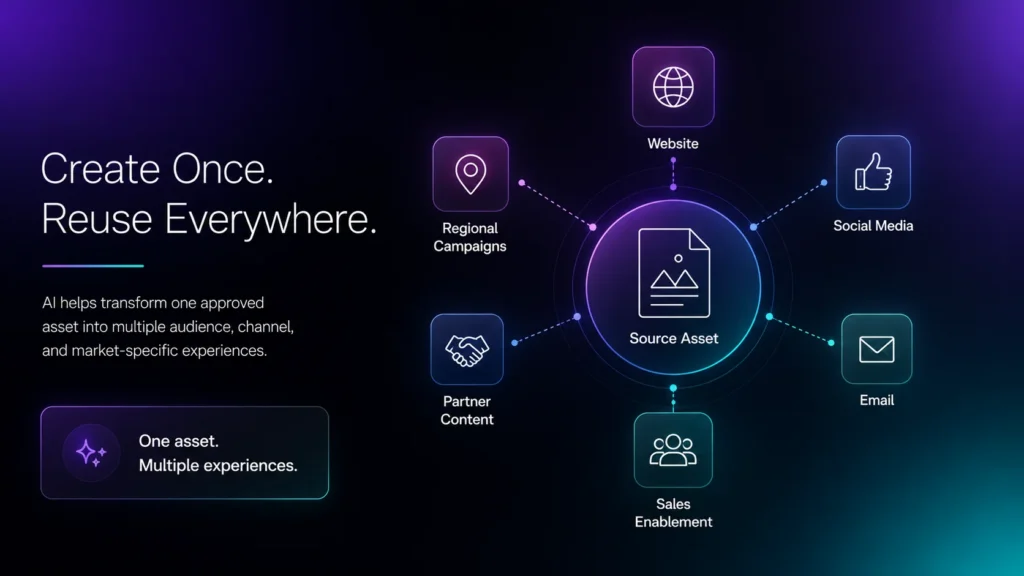
Rather than starting from scratch every time, organizations can leverage existing assets as the foundation for new experiences. AI enables teams to adapt, transform, enrich, and redistribute content at a scale that was previously impossible. The result is a new operating model where content is created once and manipulated repeatedly across audiences, channels, and use cases.
As content volumes continue to grow, organizations are under increasing pressure to produce more personalized experiences without proportionally increasing production costs. Industry research from McKinsey shows that leaders in personalization significantly outperform their peers, making content efficiency and asset reuse critical capabilities for modern marketing organizations.ext
TL;DR
- Asset reuse is becoming one of the most important drivers of content efficiency in the AI era.
- AI makes it easier to transform, adapt, localize, and personalize existing content instead of creating everything from scratch.
- DAM provides the structure needed to discover, govern, and activate reusable content assets.
- Organizations that maximize content reuse can significantly reduce production costs while accelerating time to market.
- The future of content operations is not about creating more content. It is about extracting more value from the content you already have.
Why Asset Reuse Matters More Than Ever
Content creation has always been expensive.
Whether organizations invest in photography, video production, design, copywriting, or product content, every asset requires time, expertise, and budget. Yet many enterprises continue to discover that a significant percentage of their content is rarely reused or even found after its initial use.
This represents a major operational challenge.
When teams cannot easily discover existing assets, they often recreate content that already exists. This duplication increases production costs, slows execution, and contributes to content sprawl. As content volumes grow, the problem compounds. AI changes the economics of reuse.
Instead of simply locating an existing asset and using it again, teams can now adapt that asset for new channels, formats, regions, and audiences with significantly less effort. A product image can become dozens of campaign variants. A webinar can become blogs, social posts, and sales enablement materials. A product video can be localized for multiple markets.
The value of the original asset increases because its potential uses multiply.
Asset Reuse Is No Longer Just Content Recycling
Many organizations still think about asset reuse as simply reusing the same file in multiple places. In reality, AI has expanded the definition considerably.
Today, asset reuse includes:
- Transforming assets into new formats.
- Creating localized versions.
- Generating audience-specific variations.
- Adapting content for different channels.
- Building modular content components.
- Recombining existing assets into entirely new experiences.
This shift is important because AI enables content transformation at scale. Instead of asking whether an asset can be reused, teams can ask how many ways it can be reused. This mindset changes content operations from a production-centric model to a value-maximization model.
The AI Multiplier Effect
AI does not replace asset reuse. It amplifies it. Historically, content reuse was constrained by the effort required to adapt assets manually. Teams often knew content could be reused but lacked the resources to repurpose it effectively. AI removes many of these barriers.
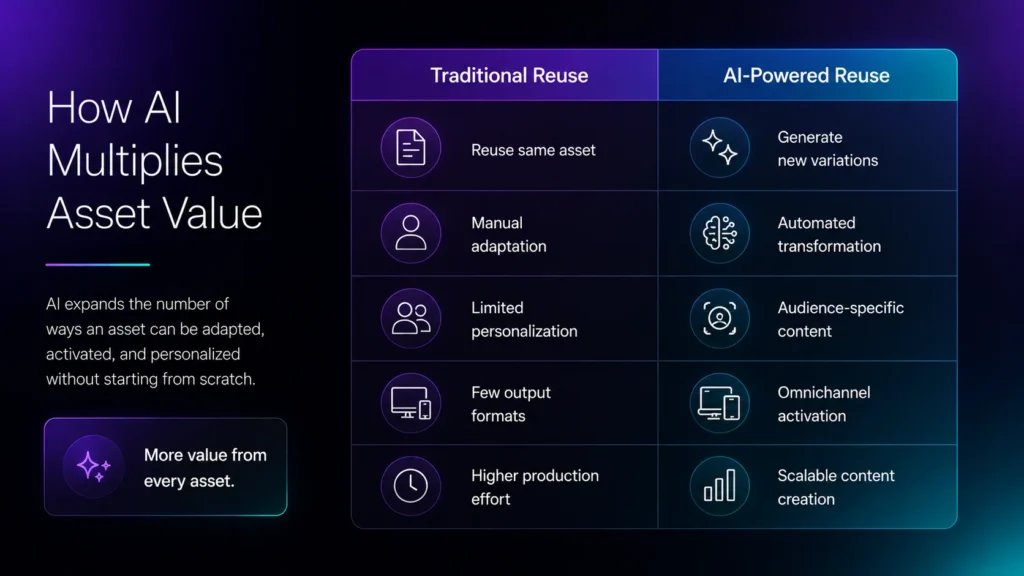
Modern AI systems can:
- Generate multiple content variations from a single source asset.
- Adapt messaging for different personas.
- Translate and localize content.
- Reformat content for new channels.
- Enrich assets with metadata.
- Identify related content for reuse opportunities.
This creates what can be described as a multiplier effect. Every asset becomes more valuable because AI increases the number of ways it can be activated. The organizations that benefit most are not necessarily those creating the most content. They are the ones maximizing the value of the content they already have.
DAM as the Foundation for Asset Reuse
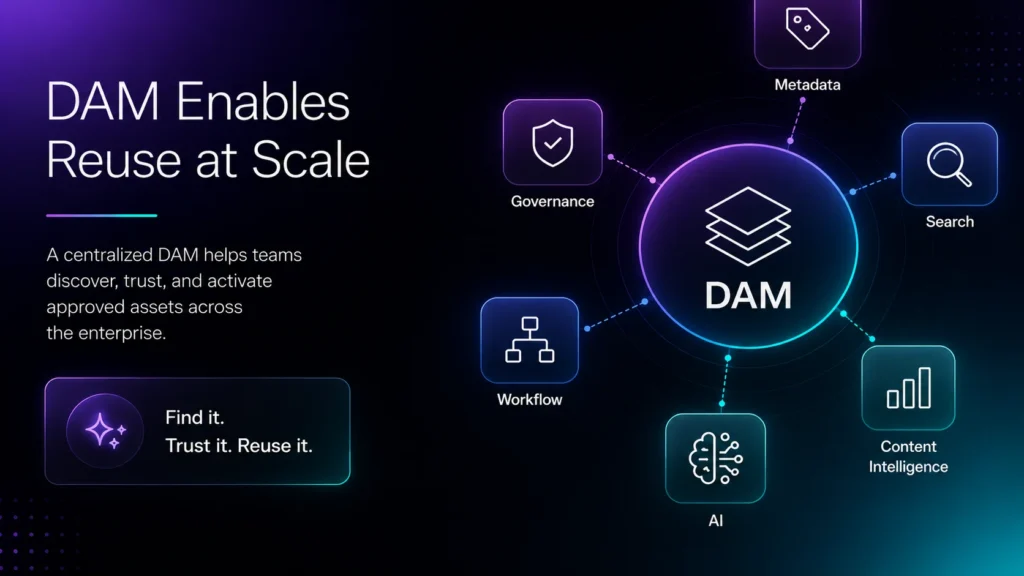
AI can only reuse what it can find. This is why digital asset management plays such a critical role in asset reuse strategies. Without a structured system for organizing, classifying, and governing content, reuse becomes difficult regardless of how advanced AI capabilities become. DAM provides the operational foundation that makes reuse possible.
It enables organizations to:
- Centralize approved content.
- Improve discoverability through metadata.
- Maintain version control.
- Govern usage rights.
- Track asset performance.
- Enable cross-team access.
As discussed in Aprimo’s article on How to Organize Digital Assets Using Metadata and Taxonomy, structure is what transforms a content repository into a usable system. Asset reuse depends on that structure. If content cannot be found, it cannot be reused.
The Role of Metadata in Content Reuse
Metadata is often overlooked when organizations discuss AI. Yet metadata is one of the most important enablers of asset reuse. AI systems need context. Metadata provides that context by describing what an asset is, where it belongs, how it can be used, and who should use it.
Effective metadata enables AI to:
- Surface relevant assets.
- Recommend reusable content.
- Identify related materials.
- Apply governance rules.
- Support personalization.
Organizations that invest in metadata quality often discover that content reuse increases naturally because assets become easier to discover and trust. This is one reason why many enterprises treat metadata governance as a core component of modern content operations.
Create Once, Personalize Everywhere
One of the biggest drivers of content volume today is personalization. Marketing teams are expected to deliver increasingly relevant experiences to customers across multiple channels, regions, and stages of the buyer journey.
Without reuse, personalization quickly becomes expensive. AI helps solve this challenge by allowing organizations to build personalization strategies on top of reusable content assets.
Instead of creating entirely new assets for every audience segment, teams can:
- Reuse approved source content.
- Generate audience-specific variants.
- Localize assets for regional markets.
- Adapt messaging based on context.
This allows organizations to scale personalization without scaling production costs at the same rate. As Aprimo highlights in its Content Personalization solution, successful personalization is increasingly driven by the ability to reuse, adapt, and activate existing content across multiple experiences rather than relying solely on net-new content creation.
Building a Reuse-First Content Strategy
Organizations that excel at content reuse often share a common mindset.
They design content with reuse in mind from the beginning.
Rather than creating assets as one-time deliverables, they treat content as modular building blocks that can be recombined, adapted, and redistributed over time.
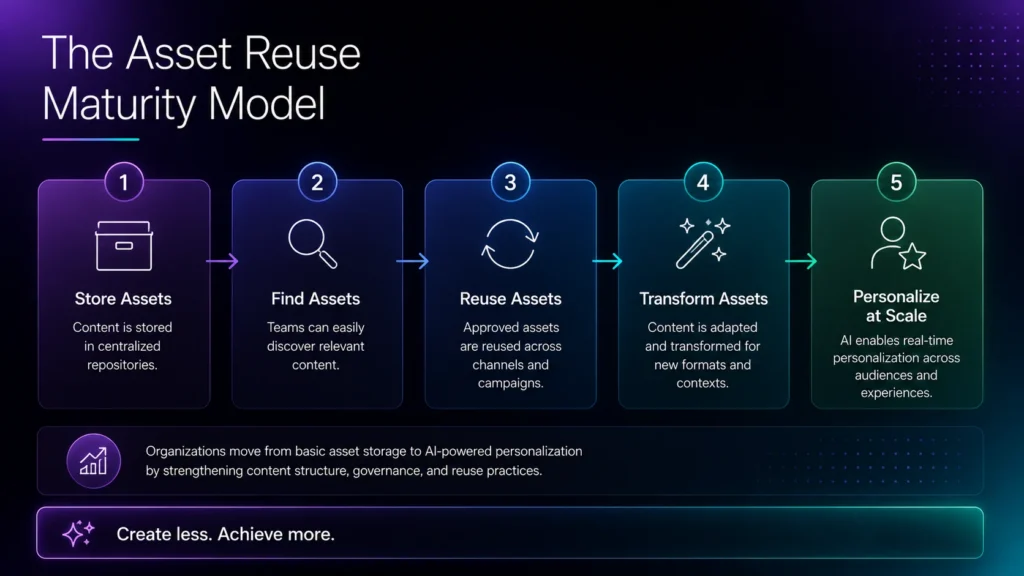
A reuse-first strategy typically includes:
Modular Content Design
Creating content as modular components allows organizations to maximize the value of every asset they produce. Instead of building entirely new content for every campaign, teams can reuse approved content elements across channels, audiences, and formats. This approach improves efficiency while making it easier to scale personalization and content production.
Strong Metadata Practices
Asset reuse depends on discoverability, and discoverability depends on metadata. Consistent tagging and classification help teams find relevant content quickly and understand how it should be used. As content libraries grow, strong metadata becomes essential for both human users and AI systems.
Centralized Asset Management
A centralized DAM provides a single source of truth for approved content across the organization. This helps reduce duplication, improve collaboration, and ensure teams always have access to current assets. It also creates the foundation needed to support large-scale content reuse.
Workflow Governance
Content reuse should be efficient, but it must also remain governed. Workflow controls help ensure that reused assets are approved, compliant, and aligned with current brand standards. This allows organizations to scale reuse without increasing risk.
AI-Powered Transformation
AI expands the value of reusable content by making it easier to adapt assets for new audiences, channels, and markets. Teams can generate variations, localizations, and personalized experiences from approved source content rather than creating everything from scratch. This helps organizations extend the lifespan and impact of every asset they create.
These capabilities work together to maximize content value while minimizing unnecessary production effort.
Common Barriers to Asset Reuse
Despite the benefits, many organizations still struggle with asset reuse.
Common barriers include:
Poor Discoverability
Teams cannot reuse assets they cannot find. When content is buried in folders, spread across systems, or lacks proper classification, users often spend more time searching than reusing. In many cases, they simply create new content because finding existing assets feels more difficult than recreating them.
Inconsistent Metadata
Assets without consistent metadata lack the context needed for effective discovery and reuse. Different teams may tag similar content in different ways, making search results unreliable and reducing confidence in what users find. Over time, this weakens both content governance and reuse efforts.
Content Silos
Content is often distributed across DAM platforms, shared drives, cloud storage, project management tools, and local systems. When assets are scattered across disconnected repositories, teams have limited visibility into what already exists. This fragmentation makes reuse difficult and increases the likelihood of duplicate content creation.
Governance Concerns
Even when teams find existing assets, they may be unsure whether those assets are still approved for use. Questions around rights, expiration dates, compliance requirements, or outdated messaging can discourage reuse and push teams toward creating new content instead. Clear governance helps build trust in reusable assets.
Cultural Habits
Many organizations have developed habits that prioritize creation over reuse. Teams often assume that new campaigns require new content, even when valuable assets already exist. Shifting to a reuse-first mindset requires both operational changes and a culture that recognizes content as a long-term business asset rather than a one-time deliverable.
Addressing these barriers often requires both technology and process improvements.
The Future of Asset Reuse
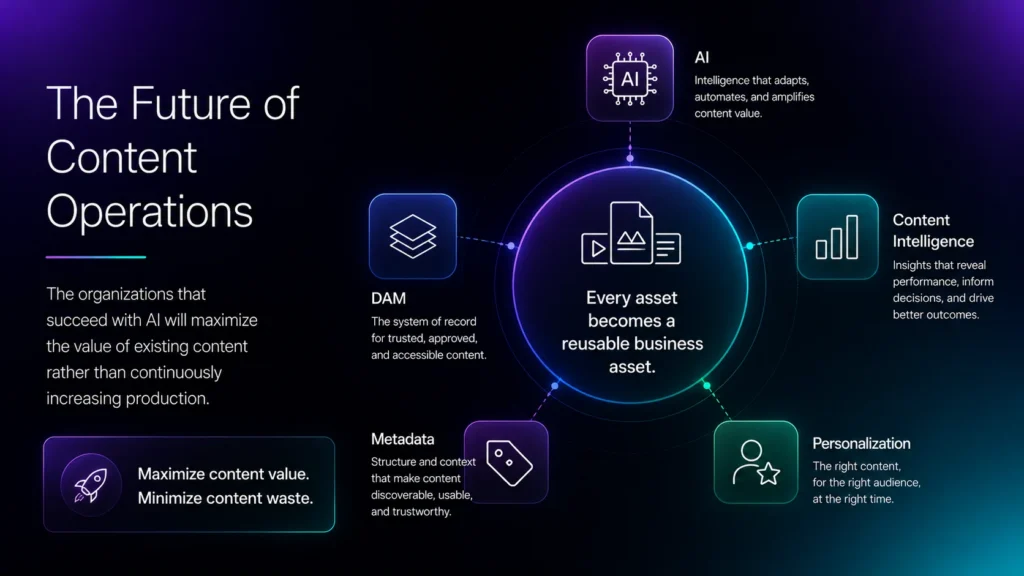
The future of content operations is increasingly tied to reuse.
As AI capabilities continue to expand, organizations will be able to generate more content variations, more personalized experiences, and more localized assets from fewer source materials.
The content supply chain will shift from creating everything manually to orchestrating reusable content assets at scale. AI agents, content intelligence, DAM, and workflow automation will all play important roles in this evolution. The organizations that succeed will not simply create more content. They will extract more value from every asset they create.
Conclusion
Asset reuse is no longer just an efficiency tactic. It is becoming a strategic capability for enterprise content operations.
AI makes it possible to transform, adapt, and personalize content at an unprecedented scale. DAM provides the structure that allows organizations to discover, govern, and activate those assets effectively. Together, these capabilities create a powerful operating model: create once, manipulate again and again.
The future belongs to organizations that treat content as a reusable business asset rather than a one-time deliverable.
FAQ
What is asset reuse in content operations?
Asset reuse is the practice of leveraging existing content assets across multiple campaigns, channels, audiences, and use cases. In the age of AI, reuse also includes transforming and adapting content into entirely new formats and experiences.
Why is asset reuse important for enterprise marketing?
Asset reuse helps organizations reduce production costs, accelerate time to market, and maximize the value of content investments. It also enables teams to scale content operations without requiring proportional increases in resources.
How does AI improve asset reuse?
AI helps organizations identify, transform, adapt, and personalize existing content more efficiently. This increases the number of ways an asset can be used while reducing the effort required to create new content.
What role does DAM play in asset reuse?
DAM serves as the system of record that enables content discoverability, governance, and activation. Without DAM, organizations often struggle to locate and reuse content effectively.
How can organizations build a reuse-first content strategy?
Organizations can build a reuse-first strategy by investing in metadata, DAM, workflow governance, modular content design, and AI-powered transformation capabilities. These foundations make it easier to discover and activate content repeatedly across the enterprise.