
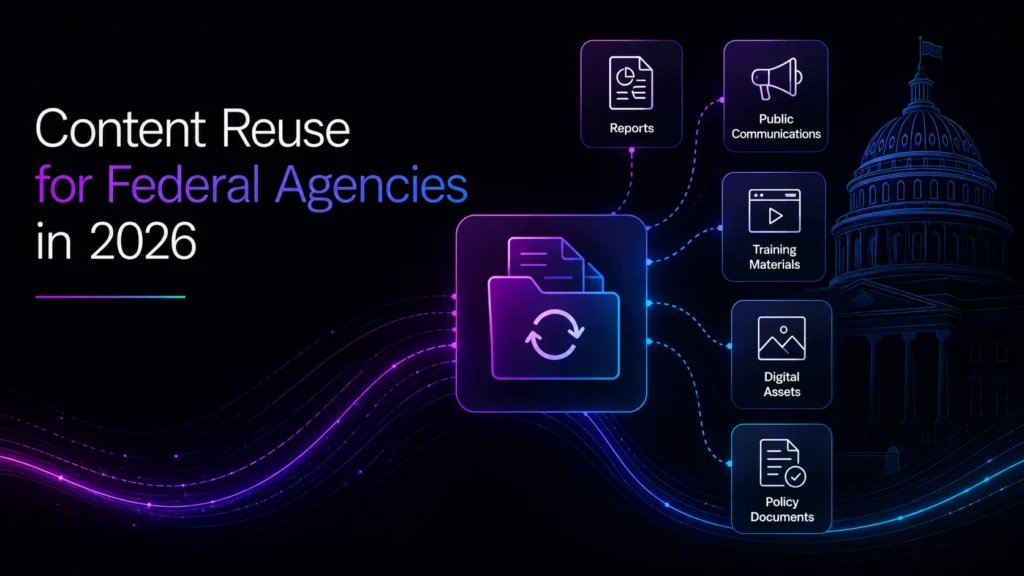
Federal agencies operate under constant pressure to deliver timely, accurate, and compliant information to the public while managing vast archives of content. The sheer volume and sensitivity of governmental communications often lead to redundant efforts, inconsistent messaging, and increased operational costs. Without a strategic approach to content management, agencies risk administrative bottlenecks and a diluted public perception. This challenge demands a forward-thinking solution that not only streamlines content creation but also ensures every piece of information serves its purpose efficiently and effectively, preparing agencies for the evolving demands of 2026 and beyond.
TL;DR
- By 2026, federal agencies must implement comprehensive content reuse strategies to enhance operational efficiency and maintain consistent, compliant public communications amidst increasing information demands.
- Adopting advanced content reuse frameworks allows federal entities to significantly reduce redundant effort, accelerate information dissemination, and reallocate valuable resources toward mission-critical initiatives.
- Effective content reuse directly strengthens an agency’s ability to meet stringent regulatory compliance requirements and consistently uphold public trust across diverse communication channels.
- Leveraging modern digital asset management (DAM) platforms designed for government needs provides the essential infrastructure for scalable content reuse, streamlining workflows and safeguarding sensitive information.
- Federal agencies that prioritize strategic content reuse will achieve measurable improvements in constituent engagement, foster greater transparency, and drive substantial cost savings by reducing content production overhead.
The Unique Content Challenges Federal Agencies Confront
Federal agencies face content challenges distinct from commercial enterprises, primarily due to stringent compliance mandates, a vast array of stakeholders, and the imperative for public transparency. Unlike the private sector, government entities must manage information that often has legal ramifications or direct public service implications, demanding unparalleled accuracy and consistency. The need to maintain an archive of accessible, accurate-at-time-of-publication, and version-controlled content is paramount.
Definition: Content reuse is the strategic practice of repurposing existing text, visual, and multimedia assets to create new communications, maximizing content’s value across various platforms and reducing redundant efforts.
Managing content across numerous departments, each with its own specific communication needs and regulatory oversight, complicates content generation and distribution. The absence of a unified content strategy often leads to siloed information, where valuable assets are duplicated or underutilized. This fragmentation exacerbates the challenge of ensuring all public-facing materials are current, approved, and aligned with the agency’s mission. Furthermore, the sensitive nature of much federal data necessitates robust security protocols and strict adherence to data governance policies, adding another layer of complexity to content management workflows.
Strategic Content Reuse: A Foundation for Federal Efficiency
Implementing strategic content reuse allows federal agencies to transform their communication processes, yielding significant gains in efficiency, compliance, and cost-effectiveness. By systematically cataloging, standardizing, and making content centrally accessible, agencies can eliminate the repetitive creation of similar materials across different departments and campaigns.
This approach directly addresses the financial implications of content redundancy, where resources are unnecessarily expended on recreating assets that already exist. Agencies can redirect these savings towards other critical public services or technological upgrades. Moreover, a structured content reuse strategy inherently supports compliance efforts by establishing clear version control and approval workflows, reducing the risk of disseminating outdated or non-compliant information.
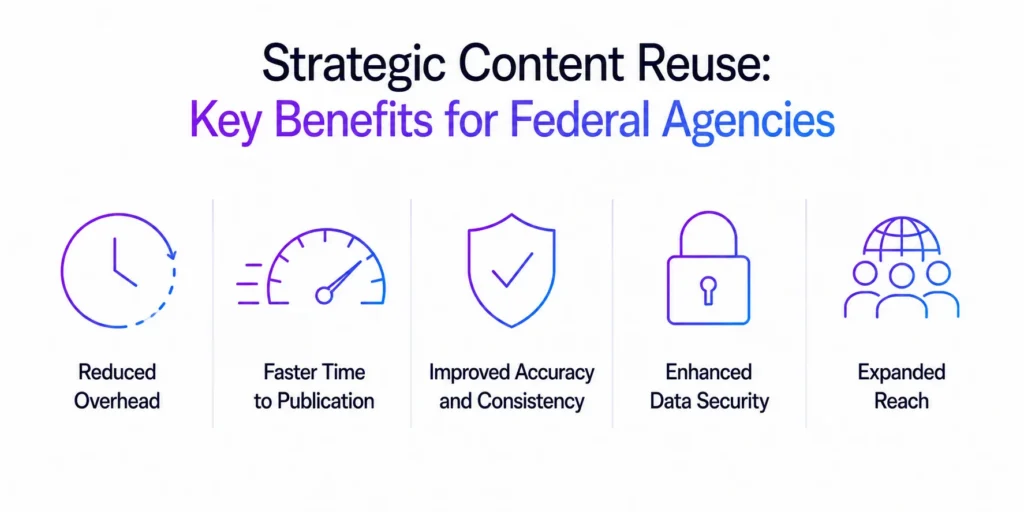
Strategic content reuse enables federal agencies to operate more efficiently, ensure compliance, reduce costs, and better serve the public.
- Reduced Overhead: Agencies save substantial time and money by not creating content from scratch for every new initiative or publication.
- Faster Time to Publication: Approved content can be quickly assembled and deployed for new campaigns or urgent public announcements, enhancing responsiveness.
- Improved Accuracy and Consistency: Centralized content ensures that messaging, terminology, and factual data remain uniform across all communications, building public trust.
- Enhanced Data Security: A unified system provides better oversight and control over who accesses and modifies sensitive information, bolstering security measures.
- Expanded Reach: Consistent and readily available content allows agencies to adapt materials for diverse platforms and audiences more efficiently.
These advantages collective contribute to a more agile and responsible federal operation. These advantages collectively contribute to a more agile and responsible federal operation, ultimately enhancing the government’s ability to serve its constituents effectively and efficiently. Strategic content reuse is not merely a technological upgrade but a fundamental shift towards more intelligent and sustainable governance.
The Role of Digital Asset Management in Federal Content Reuse
Digital Asset Management (DAM) platforms are indispensable for federal agencies seeking to establish a robust content reuse strategy, providing the centralized infrastructure needed to organize, store, and distribute approved digital assets. A purpose-built DAM system empowers agencies to maintain strict control over their content lifecycle while facilitating easy access and repurposing for authorized users.
Unlike generic file storage solutions, a DAM offers advanced functionalities critical for government operations. It provides comprehensive metadata management, enabling detailed tagging and classification of assets for quick retrieval, ensuring that the right content is found and adapted efficiently. Version control capabilities are also central, allowing agencies to track every iteration of an asset, revert to previous versions if needed, and ensure only the latest approved content is in circulation, which is vital for regulatory compliance.
DAM systems designed for the public sector often incorporate enhanced security features and audit trails, crucial for protecting sensitive government information and demonstrating accountability. By integrating a DAM, federal agencies gain a single source of truth for all their digital assets, reducing content fragmentation and promoting collaborative content development across departments.
Meeting Compliance and Consistency Demands with Reused Content
Federal agencies must navigate an intricate web of regulatory requirements and public expectations for transparency and accuracy, making robust content governance non-negotiable. Strategic content reuse, when implemented through directly supports adherence to these mandates and reinforces consistent messaging. This approach fosters an environment where every piece of public-facing content, regardless of its origin within the agency, speaks with a unified voice and adheres to the highest standards.
Consider the contrast between haphazard content management and a structured content reuse framework. In a disorganized environment, different departments might independently draft communications on similar topics, leading to conflicting information or varied interpretations of policy. This not only erodes public trust but can also result in costly compliance errors. A decentralized approach often lacks enforceable review and approval processes, increasing the risk of unapproved or outdated content reaching the public.
Conversely, a centralized content reuse strategy ensures that all foundational information, legal disclaimers, and agency-approved messaging components are maintained in a single, auditable repository. This dramatically simplifies the review and approval process, as content integrity checks are performed on reusable components before assembly. When content is assembled from pre-approved, compliant modules, the final output is inherently more consistent and less prone to errors. This proactive approach significantly reduces the administrative burden of compliance verification for each new publication and reinforces a credible, authoritative agency presence.
Future-Proofing Federal Agencies: Content Reuse in 2026
By 2026, federal agencies that have embraced advanced content reuse strategies will be significantly better positioned to leverage emerging technologies like AI and manage ever-increasing data volumes. The foundation of structured, reusable content is critical for unlocking the full potential of AI-driven content generation and personalization tools. Without a clean, organized, and tagged content inventory, AI applications struggle to perform effectively or reliably.
Agencies that commit to content reuse today are investing in future operational agility. This prepares them for a landscape where AI tools will not only assist in drafting content variations but also automate content assembly for targeted audiences, analyze content performance at scale, and ensure real-time compliance checks. The ability to quickly adapt existing content for new digital formats, virtual assistants, and immersive experiences will become a competitive differentiator in public service delivery.
As cybersecurity threats evolve, a well-managed content repository through a DAM system provides enhanced protection for governmental information assets. By centralizing control and instituting granular access permissions, agencies can mitigate risks associated with dispersed, unmanaged content. The integration of content reuse with advanced security protocols will be a non-negotiable aspect of federal digital strategy by 2026, reinforcing public trust and operational resilience . These strategic investments ensure federal agencies can uphold their mission with greater effectiveness and public confidence.
Conclusion
Content reuse represents a transformative approach for federal agencies, offering a clear path to enhanced operational efficiency, unwavering compliance, and improved public engagement by 2026. By moving beyond ad-hoc content practices to a strategic, platform-driven model, agencies can overcome the inherent challenges of managing vast and sensitive information landscapes. Adopting a comprehensive content reuse framework, supported by robust digital asset management, enables federal entities to not only meet current demands but also to proactively prepare for future technological shifts and increasing public expectations. Embracing this strategy means delivering information with greater accuracy, speed, and consistency, ultimately reinforcing the core mission of public service.
Experience AI-Powered Content Operations
See how Aprimo’s AI-powered Librarian Agents automatically enrich content with metadata, improve discoverability, strengthen governance, and unlock greater content reuse across the entire content lifecycle.
FAQ
How does content reuse adapt to urgent public communication needs?
Content reuse enhances an agency’s ability to respond to urgent public communication needs by providing a readily accessible library of approved, adaptable assets. In crisis situations, pre-approved statements, FAQs, or visual elements can be quickly assembled and deployed. This agility ensures timely dissemination of critical information, allowing agencies to inform the public rapidly and accurately, which is crucial during emergencies.
What is content reuse federal agencies and why does it matter for Industry-specific Buyer?
content reuse federal agencies describes the practices and tooling teams use to plan, govern, and scale content operations across the enterprise. For Industry-specific Buyer, it directly affects speed to market, brand consistency, and the ability to measure content performance against revenue. Treating it as a strategic capability, not a tactical add-on, is what separates leaders from laggards in this space.
How do Industry-specific Buyer typically get started with content reuse federal agencies?
Most teams begin by auditing the current content lifecycle, mapping where requests originate, who approves them, and where work stalls. From there, they prioritize one or two high-volume workflows for automation and standardization before expanding. This phased approach builds internal trust and produces measurable wins that justify broader investment.
What ROI should Industry-specific Buyer expect from investing in content reuse federal agencies?
Realistic returns include faster campaign launches, fewer duplicated assets, and meaningful reductions in agency or production spend. Teams also report improvements in compliance and brand consistency that are harder to quantify but reduce real downstream risk. The largest gains come when content reuse federal agencies is connected to upstream planning and downstream performance data.
What are the most common pitfalls when scaling content reuse federal agencies?
The biggest mistakes are treating content reuse federal agencies as a pure technology purchase, skipping governance design, and rolling it out without persona-specific training. Without a clear operating model, even capable platforms fail to change how work actually gets done. Successful programs pair platform implementation with workflow redesign and named accountability for adoption.