

Key Takeaways
Modern content planning demands intelligent automation, centralized asset management, and data-driven workflows that adapt in real time.
- AI-powered workflows eliminate manual bottlenecks and enable teams to focus on strategic, high-impact work.
- Integrating digital asset management (DAM) with your content calendar strategy creates a single source of truth for all assets.
- Organizations with documented, data-driven content strategies see measurably higher engagement and ROI.
- Start by auditing your current workflows and identifying where automation and centralization can deliver immediate efficiency gains.
The way marketing teams approach content planning looks fundamentally different than it did even two years ago. Static editorial calendars and disconnected spreadsheets can no longer keep pace with the volume, velocity, and personalization demands of modern content operations. According to research from the Content Marketing Institute, only 29% of marketers with a documented content strategy rate it as extremely or very effective. Among those struggling, 42% point to a lack of clear goals as a primary culprit.
These numbers reveal an uncomfortable truth: having a content plan is no longer enough. The plan itself must evolve to incorporate intelligent automation, real-time performance data, and seamless integration with the systems that store and distribute your assets. Teams that continue relying on manual processes will find themselves outpaced by competitors who have embraced a more sophisticated approach to content operations.
What Does Effective Content Planning Look Like Today?
Content planning creates a detailed roadmap that outlines what content gets created, where it will be distributed, and how success will be measured. In 2025 and beyond, this process has expanded to include intelligent workflow automation, performance prediction, and adaptive strategy optimization. Think of it as a living system rather than a static document.
The most successful teams now integrate three core components: strategic vision, operational efficiency, and continuous optimization. Strategic vision defines your goals and audience. Operational efficiency ensures your workflows eliminate friction. Continuous optimization uses performance data to refine your approach in real time, not quarterly.

Why Do Traditional Approaches Fall Short?
Traditional content planning typically involves creating a content calendar, assigning tasks, and hoping everyone stays on schedule. The problem? This approach relies heavily on manual coordination, disconnected tools, and reactive decision-making. When assets live in scattered folders, approval chains create bottlenecks, and performance insights arrive weeks after publication, teams cannot adapt quickly enough.
According to McKinsey’s State of Organizations research, two-thirds of executives see their organizations as overly complex and inefficient, with cross-cutting management processes consuming 40 to 65 percent of management and overhead time. This complexity directly impacts content operations, where fragmented workflows and disconnected systems prevent teams from allocating resources effectively. The resource allocation challenge stems directly from poor visibility into what content already exists, what performs well, and what gaps remain unfilled.
How Is AI Transforming Content Planning Workflows?
Artificial intelligence has moved from experimental to essential in content operations. According to Gartner research, 73% of marketing teams now use generative AI, with adoption accelerating fastest among teams that consistently exceed their targets.

McKinsey’s analysis reinforces these findings, noting that marketing productivity could increase by 5 to 15 percent of total marketing spend through generative AI adoption, representing approximately $463 billion in annual value.
AI transforms content planning in several concrete ways. Intelligent systems can automatically tag and categorize assets, making them instantly findable. They can predict which content topics will resonate with specific audience segments. They can route approval requests to the right stakeholders based on capacity and expertise. Perhaps most importantly, AI enables teams to analyze performance data continuously and adjust strategies without waiting for end-of-quarter reviews.
What Tasks Can AI Automate in Your Content Calendar Strategy?
The most impactful AI applications target repetitive, time-consuming tasks that drain creative energy. Metadata population, which traditionally required manual tagging of every asset, can now happen automatically upon upload. Content performance analysis, once a monthly reporting exercise, becomes a continuous feedback loop. Review routing, previously managed through email chains and status meetings, transforms into an intelligent workflow that adapts based on team availability and project priority.
These automations free teams to focus on the work that requires human judgment: strategic positioning, creative development, and relationship building. The goal is to eliminate manual bottlenecks, enabling your content calendar strategy to operate with greater speed and precision.
Why Does Digital Asset Management Matter for Content Planning?
A digital asset management (DAM) system serves as the central hub for all your creative assets. When properly integrated with your content planning processes, DAM eliminates the fragmentation that plagues most marketing teams. Assets no longer live in random folders, personal drives, or email attachments. Instead, they exist in a searchable, governed, single source of truth.
This centralization directly impacts planning effectiveness. When you can instantly locate existing assets, you avoid recreating content that already exists. When metadata tells you how previous assets performed, you can make informed decisions about what to create next. When version control ensures everyone accesses the correct file, you eliminate costly mistakes and rework. The connection between content operations and DAM workflows becomes the foundation for scalable, efficient content production.

How Does DAM Connect to Your Content Operations?
Understanding what content operations encompasses helps clarify DAM’s role. Content operations includes the people, processes, and technologies needed for strategically planning, creating, managing, and analyzing content across channels. DAM sits at the center of this ecosystem, connecting upstream creative work with downstream distribution and measurement. When your DAM integrates with planning tools, project management systems, and publishing platforms, content moves smoothly through its entire lifecycle without manual handoffs or duplicated effort.
What Are the Essential Elements of Modern Content Planning?
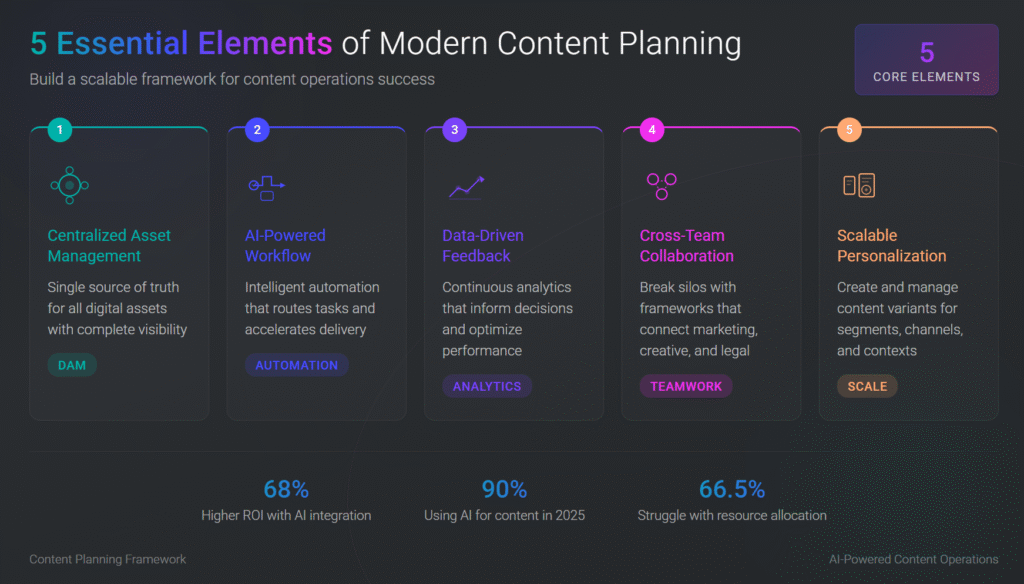
Building an effective content planning framework requires attention to several interconnected components. Each element reinforces the others, creating a system that performs better than the sum of its parts.
1. Centralized Asset Management: A DAM system provides the single source of truth for all digital assets. This centralization enables findability, version control, and governance at scale.
2. AI-Powered Workflow Automation: Intelligent workflows route tasks, trigger approvals, and adapt based on real-time conditions. This automation reduces manual coordination and accelerates time to market.
3. Data-Driven Performance Feedback: Continuous analytics inform planning decisions. Understanding what content performs allows teams to double down on success and retire underperforming assets. Data-driven content strategies transform guesswork into informed action.
4. Cross-Team Collaboration Frameworks: Content planning involves stakeholders from marketing, creative, legal, compliance, and beyond. Effective frameworks break down silos and enable seamless collaboration regardless of location.
5. Scalable Personalization Capabilities: Modern audiences expect personalized experiences. Your planning process must account for creating and managing content variants that address different segments, channels, and contexts.
How Can You Build a Content Planning Framework That Scales?
Scaling content operations requires alignment across people, process, and technology. Start by documenting your current workflows and identifying friction points. Where do projects stall? What information is difficult to find? Which approvals create bottlenecks? These pain points reveal opportunities for automation and centralization.
Next, establish governance structures that balance control with agility. Clear guidelines about brand standards, approval authorities, and compliance requirements enable teams to move quickly within defined boundaries. Understanding the full content lifecycle management process helps ensure nothing falls through the cracks from ideation through archival.
Finally, invest in integrated technology that connects planning, creation, management, and distribution. Disconnected point solutions create data silos and manual workarounds. An integrated platform approach ensures information flows freely and teams maintain visibility across the entire content operation.
How Should You Prepare Your Content Planning for 2026?
Looking ahead, several trends will shape content planning practices. AI agents will take on increasingly autonomous roles, handling complex multi-step workflows that previously required human intervention at each stage. Personalization will become table stakes, with audiences expecting content tailored to their specific needs and contexts. Compliance requirements will continue expanding, making governance and audit capabilities essential.
To prepare, audit your current content planning maturity. Evaluate whether your processes are documented, your workflows are automated, and your assets are centralized. Identify the gaps between where you are and where you need to be. Then build a roadmap that prioritizes quick wins while laying the foundation for more sophisticated capabilities.

Frequently Asked Questions
What is content planning and why does it matter?
Content planning is the process of defining what content to create, when to publish it, where to distribute it, and how to measure success. It matters because strategic planning ensures content aligns with business objectives, reaches target audiences effectively, and delivers measurable ROI. Without effective planning, teams waste resources on content that fails to perform.
How does AI improve content planning workflows?
AI improves content planning by automating repetitive tasks like metadata tagging, performance analysis, and approval routing. It enables predictive insights that inform content decisions, identifies content gaps, and helps teams understand what resonates with audiences. AI also enables continuous optimization by analyzing performance data in real time rather than waiting for periodic reviews.
What role does DAM play in content planning?
Digital asset management (DAM) serves as the central hub for all creative assets, providing a single source of truth that enhances content planning. DAM enables instant asset findability, prevents duplicate content creation, maintains version control, and connects with planning tools to streamline workflows. When DAM integrates with your content calendar strategy, teams gain complete visibility into available assets and can plan more effectively.
How do I measure the effectiveness of my content planning?
Measure content planning effectiveness by tracking metrics aligned with your business goals. Common indicators include time to market for new content, asset reuse rates, workflow efficiency (time from request to publication), content performance metrics (engagement, conversions, ROI), and team productivity measures. The most mature organizations connect content performance data directly back to planning processes, creating continuous improvement loops.
Taking the Next Step
Content planning has evolved from a simple scheduling exercise into a strategic discipline that demands intelligent automation, centralized asset management, and continuous optimization. Organizations that embrace this evolution will produce more content, faster, with better results. Those that cling to outdated approaches will struggle to keep pace.
Aprimo’s AI-powered content operations platform helps marketing teams modernize their content planning with intelligent workflows, SMART digital asset management, and data-driven insights. Ready to transform how your team plans, creates, and optimizes content? Request a demo to see how Aprimo can help you stay ahead.