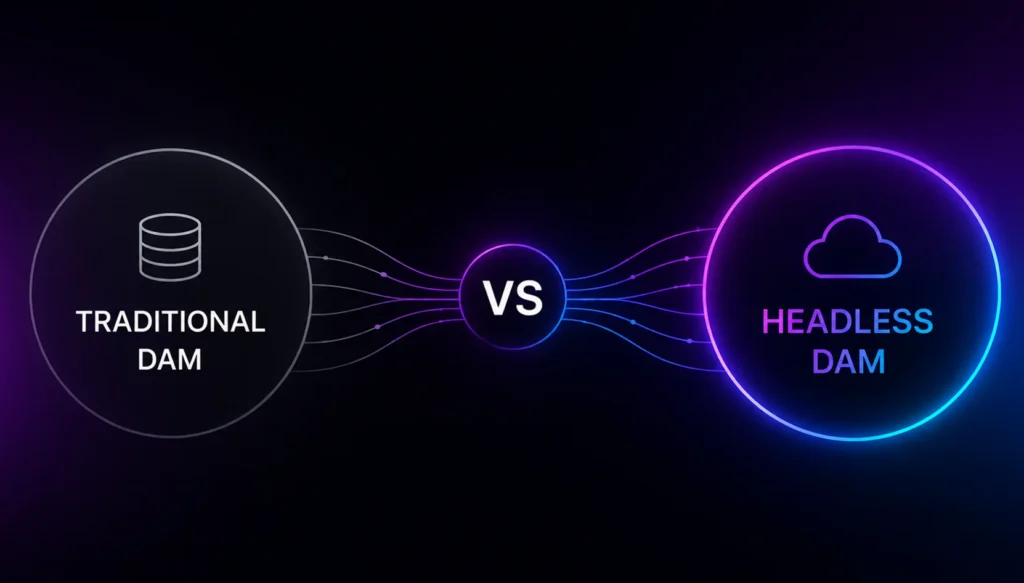
The shift from traditional DAM to headless architecture represents one of the most significant infrastructure decisions a content operations leader can make. When choosing a traditional DAM, the decision is often “which interface works best for our team?”. Selecting a headless DAM requires a different framework entirely.
You’re not just evaluating software. You’re making a commitment to API-first architecture, development resources, integration complexity, and organizational change. And unlike the glossary definitions might suggest, headless DAM isn’t automatically the right choice for every organization—even those with multi-channel needs.
This guide focuses on what matters most to buyers: How do you know if headless DAM is right for you? How do you evaluate vendors objectively? What will it cost in time and resources? And how do you ensure implementation doesn’t become a long-winded project?
In this article, we will focus on the practical decisions you need to make when considering a headless DAM solution for your business.
TL;DR
- Headless DAM is an architectural commitment, not just a software choice. It requires upfront investment in integration and development resources, but delivers compounding returns at scale through multi-channel efficiency and automation.
- Not every organization needs headless DAM. Even multi-channel organizations might be better served by a hybrid or traditional DAM if they lack development resources or have simple integration needs.
- Vendor selection should focus on API maturity, scalability, and support quality. Your success depends on how well the vendor’s APIs support your specific integrations, not on having the most features.
- ROI becomes positive when you hit the multi-channel inflection point. Typically around 3-5 channels where manual asset distribution and duplication costs exceed the investment in headless infrastructure.
Part 1: Should Your Organization Buy Headless DAM?
The Real Cost of Traditional DAM at Scale
Before evaluating headless DAM solutions, understand what you’re paying to avoid with your current approach.
In traditional DAM environments, multi-channel distribution creates hidden costs:
Manual Replication: Your ecommerce team exports product images. Your social team requests variants. Your marketplace team needs different formats. Marketing email team needs optimized sizes. Instead of one source of truth, you now have 4-5 versions of the same asset stored across systems.
Version Chaos: Which is the approved product photo? The one from last month in the email platform? The one updated last week in ecommerce? Six months later, an old version appears in a printed catalog because no one knew a newer one existed.
Channel-Specific Workflows: You build separate approval processes for each channel because each has unique metadata requirements, format needs, and brand rules. A marketing asset approved for web needs reapproval for social. A product image approved for US market needs metadata changes for EU.
Governance Breakdown: With assets scattered across systems, compliance and brand control become impossible. Expired assets stay live. Off-brand content ships. Compliance violations happen because you can’t quickly identify where your assets are deployed.
Team Productivity Loss: Your content operations team spends 30% of time distributing, reformatting, and managing asset copies instead of governance and strategy.
The question isn’t “Should we buy headless DAM?” It’s “At what scale does the cost of multi-channel distribution in traditional DAM exceed the investment in headless infrastructure?”
The Headless DAM Readiness Checklist
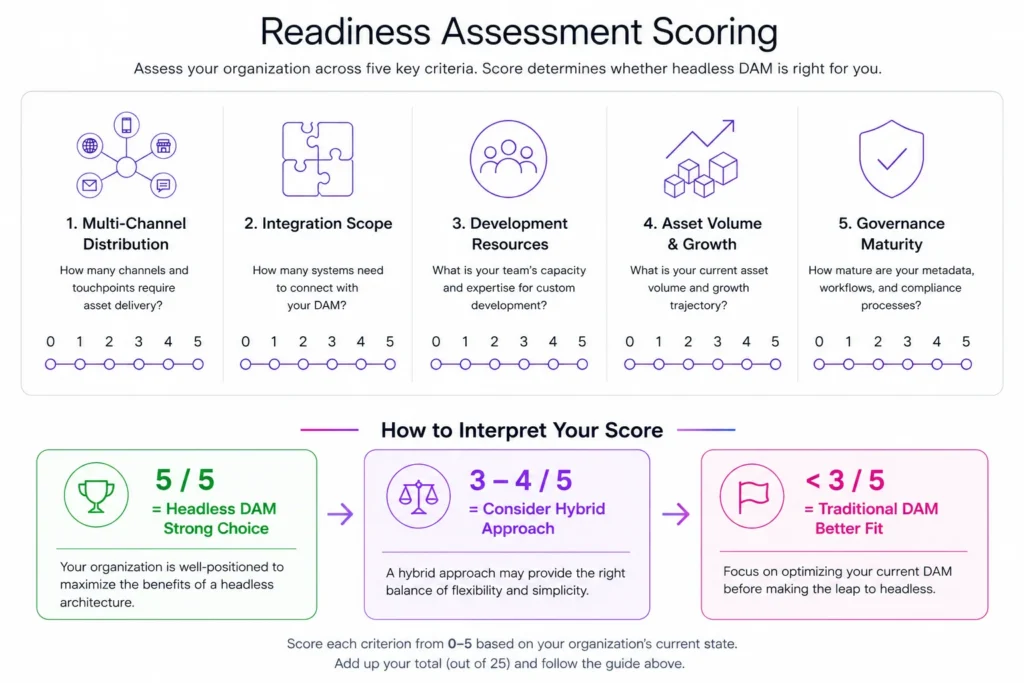
Before moving forward, evaluate your organization on these criteria:
1. Multi-Channel Distribution Complexity (Required)
- How many channels do you currently distribute assets to? (ecommerce, website, mobile app, email, social, marketplace, print, in-store displays, etc.)
- Is that number growing?
- Do different channels require different formats, metadata, or approval workflows?
VERDICT: If you have 1-2 channels with similar needs, traditional DAM is likely sufficient. If you have 4+ channels with distinct requirements, headless DAM becomes valuable.
2. Integration Scope (Required)
- Which systems need real-time access to assets? (PIM, ecommerce platform, CMS, marketing automation, social media management, etc.)
- Are these integrations currently manual or automated?
- Do you need real-time asset updates or can batches suffice?
VERDICT: If integrations are manual or limited to 1-2 systems, headless complexity isn’t justified. If you have 3+ critical integrations requiring real-time data, headless DAM reduces manual work significantly.
3. Development Resources (Critical)
- Do you have an internal development team who can build and maintain API integrations?
- Is your organization comfortable with API-first workflows?
- Do you have budget for the entirety of the implementation work?
VERDICT: Headless DAM without development resources becomes a liability. If you lack internal development capacity, consider hybrid approaches or traditional DAM with API connectors.
4. Asset Volume and Growth Rate (Important)
- How many assets do you currently manage? (Thousands, tens of thousands, hundreds of thousands?)
- What’s your annual growth rate?
- Do you expect to manage significantly more assets in 3-5 years?
VERDICT: If you’re at 100K+ assets with 20%+ annual growth, headless DAM’s scalability becomes essential.
5. Organizational Governance Maturity (Important)
- Do you have a defined taxonomy and metadata standard across teams?
- Can teams agree on asset naming conventions and approval workflows?
- Does leadership support enforcing consistent governance across channels?
VERDICT: Headless DAM amplifies good governance and bad governance equally. If you lack governance discipline, headless DAM won’t fix it. It will make these problems more visible at scale.
Scoring:
5/5 criteria met: Headless DAM is a strong choice
4/5 criteria met: Headless DAM is likely right, but consider hybrid options
3/5 criteria met: Hybrid or traditional DAM may be more cost-effective
<3/5 criteria met: Traditional DAM or lightweight content platform likely better fit
Part 2: Evaluating Headless DAM Vendors
The Evaluation Framework
Vendor selection for headless DAM is fundamentally different from traditional DAM evaluation because your success depends on integration capability, not UI polish or out-of-box features.
Most buyers evaluate vendors on the wrong criteria:
Which has more features?
(Feature list doesn’t matter if APIs don’t support your integrations)
Which is easiest to use?
(UI doesn’t matter—developers use APIs, not the interface)
Which is cheapest?
(Integration and support costs will exceed licensing costs by 5-10x)
Instead, evaluate on these criteria:
API Maturity and Completeness
What to assess:
- Does the vendor expose REST APIs, GraphQL, or both? (REST is table stakes; GraphQL is preferred for efficiency)
- Are all core operations available via API? (Asset retrieval, metadata management, permissions, workflows, search)
- Can you query assets with complex filters? (color=red + category=shoes + region=EU simultaneously)
- Are APIs documented clearly?
- Does the vendor maintain API versioning and backwards compatibility?
Red flags:
- “Most features available via API” (not all)
- API documentation is outdated or incomplete
- No GraphQL option
- APIs don’t support your specific metadata structures
- Vendor changes APIs frequently without versioning
Scalability and Performance
What to assess:
- Can the system handle your projected asset volume in 3-5 years?
- What are API response times at scale?
- Is there built-in caching or CDN integration?
- How does the system handle peak traffic during campaigns or product launches?
Questions to ask:
- “What’s the largest customer you support, and how many assets do they manage?”
- “Can you show us performance benchmarks at our projected volume?”
- “What happens to API response times when we go from 100K to 500K assets?”
Integration Ecosystem
What to assess:
- Does the vendor have pre-built connectors for your key systems?
- If connectors don’t exist, how easy is it to build custom integrations?
- Does the vendor offer webhook support for event-driven workflows?
- Are there community-built integrations or an app marketplace?
Questions to ask:
- “What integrations do you have pre-built for our tech stack?”
- “If we need a custom integration, do you provide SDKs or code samples?”
- “Can you trigger workflows when assets are uploaded or approved?”
Support Quality and Responsiveness
What to assess:
- What’s the SLA for API support?
- Do you get a dedicated technical contact or account manager?
- Does the vendor provide implementation support or just post-launch support?
Red flags:
- No guaranteed SLA
- Support only via ticketing system
- Limited documentation
- Slow response times
Questions to ask:
- “What’s your SLA for critical API issues that block our ecommerce site?”
- “Will you assign a technical contact to our implementation?”
- “How often do you release API updates and improvements?”
Compliance, Security, and Governance
What to assess:
- Does the vendor meet your compliance requirements? (SOC 2, HIPAA, GDPR, etc.)
- What authentication methods do they support? (OAuth, API keys, SSO)
- Can you implement role-based access control at the API level?
- Do they provide audit logging for regulatory requirements?
Questions to ask:
- “Which compliance certifications do you maintain?”
- “How do you handle API authentication for different user types?”
- “Can you show us how audit logging works for compliance reporting?”
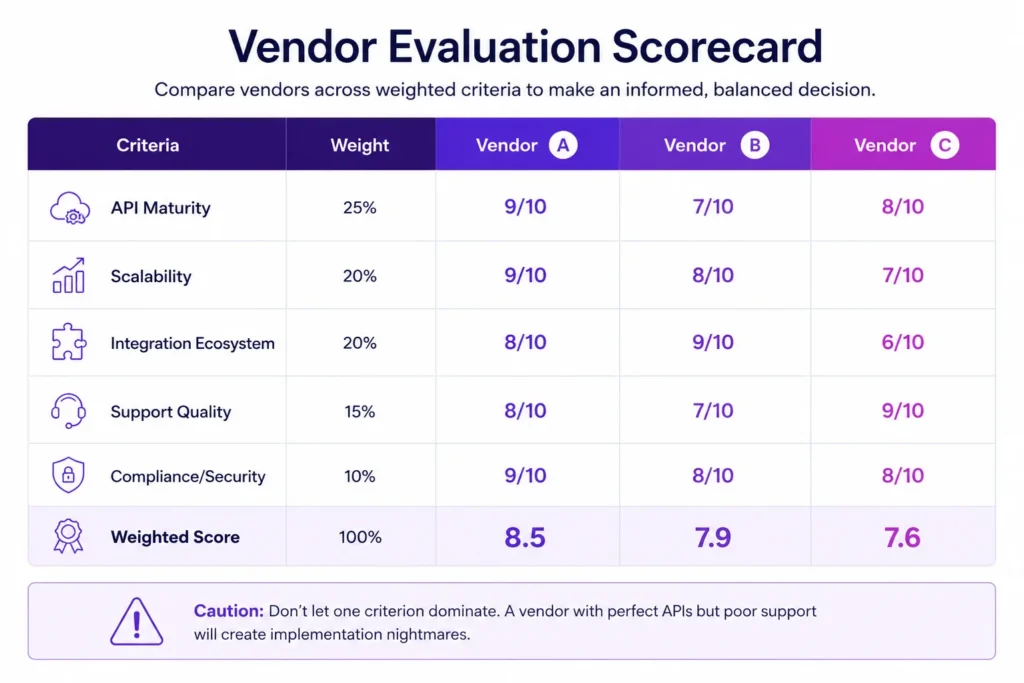
Vendor Comparison Template
Create a scorecard with the vendors in your shortlist using your selected criteria. (See sample below)
Ready to Modernize Your Content Operations?
Generate a tailored Digital Asset Management RFI based on your requirements, use cases, and business goals.

Part 3: Common Pitfalls and How to Avoid Them
Pitfall 1: Underestimating Integration Complexity
The Problem:
You assume, “It’s just APIs, it should be straightforward.” Then you discover that your CMS has an unusual authentication method, your ecommerce platform’s webhook is unreliable, and your marketing automation tool doesn’t support real-time asset updates.
How to Avoid:
- During vendor evaluation, do a technical proof of concept with at least one of your core integrations
- Map every integration in detail before implementation starts, not during
- Allocate 20-30% of development time as contingency for unexpected integration challenges
- Rollout in phases. Get one integration working perfectly before adding the next
Pitfall 2: Weak Metadata Foundation
The Problem:
You implement headless DAM without establishing consistent metadata standards first. Six months in, assets are tagged inconsistently, search results are unreliable, and the system isn’t delivering value.
How to Avoid:
- Spend 4-6 weeks before selecting a vendor defining your metadata strategy
- Audit your current metadata. List what works, what’s broken, what’s missing
- Define required vs. optional metadata fields for each asset type
- Get stakeholder buy-in (designers, marketing, ecommerce) on metadata standards before implementation
- Test metadata with pilot channels before full rollout
Pitfall 3: No Dedicated Implementation Leadership
The Problem:
Implementation becomes everyone’s side project. Developers get pulled to other work. No one owns the timeline or makes decisions. Implementation stretches longer.
How to Avoid:
- Assign a single internal project lead (full-time during implementation, 50% after)
- Vendor should assign a dedicated implementation manager (not just support tickets)
- Weekly sync meetings with clear decisions and action items
- Clear escalation path for blockers (don’t let them sit unresolved)
Pitfall 4: Rushing to Multi-Channel Before Proving Single-Channel Success
The Problem:
You want to light up all 5 channels immediately. But the first integration has issues you didn’t anticipate. Now you’re trying to troubleshoot production issues while launching new channels.
How to Avoid:
- Prove the model with one channel first.
- Get it stable, running smoothly, delivering value
- Only then expand to the next channel
- Phased rollout also lets you refine workflows and metadata before adding complexity
Pitfall 5: Insufficient Support and Training
The Problem:
Implementation finishes. Your internal team doesn’t fully understand the APIs or workflows. When issues arise, there’s confusion about whether it’s a DAM problem or an integration problem. Support tickets go unanswered.
How to Avoid:
- Budget 2-4 weeks for team training before full launch
- Create internal documentation about your specific integrations (not just vendor docs)
- Ensure someone on your team is comfortable debugging API calls
- Establish clear escalation (when do you contact vendor vs. internal troubleshooting)
Part 4: Building Your Business Case and ROI Model
Quantifying the Value
To justify headless DAM investment, calculate the specific costs you’re avoiding:
Manual Content Distribution
- How many asset copies exist across systems today? (ecommerce copy, email copy, social copy, etc.)
- How much storage capacity could you eliminate? (100 GB = $X cost/year)
- How many hours per month does your team spend reformatting and copying assets?
Example: 3 full-time content operations people spend 40% of time on manual distribution = $100K annual labor cost
Version and Compliance Costs
- How many compliance issues, brand violations, or expired asset deployments occur annually?
- What’s the estimated cost of each (compliance violation = $10K, brand inconsistency = $5K, etc.)?
Example: 5 compliance issues per year × $20K cost = $100K annual risk cost
Time to Market Delays
- How much slower are multi-channel campaigns launched today because of asset distribution bottlenecks?
- What’s the revenue impact of 2-week delays in campaign launches?
Example: 8 campaigns/year × 2-week delay × $50K lost revenue per week = $800K opportunity cost
Metadata and Governance Overhead
- How many hours do your compliance or governance teams spend manually tracking assets across systems?
- How many incidents occur because asset locations aren’t tracked?
Example: 0.5 FTE × $80K = $40K annual cost
FTE = Full-Time Equivalent (one person’s annual cost)
Building the ROI Model
Year 1 Costs:
- Software licensing: $x
- Implementation: $y
- Training: $z
- Total: $(x+y+z)
Year 1 Savings:
- Reduced manual distribution: $x (e.g. assume 50% reduction)
- Compliance risk mitigation: $y (e.g. assume 40% fewer issues)
- Storage cost reduction: $z
- Total: $(x+y+z)
Year 1 ROI: Break-even (~0%)
Year 2 Costs:
- Software licensing: $x (e.g. assume 15% increase)
- Maintenance/support: $y
- Total: $(x+y)
Year 2 Savings:
- Reduced manual distribution: $x (e.g. assume 70% reduction as more channels automate)
- Compliance risk mitigation: $y (e.g. assume 80% fewer issues)
- Storage cost reduction: $z
- Total: $(x+y+z+a)
- Faster campaign launches: $a (e.g. assume revenue recovered)
Year 2 ROI: x%
3-Year Total ROI: y%
Part 5: Making the Final Decision
Decision Framework
Use this simple framework to decide:
Does your organization meet the headless DAM readiness criteria?
If you scored <3/5 on the readiness checklist (Part 1), stop here. Headless DAM isn’t right for you yet.
Do you have the development resources to implement and maintain the system?
If you’re relying on the vendor to do all integration work, budget 50% more time and cost than quoted.
Is your financial ROI model positive within 18-24 months?
If payback period exceeds 24 months, the investment isn’t justified unless you have strategic (non-financial) reasons.
Does your organization have governance discipline?
If teams can’t agree on basic metadata standards today, headless DAM will amplify that dysfunction.
If the answer is yes to all four questions, proceed with headless DAM implementation.
Conclusion
Headless DAM is transformative for organizations with complex multi-channel needs and development resources. But it’s not a universal solution. Before evaluating vendors, honestly assess whether your organization meets the readiness criteria and whether the ROI justifies the investment.
The buyers who succeed with headless DAM share three things: clear governance discipline, dedicated internal development resources, and vendor support quality. The ones who struggle have confused expectations, underestimated complexity, or tried to implement without sufficient technical support.
Next Steps
- Complete the readiness checklist (Part 1) – Determine if headless DAM is right for your organization
- Map your integration scope – Which systems need asset access? What’s the complexity of each?
- Build your ROI model – Calculate specific costs you’d avoid with headless architecture
- Assemble your implementation team – Secure dedicated internal resources before starting vendor conversations
Ready to explore how Aprimo’s headless DAM capabilities can support your multi-channel strategy?
FAQ
Should we move from traditional DAM to headless DAM if our current system still works?
Yes, if the cost of multi-channel management in traditional DAM exceeds the investment in headless infrastructure. If you have 1-2 channels with manual distribution, traditional DAM is more cost-effective. If you have 4+ channels with different requirements, headless DAM ROI becomes positive within 12-18 months. Map your specific scenario before deciding.
Can we implement headless DAM without internal development resources?
Technically yes, but practically no. You’ll become dependent on the vendor or a third-party provider for every integration change, which becomes expensive and slow. Budget for at least one full-time developer or consider a hybrid approach (traditional DAM with API connectors) if development resources are unavailable.
How do we choose between vendors if they all have good APIs?
Differentiate on support quality, implementation experience, and pre-built connectors for your specific tech stack. The vendor who gets you live fastest and provides best support during production issues is the one that delivers ROI.
What’s the biggest mistake organizations make when buying headless DAM?
Not planning ahead and rushing to go live before metadata and workflows are solid. The result is a system that deploys on time but fails in production because assets are tagged inconsistently or integrations are unreliable. Invest more time in planning and testing, less time in rushing to launch.