
Answer Engine Optimization for Enterprise Brand Content
Search is changing.
According to the McKinsey article New front door to the internet: Winning in the age of AI search, AI search is the primary way consumers now research, compare, and evaluate brands. Google has also expanded AI-generated search experiences through AI Overviews, making answer-ready content more important for enterprise marketers.
Instead of scanning multiple links, users increasingly expect direct answers. Ahrefs research even shows that when a Google search includes an AI overview, it decreased the likelihood of clicking through by 34.5%.
This shift is driving the rise of Answer Engine Optimization, or AEO.
AEO methods focus on structuring web content so that it can be easily interpreted, retrieved, and delivered by AI systems. It prioritizes clarity, context, and relevance, ensuring that content can serve as a direct answer rather than just a searchable resource.
For enterprise brands, this represents both an opportunity and a challenge. The opportunity is increased visibility in AI-driven experiences. The challenge is adapting content operations to support this new paradigm.
As content complexity grows, organizations need more than just SEO tactics. They need structured, data-driven content strategies that connect creation, governance, and performance.
TL;DR
- Answer Engine Optimization (AEO) focuses on structuring content so AI systems can surface direct answers.
- It builds on SEO but prioritizes context, clarity, and structured content over keyword ranking alone.
- DAM and Content Intelligence play a critical role in making content discoverable and reusable.
- AEO enables enterprise brands to improve visibility across AI-powered search and conversational interfaces.
- The most effective AEO strategies connect structured content, metadata, and workflows across the content lifecycle.
What Is Answer Engine Optimization (AEO)?
Answer Engine Optimization is the practice of structuring and optimizing content so that it can be directly surfaced as answers by AI-driven systems, including search engines, virtual assistants, and conversational interfaces.
Unlike traditional SEO, which focuses on ranking content within search results, AEO focuses on being the answer itself.
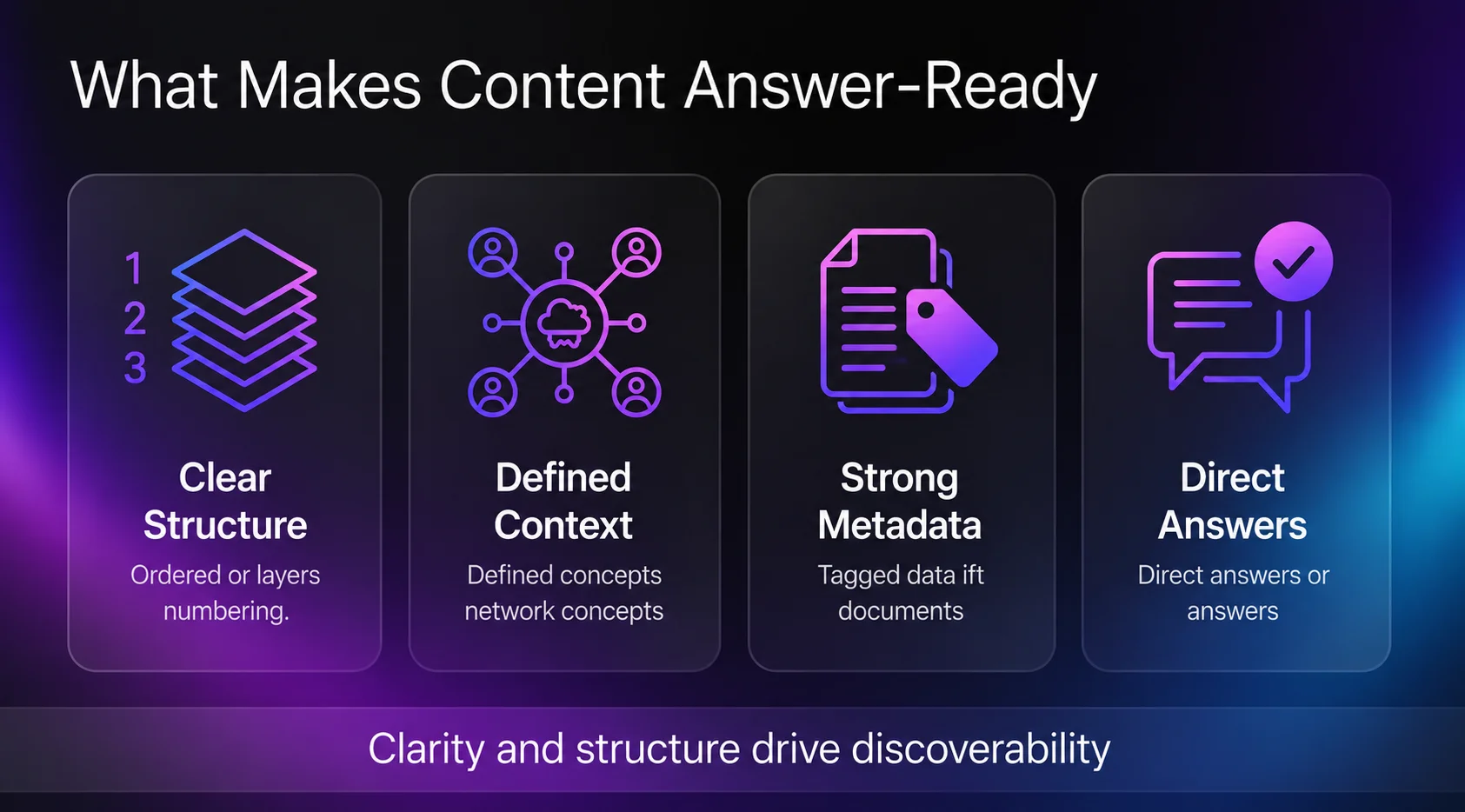
This requires a different approach to content creation. Instead of optimizing for keywords alone, organizations must focus on:
- Clear, concise, and structured content
- Context-rich information supported by metadata
- Content that directly addresses user intent
Instead of being a replacement for SEO, AEO is an evolution of it. While SEO helps users find content and websites relevant to their needs, the main goal of AEO is to deliver well-researched answers and solutions automatically, reducing any decision-making lag for users.
Why AEO Matters for Enterprise Brands
Enterprise organizations manage large volumes of content across multiple channels, regions, and audiences. As AI-driven search becomes more prevalent, the ability to deliver structured, answer-ready content becomes a competitive advantage.
Without AEO, content may still exist, but it may not be surfaced effectively.
One of the biggest challenges is that enterprise content is often fragmented across systems. This makes it difficult for AI systems to access, interpret, and deliver relevant answers. As a result, valuable content may go underutilized.
AEO addresses this by aligning content structure with how AI systems retrieve and present information.
This is closely connected to broader content strategy challenges. As Aprimo explains in its blog on data-driven content strategies, organizations often struggle to connect content production with performance insights. AEO builds on this by ensuring that content is not only effective but also discoverable in AI-driven environments.
How AEO Differs from Traditional SEO
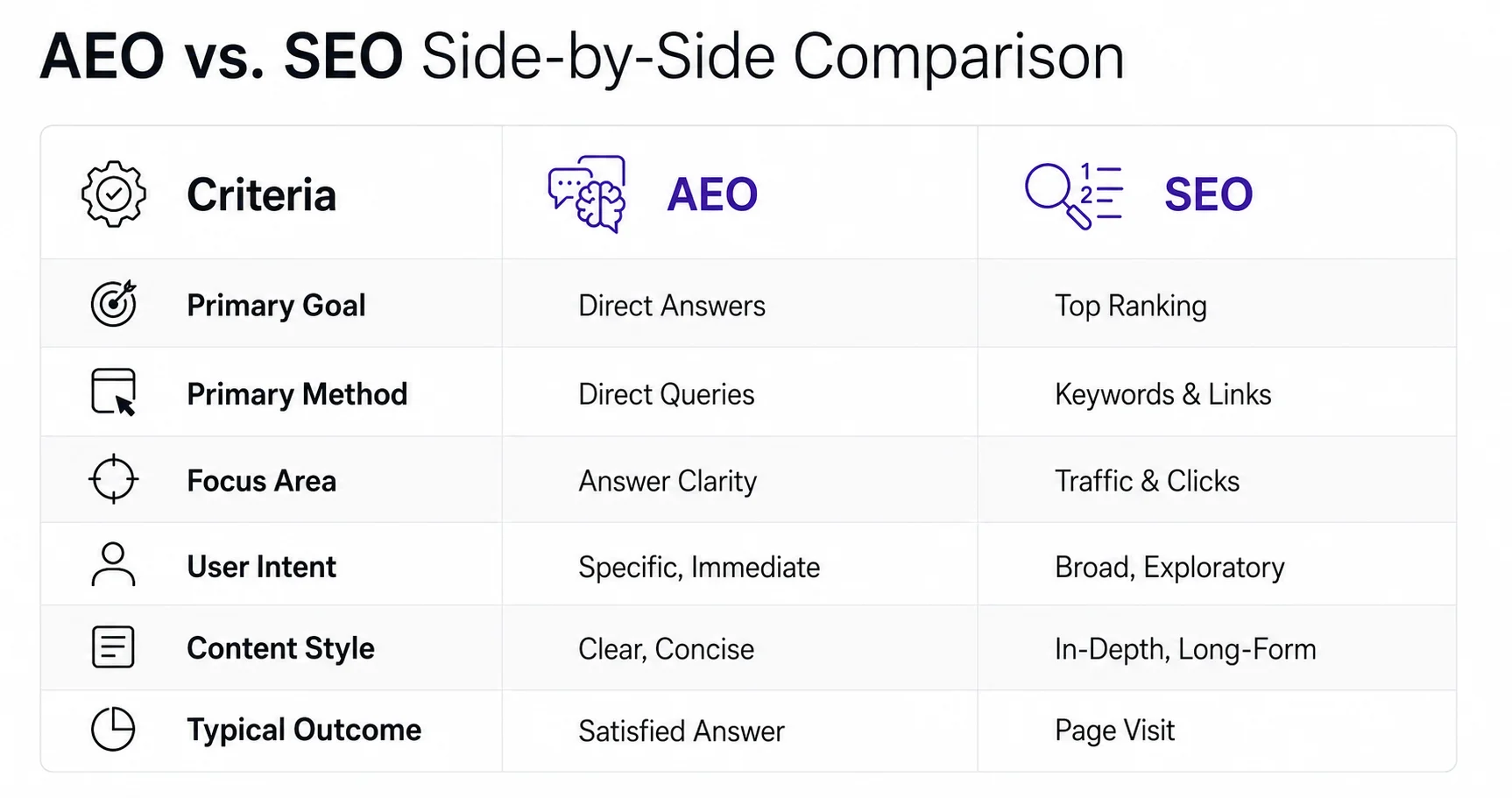
While SEO and AEO share common goals, they differ in execution and focus.
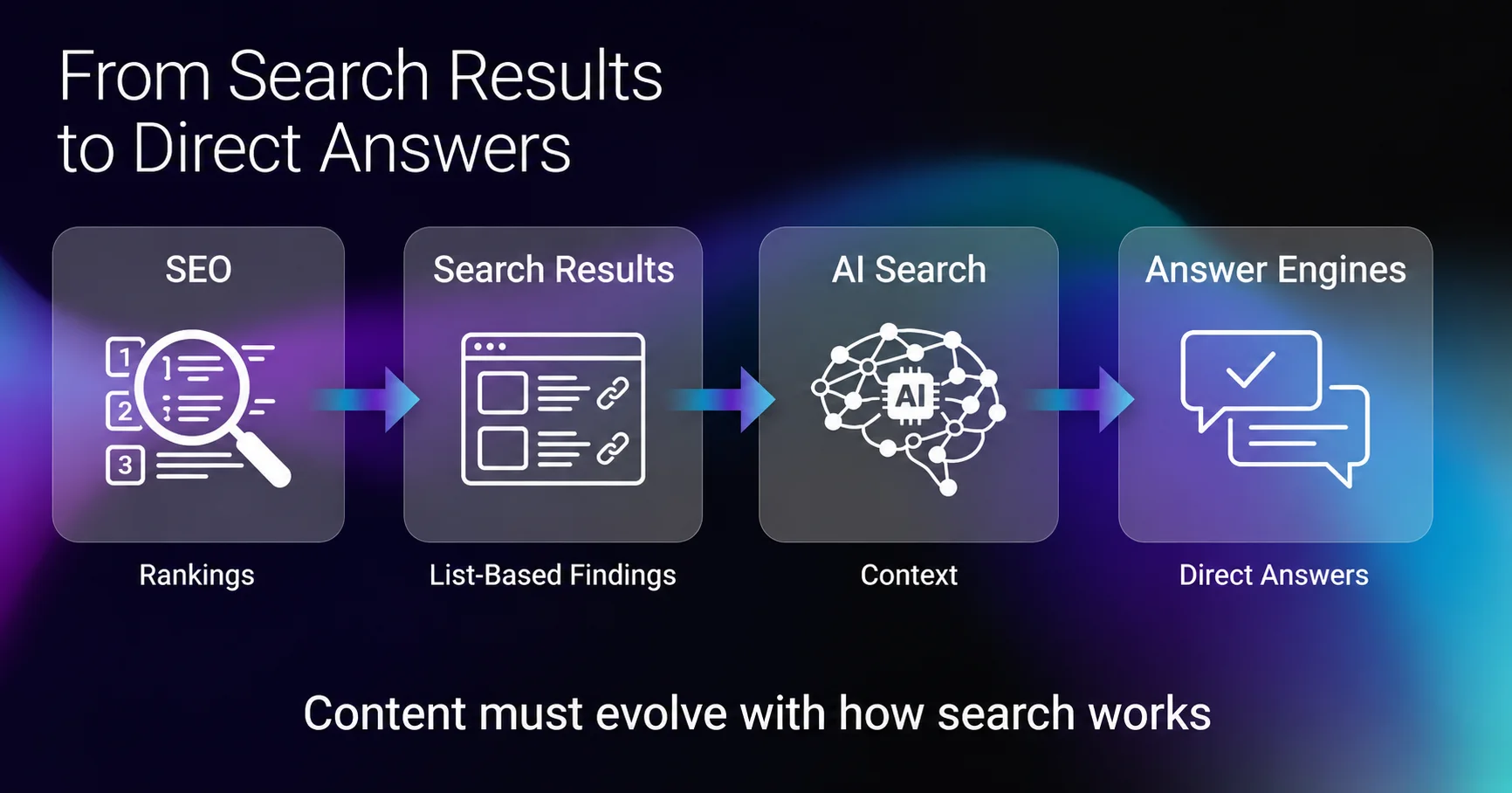
Traditional SEO prioritizes ranking factors such as keywords, backlinks, and page authority. It is designed for search engines that present lists of results.
AEO, on the other hand, is designed for systems that provide direct answers.
This means content must be:
- Structured for quick interpretation
- Contextually complete
- Optimized for intent rather than just keywords
For enterprise teams, this requires a shift in mindset. Content is no longer just a destination. It is a source of answers that can be extracted and delivered in multiple formats.
The Role of Structured Content in AEO
Structured content is the foundation of AEO.
Without structure, AI systems struggle to interpret and retrieve content effectively. This is especially true for enterprise environments, where content is often complex and distributed across multiple systems.
Structured content relies on metadata, taxonomy, and standardized formats to provide context.
As Aprimo highlights in its work on content operations, structure enables scalability and consistency across content workflows. Without it, content becomes difficult to manage, analyze, and optimize.
For AEO, this means:
- Clearly defined content components
- Consistent metadata on content including images with alt tags
- Standardized content models
These elements make it easier for AI systems to extract and deliver relevant answers.
Integrating AEO into Content Operations
AEO is not just a content tactic. It is an operational strategy.
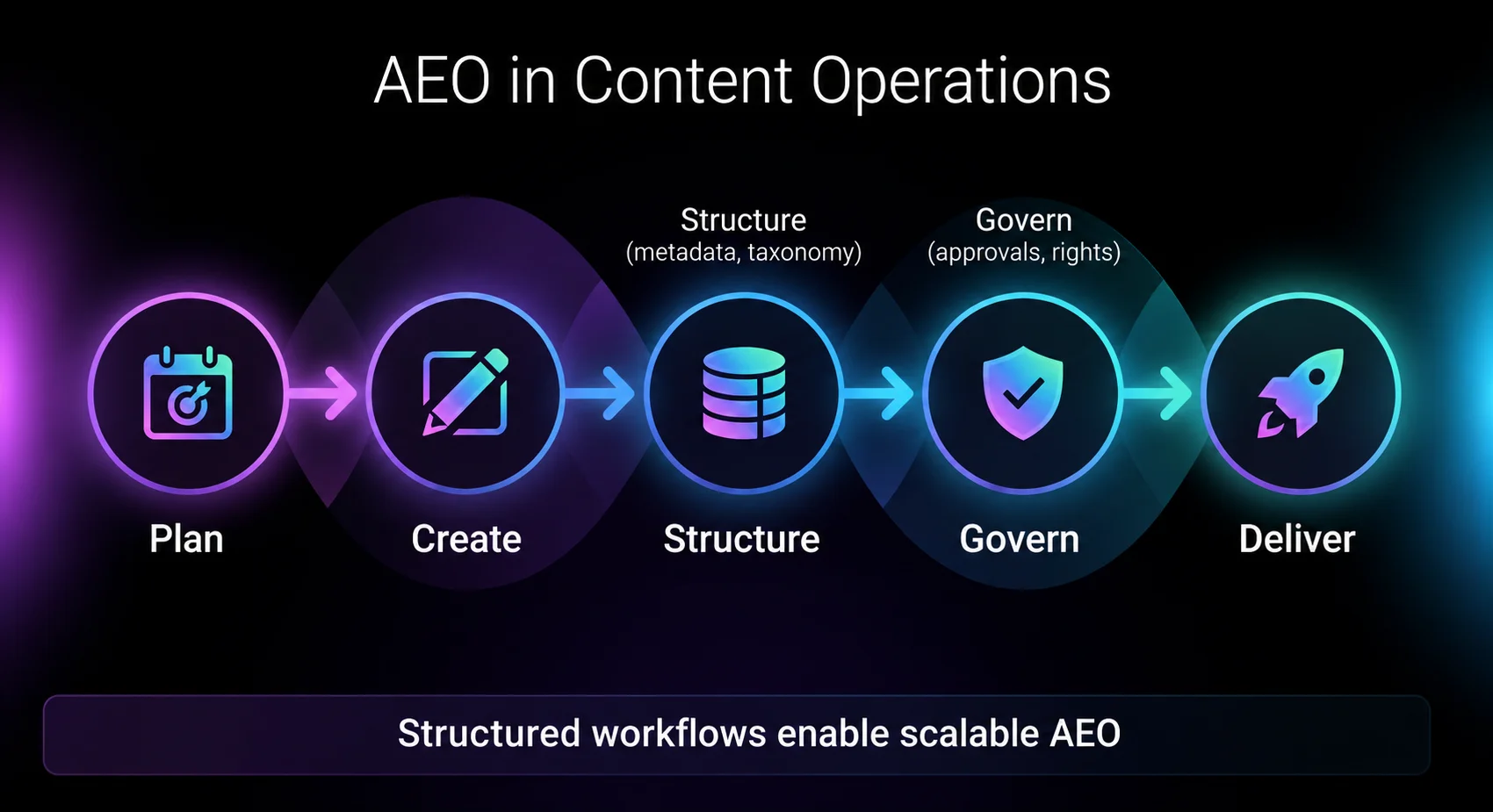
To implement AEO effectively, organizations need to integrate it into their content operations framework. This includes planning, creation, governance, and distribution.
One of the key enablers of this integration is digital asset management.
DAM provides a centralized system for managing content, ensuring that assets are organized, governed, and accessible. This is essential for AEO, where content must be easily retrievable and usable across different contexts.
Aprimo’s vision for future-ready content operations highlights how AI, workflows, and structured systems come together to enable scalable content strategies.
AEO fits naturally into this model.
Building an AEO Strategy for Enterprise Content
Developing an AEO strategy requires a combination of structure, insight, and execution.
Organizations need to:
- Align content with user intent and common queries
- Structure content for clarity and accessibility
- Use metadata and taxonomy to provide context
- Integrate insights from content intelligence
- Ensure governance and consistency across teams
This process is iterative. As AI systems evolve, content strategies must adapt.
AEO is not a one-time optimization. It is an ongoing effort to ensure that content remains relevant and discoverable.
Common Challenges in AEO
Implementing AEO comes with challenges.
One of the biggest is content fragmentation. When content is spread across multiple systems, it becomes difficult to maintain consistency and structure.
Another challenge is lack of metadata. Without proper tagging and taxonomy, content cannot be effectively interpreted by AI systems.
Organizations also face challenges in aligning teams. AEO requires collaboration across marketing, content, IT, and operations.
Finally, there is the challenge of measurement. Unlike traditional SEO, AEO success is not always reflected in rankings. It requires new metrics and approaches to evaluation.
How Aprimo AI Agents Help with AEO
Aprimo AI Agents help enterprise teams operationalize AEO by making content more structured, descriptive, and usable across AI-powered search experiences. Instead of treating optimization as a final step, agents support AEO across the full content lifecycle.
Before assets enter the DAM, Librarian Agents can pre-insert metadata such as alt text through third-party creative or ingestion tools. Once assets are in Aprimo DAM, Librarian Agents can create, review, and improve metadata, including alt text, asset titles, and other descriptive fields. This gives AI systems more context about each asset, which helps improve retrieval and answer relevance.
Critic Agents add another layer of optimization by recommending text improvements that make content clearer and more useful for AI engines. Production Agents can then generate web or landing page copy based on brand voice, tone, and AEO best practices. This helps teams create content that is both on-brand and answer-ready.
After content is published, Critic and Compliance Agents can review web pages, email, and ad copy to ensure brand and regulatory alignment. Together, these agents help enterprise brands scale AEO without sacrificing governance, consistency, or quality.
AEO Case Study: Automating Accessibility and Metadata at Global Scale
A global manufacturer of outdoor power equipment needed to support B2C e-commerce across more than 100 markets. New accessibility regulations required descriptive, localized alternate text for every product image. Manual creation and translation would have taken years, increased compliance risk, and slowed campaign execution. As the content library continued to grow, a one-time remediation effort would not have solved the problem.
Using Aprimo Agentic DAM, the company automated the process across the content lifecycle. Librarian Agents continuously generated and maintained accessible image metadata at ingestion. Production Agents translated alternate text into more than 60 languages automatically. Critic Agents reviewed and optimized metadata quality before distribution. Compliance Agents helped ensure accessibility requirements were enforced consistently across channels.
The impact was significant.
- The company reduced manual translation costs by 92%.
- It also automated an estimated seven years of manual work.
- Most importantly, time to market for campaigns was reduced from weeks to minutes.
For AEO, this case shows why metadata and accessibility matter. When product images include accurate, localized, and governed descriptions, they become easier for AI systems to understand, retrieve, and surface as relevant answers.
The Future of AEO
AEO will continue to grow as AI-driven search becomes more prevalent.
Future developments are likely to include:
- More advanced conversational interfaces
- Greater reliance on structured data
- Increased integration with personalization systems
- Real-time content optimization
As these trends evolve, the importance of structured, data-driven content will only increase.
Organizations that invest in AEO now will be better positioned to adapt to these changes.
Conclusion
Answer Engine Optimization represents the next phase of content strategy.
It shifts the focus from ranking content to delivering answers. For enterprise brands, this requires a new approach to content creation, management, and optimization.
By combining structured content, content intelligence, and DAM, organizations can create content that is not only discoverable but also actionable.
The key is integration.
AEO works best when it is embedded into content operations, supported by data, and aligned with business goals. That is what allows enterprise brands to stay visible, relevant, and competitive in an AI-driven world.
FAQ
What is Answer Engine Optimization?
Answer Engine Optimization is the practice of structuring and optimizing content so that it can be directly surfaced as answers by AI-driven systems. It focuses on clarity, context, and relevance, ensuring that content can be easily interpreted and delivered by search and conversational interfaces.
How is AEO different from SEO?
SEO focuses on improving content visibility in search engine results pages through ranking factors such as keywords and backlinks. AEO, on the other hand, focuses on making content usable as a direct answer by prioritizing structured content and user intent.
Why is AEO important for enterprise brands?
AEO is important because it helps enterprise brands remain visible in AI-driven search experiences where users expect immediate answers. It also ensures that high-value content is surfaced effectively, improving engagement and overall content performance.
How does DAM support AEO?
DAM supports AEO by providing a centralized, structured system for managing and governing content. It ensures that assets are enriched with metadata, approved for use, and easily accessible for AI systems to retrieve and deliver as answers.
What is the future of AEO?
The future of AEO involves deeper integration with AI-driven search, personalization systems, and real-time content delivery. As AI continues to evolve, AEO will become a critical part of enterprise content strategies, enabling brands to deliver more relevant and context-aware experiences.