

AI-driven marketing has shifted to enterprise-critical infrastructure, with organizations that invest in AI seeing measurable advantages.
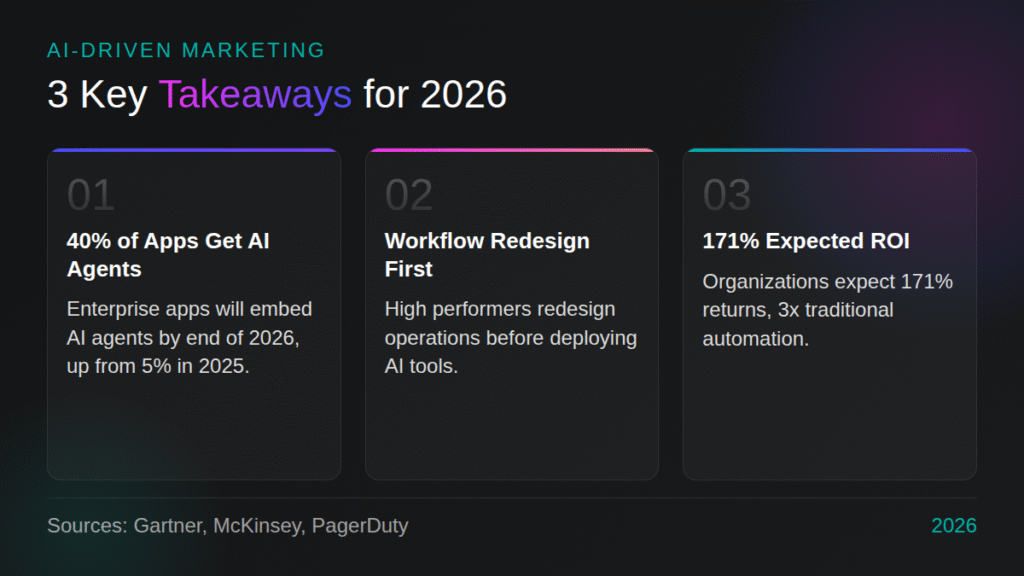
- Enterprise AI agents are projected to be embedded in 40% of business applications by the end of 2026, changing how marketing teams execute campaigns.
- Marketing automation AI operates autonomously, making real-time decisions about content selection, budget allocation, and audience targeting without constant human oversight.
- Organizations implementing AI strategies across marketing functions report revenue uplifts and improvements in sales ROI.
Start with workflow redesign: The highest-performing companies treat AI as a catalyst to transform operations, not as a feature to bolt onto existing processes.
The gap between organizations that have operationalized AI and those still experimenting is widening faster than anyone predicted. According to Gartner’s research, 40% of enterprise applications will include task-specific AI agents by the end of 2026.
The conversation has moved beyond whether to adopt AI-driven marketing strategies. The question now centers on implementation: which capabilities deliver measurable outcomes, and how do content operations platforms need to evolve to support autonomous execution at enterprise scale?
This guide examines the strategies that will define marketing success in 2026, from enterprise AI agents that function as digital team members to marketing automation AI that adapts campaigns in real time.
What Makes AI-Driven Marketing Different in 2026?
The distinction between 2026’s AI capabilities and earlier iterations lies in autonomy. Previous generations of marketing AI required constant human input, functioning essentially as sophisticated recommendation engines. You still pushed every button and made every decision; the technology suggested what those decisions might be.
AI-driven marketing in 2026 operates differently. Agentic AI systems can independently analyze customer data, select optimal content variants, adjust campaign parameters, and execute multi-step workflows without waiting for human approval at each stage. They learn from outcomes and continuously refine their approaches.
This shift addresses the growing chasm between content demands and available resources. When businesses actively invest in personalization at unprecedented rates, yet marketing budgets remain flat at roughly 7.7% of company revenue, something has to give. Either quality suffers, teams burn out, or technology bridges the gap.
The organizations pulling ahead have chosen the third option. They’re deploying AI agents that autonomously handle content operations, freeing human creativity for strategic work that actually requires human judgment.
How Agentic AI Differs from Traditional Automation
Traditional marketing automation follows rigid if-then logic. If someone abandons a cart, send this email in 24 hours. If they click a link, add them to this segment. The system never questions whether those rules make sense for a particular customer in a particular context.
Enterprise AI agents approach problems differently. They evaluate multiple factors simultaneously, including historical behavior patterns, real-time contextual signals, content performance data, and predicted outcomes. Rather than following predetermined paths, they determine the best action for each customer at each moment.
A traditional automation system might send identical follow-up sequences to every prospect who downloads a whitepaper. An AI agent recognizes that prospects engaging primarily with video content on Tuesday mornings respond better to different messaging than those who prefer long-form articles on Friday afternoons. It adjusts content format, timing, and messaging accordingly, learning from each interaction.
Contextual intelligence transforms static workflows into dynamic, responsive systems that improve with every customer interaction.
How Should Teams Implement Marketing Automation AI in 2026?
Implementation success depends less on which tools you choose and more on how you’re willing to redesign your operations. While 62% of organizations are experimenting with agentic AI, only about one-third report scaling AI agents across the organization. The bottleneck is operational architecture.
High-performing organizations redesign workflows first, then deploy AI within those redesigned processes. Bolting AI onto broken systems produces marginal gains at best. Rebuilding processes with AI-native capabilities as a core assumption produces transformation.
Five Pillars of Effective Marketing Automation AI
- Intelligent Audience Segmentation: Move beyond demographic buckets. AI analyzes behavioral patterns to identify micro-segments you’d never discover manually, finding subsets of visitors with specific engagement patterns that correlate with conversion likelihood. These behavioral cohorts consistently outperform traditional demographic targeting because they’re based on actions, not assumptions.
- Predictive Lead Scoring: AI evaluates hundreds of signals to identify which prospects are most likely to convert, when they’re most receptive to outreach, and what content will resonate. This intelligence lets teams focus resources where they’ll generate the greatest return.
- Dynamic Budget Allocation: Instead of setting monthly budgets and hoping for the best, AI shifts spend toward campaigns and channels showing the strongest performance signals in real time. When one campaign starts outperforming another, the system automatically reallocates.
- Real-Time Personalization: AI-driven content personalization operates at speeds impossible for human teams. The system evaluates each visitor’s context, selects optimal content variants, and delivers personalized experiences across every touchpoint without manual intervention.
- Attribution Modeling: Traditional last-click attribution ignores every touchpoint except the final one. AI-powered attribution connects touchpoints to revenue, revealing which combinations of content and channels actually drive business outcomes.
What Enterprise AI Agents Will Marketing Teams Deploy?
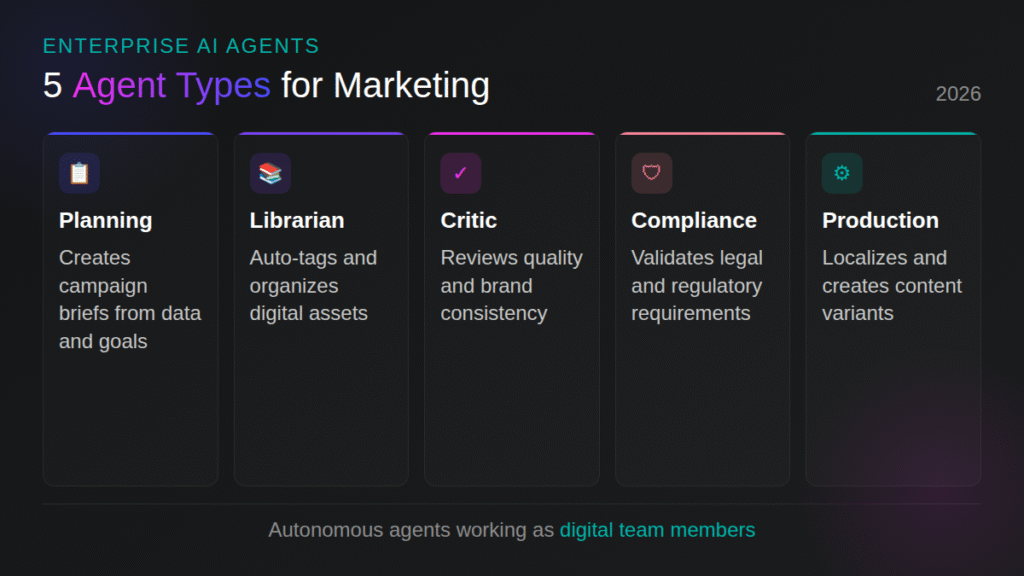
The enterprise AI agents reshaping marketing operations in 2026 fall into distinct categories, each handling specific aspects of content workflow automation. Understanding these categories helps organizations identify where autonomous capabilities deliver the most value.
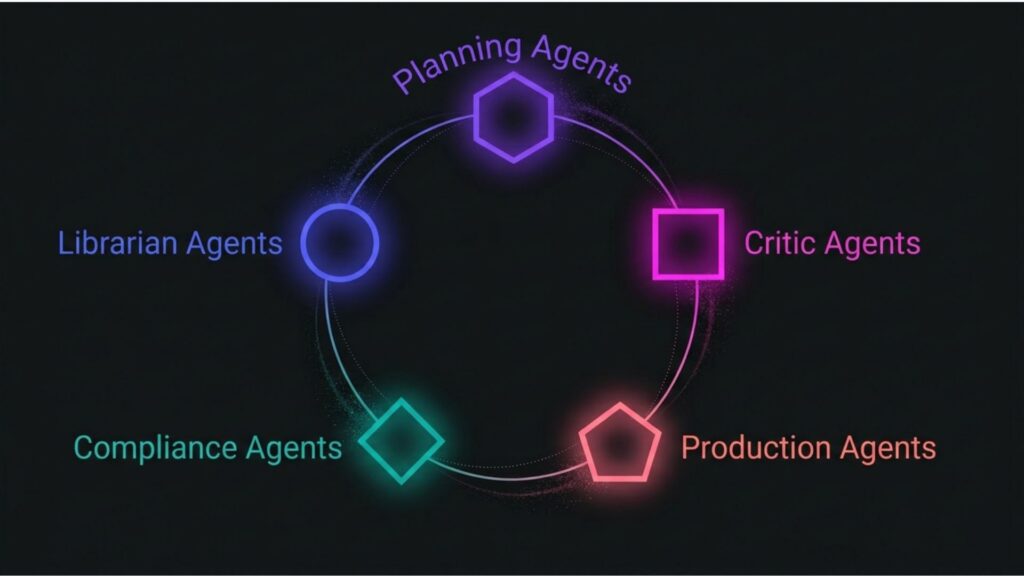
Planning Agents
These agents generate structured, insight-driven content and campaign briefs. They analyze historical performance data, audience preferences, and business objectives to create comprehensive briefs that align creative work with strategic goals. Planning agents can automatically break master briefs into regional or channel-specific versions, eliminating the back-and-forth that typically delays campaign starts.
Creative teams receive actionable direction immediately, reducing the weeks often spent aligning on scope and approach.
Librarian Agents
Metadata management is one of the most time-intensive aspects of digital asset management. Librarian agents handle this work automatically, populating metadata fields using AI analysis, organizing files according to proprietary taxonomies, and applying predictive tagging that makes assets discoverable.
These agents continuously learn from how teams use assets, improving their recommendations over time. The result is faster asset discovery and higher content reuse rates.
Critic Agents
Quality assurance at scale requires consistent evaluation across hundreds or thousands of content pieces. Critic agents analyze tone, sentiment, and language against brand standards. They provide optimization suggestions for search visibility and assess whether content maintains quality thresholds before publication.
Rather than catching issues after content goes live, these agents flag concerns during production when corrections are cheapest.
Compliance Agents
For organizations in regulated industries, content compliance checks create bottlenecks. Compliance agents automate brand guideline enforcement, legal requirement checks, and industry-specific regulation validation. They verify content against approved claims libraries and accelerate approval processes in financial services, healthcare, and other regulated sectors.
The shift from manual compliance review to automated verification often reduces approval cycles from days to hours.
Production Agents
Content localization and variant creation traditionally require significant manual effort. Production agents automate image transformations, translate content, apply local taxonomies, and create regional campaign variants from master assets.
When a single campaign requires dozens of localized versions across different markets and channels, production agents handle the mechanical work while human teams focus on adaptations that require cultural insight.
7 AI-Driven Marketing Strategies for Immediate Implementation
Organizations ready to operationalize AI-driven marketing should focus on these seven strategies, each proven to deliver measurable outcomes in enterprise environments:
- Establish a unified data foundation. AI agents require clean, connected data to function effectively. Consolidate customer data platforms, ensure consistent identity resolution across touchpoints, and create governance frameworks that support real-time data access.
- Redesign workflows before deploying tools. Map current content operations processes and identify where human intervention adds value versus where it simply moves work along. Rebuild workflows with autonomous execution as the default, human review as the exception.
- Implement specialized agents incrementally. Rather than attempting an organization-wide AI transformation, deploy specific agent categories where they’ll demonstrate value quickly. Metadata automation often provides the fastest, most visible returns.
- Create governance frameworks for autonomous systems. Define what decisions AI can make independently, what requires human approval, and what escalation paths look like when agents encounter situations outside their parameters.
- Train teams for strategic oversight, not task execution. When AI handles routine operations, human value shifts toward strategy, creative direction, and quality judgment. Help teams embrace these evolving roles through deliberate change management.
- Connect performance data to agent learning loops. The agents that improve fastest receive consistent, high-quality feedback from real-world outcomes. Ensure your measurement systems can provide the signals agents need to optimize.
- Plan for multi-agent orchestration. Individual agents deliver value; coordinated agent systems deliver transformation. Design your architecture to support agents working together across the full content operations lifecycle.
What ROI Can Organizations Expect from AI in Marketing?
The business case for AI-driven marketing is becoming increasingly concrete. Organizations expect average returns of 171% on their agentic AI investments, with U.S. enterprises projecting approximately 192% ROI. These expectations are grounded in early results showing that AI deployments exceed traditional automation returns by a factor of three.
The revenue impact concentrates in specific areas. McKinsey’s research identifies customer operations, marketing and sales, software engineering, and R&D as the functions capturing the largest value pools, contributing to an estimated $2.6–$4.4 trillion in annual impact potential across the economy.
For marketing specifically, organizations investing in AI see productivity increases valued at 5–15% of total marketing spend, worth approximately $463 billion annually. One documented case achieved a 40% lift in campaign response rates alongside a 25% reduction in deployment costs by using AI to shift from broad segments to 150 personalized audience segments.
The highest returns come from organizations that redesign operations around AI capabilities rather than layering AI onto existing processes. A 2025 AI Agent Survey found that while 79% of organizations report some AI agent adoption, only companies that restructure workflows capture transformational value.
Measuring Success Beyond Efficiency
Efficiency metrics capture only part of AI’s impact. The most sophisticated organizations track both leading indicators like adoption rates and workflow cycle times, plus business outcomes including customer satisfaction, conversion rates, and revenue attribution.
Leading indicators reveal whether AI is being used effectively. Business outcomes reveal whether that usage translates to a competitive advantage. Organizations that track only efficiency often miss the strategic benefits that justify sustained AI investment.
How Will AI in Enterprise Marketing Evolve Through 2026?
The trajectory points toward increasingly autonomous systems capable of handling complex multi-step workflows with minimal human intervention. Gartner predicts that by 2028, at least 15% of day-to-day work decisions will be made autonomously through agentic AI. For content operations, this means workflows that adapt in real time, assets that enrich themselves, and reviews that happen proactively rather than reactively.
Several trends will accelerate through 2026. Multi-agent architectures will become standard, with specialized agents coordinating across functions to execute complete campaign lifecycles. Natural language interfaces will replace traditional dashboards, allowing marketers to direct AI systems through conversation rather than configuration.
Privacy-first strategies will reshape targeting approaches as third-party cookies disappear and regulations tighten. AI systems will become essential for extracting maximum value from first-party data, finding patterns and opportunities that manual analysis would miss.
The relationship between human marketers and AI systems will mature. Rather than viewing AI as either a threat to jobs or a silver bullet for all challenges, successful organizations treat AI agents as digital team members with specific strengths, working alongside humans who contribute judgment, creativity, and strategic direction.
Frequently Asked Questions
What is the difference between AI-driven marketing and traditional marketing automation?
Traditional marketing automation follows predetermined rules: if a customer takes action X, trigger response Y. AI-driven marketing uses machine learning to analyze patterns, predict outcomes, and make autonomous decisions. Rather than following static paths, AI systems adapt to each customer’s context and learn from every interaction.
What skills do marketing teams need to work effectively with AI agents?
Teams need skills in AI system management, prompt engineering, quality evaluation, and exception handling. They need comfort with ambiguity and the judgment to know when human intervention adds value versus when AI can operate autonomously.
How do AI agents maintain brand consistency across automated content?
Enterprise AI agents operate within defined parameters that encode brand guidelines, voice standards, and compliance requirements. Compliance agents specifically evaluate content against these standards before publication. The systems learn from human feedback, continuously improving their ability to recognize and maintain brand consistency at scale.
Transform Your Marketing Operations with Intelligent Automation
The transition from experimental AI usage to enterprise-scale implementation defines the competitive divide in 2026. Organizations capturing the full potential of AI-driven marketing have recognized that technology adoption alone isn’t enough; operational transformation is required.
Aprimo’s Agentic DAM platform provides the intelligent content operations foundation these strategies require. With AI agents that have been production-ready since 2023, organizations can scale content creation, accelerate campaign execution, and achieve the ROI that transforms marketing from a cost center into a strategic growth driver. Request a demo to see how intelligent automation can reshape your marketing operations.