
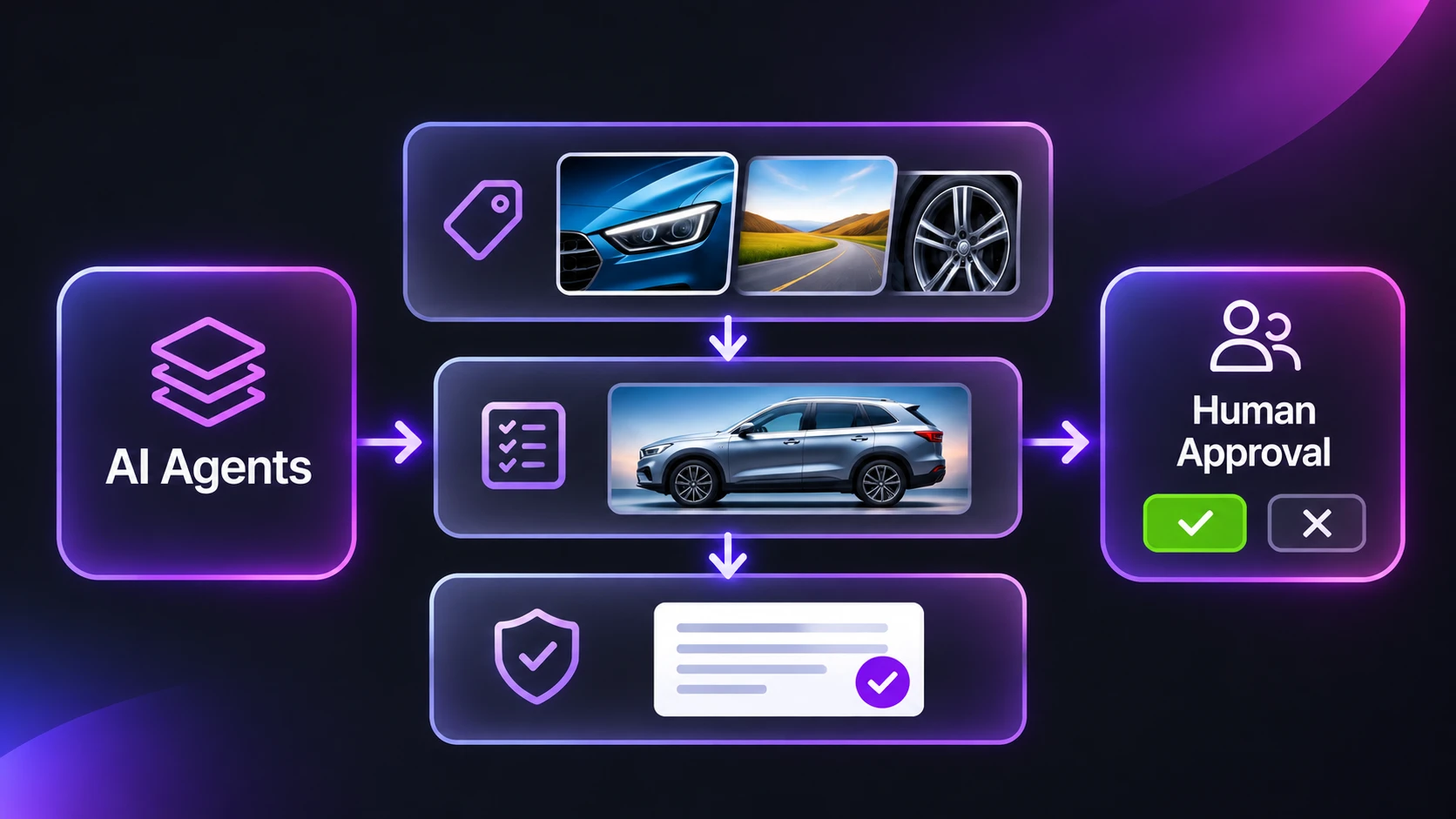
Agentic AI workflows change who does the work inside content operations. For years, AI in marketing meant suggestions: a recommended tag, a drafted caption, a faster search. Agents work differently. They take the action, within limits that people define. That shift moves the central question from what AI can suggest to what AI can be trusted to do.
Most content teams are not ready for that question. Forrester research shows AI innovation moving faster than customer readiness, since vendors embed AI across the DAM stack faster than organizations can govern it. The gap between capability and confidence is where the important decisions now sit.
This post explains how agentic AI workflows operate in content operations, which tasks agents handle today, and what governance they require. It also gives a practical path for teams starting from a manual process. The focus stays on what is observable in production environments, because agent claims are easy to make and hard to verify without specific questions.
TL;DR
- Agentic AI workflows let AI agents execute content tasks inside policies that people configure.
- Agents differ from assistants because the agent acts, while an assistant improves an action a person takes.
- Five agent families cover the content lifecycle: planning, librarian, critic, compliance, and production.
- Production metrics from live deployments show large drops in repetitive task time.
- Autonomy levels, confidence thresholds, and audit logs decide whether agents reduce risk or add it.
- Teams should start with one governed workflow, measure it, and expand from evidence.
What are agentic AI workflows in content operations?
Agentic AI workflows are content processes in which AI agents carry out tasks, make bounded decisions, and hand work to people only when policy requires it. The workflow keeps its structure, but the agent performs the steps that used to require a person.
Definition: An agentic AI workflow is a content process in which AI agents execute tasks under configured policies, confidence thresholds, and human review gates, with each action recorded for audit.
A comparison shows why the distinction matters:
- Feature model: A person takes an action, and AI improves the result. The person remains the bottleneck.
- Agent model: The agent takes the action, and configured rules decide when a person must intervene. Volume no longer depends on headcount.
The change is structural, not cosmetic. Aprimo’s 2027 DAM trends report describes the DAM of 2024 as AI layered onto existing workflows. Aprimo delivers its agents through a Content Operations Platform that keeps workflow, governance, and assets in one place. It describes the DAM of 2027 as a platform where agents execute workflows autonomously within defined governance boundaries.
Forrester’s profile of Aprimo in its Q1 2026 Wave described a DAM as an intelligent system of action, built on an AI agent strategy that began in 2023, according to Aprimo’s announcement. The label matters less than the behavior: a system of action starts work instead of waiting for it.
How do agentic AI workflows differ from automation scripts and AI assistants?
Agentic AI workflows differ from scripts because agents handle variation, and they differ from assistants because agents act without a prompt for each step. Scripts follow fixed rules. Assistants wait for a person to ask.
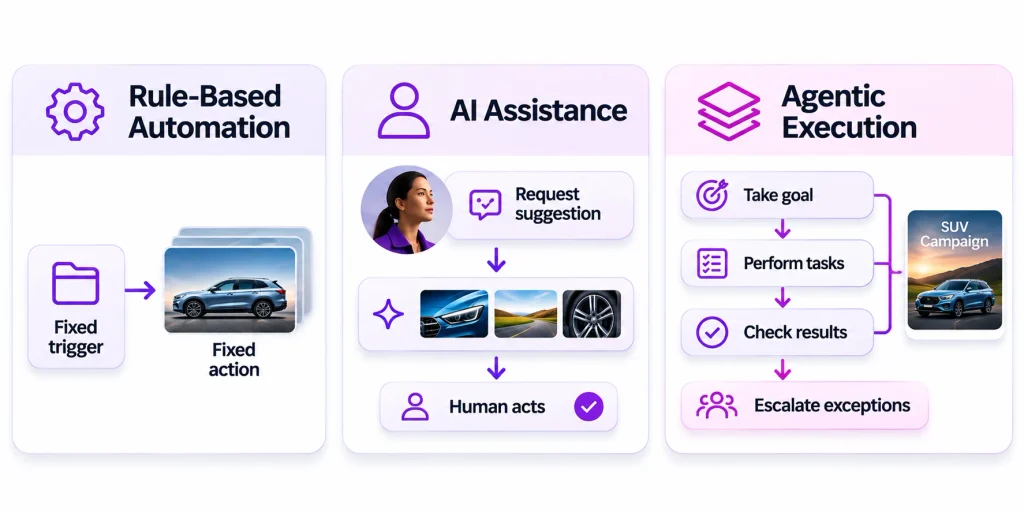
Three levels of capability sit on a spectrum:
- Rule-based automation: Fixed triggers produce fixed actions. A file lands in a folder, and a rule moves it.
- AI assistance: A person requests help, and the AI responds. Drafting a caption or suggesting a tag falls here.
- Agentic execution: An agent receives a goal, performs the steps, checks its own output, and escalates exceptions.
Each level suits different work. Rules handle predictable steps cheaply. Assistance helps individuals with creative tasks. Agents suit high-volume, repeatable work that needs judgment, such as classifying thousands of assets or checking content against brand and legal standards.
Buyers should ask who clicks during a demo. If a person still triggers every step, the product is an assistant with a new name. If the agent starts the step, evaluates the result, and routes exceptions by policy, the product behaves as an agent.
Which content tasks do agents handle today?
Agents handle five families of content tasks that cover the lifecycle from planning through distribution. Aprimo’s AI Agents page describes each family.
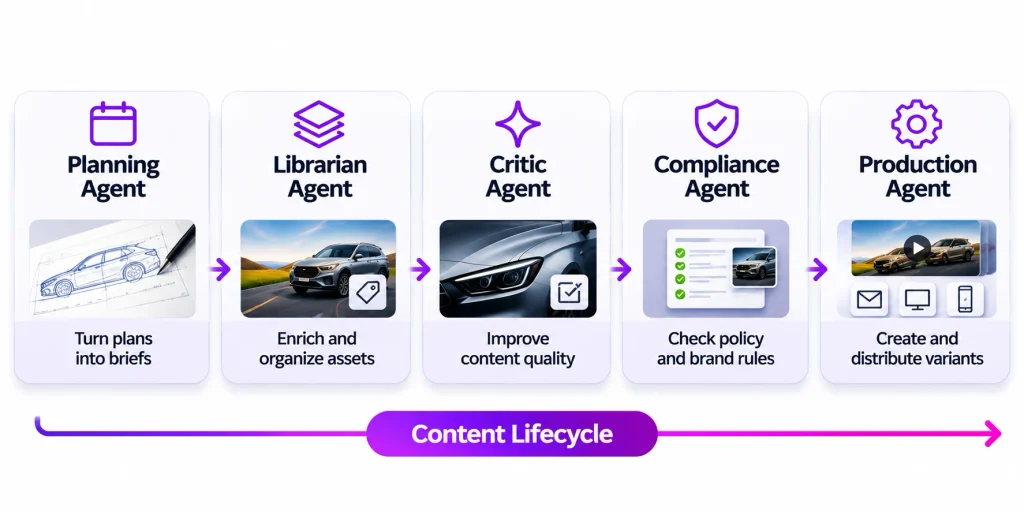
- Planning agents generate campaign and content briefs.
- Librarian agents classify assets, enrich metadata, and power search.
- Critic agents evaluate quality and tone against defined standards.
- Compliance agents check content for brand, legal, and regulatory risk before release.
- Production agents generate, transform, localize, and distribute content.
Coverage across all five matters more than excellence in one. A point solution that tags assets well but cannot route a compliance check leaves manual gaps on either side. Gaps force people back into the workflow, which limits the gains.
Librarian work shows how this plays out in practice. Metadata enrichment benefits most from automation, since metadata quality decides search, reuse, and governance later. Aprimo’s Librarian Agents interactive demo shows how agents generate context-aware metadata.
See agent coverage across the content lifecycle
Build a tailored DAM RFI from your own requirements, use cases, and business goals in minutes.
What results are early adopters reporting from agentic AI workflows?
Early adopters report large reductions in repetitive task time, with several metrics coming from live production environments. The figures below come from Aprimo’s trends report, so buyers should request comparable evidence from any vendor.
According to the 2027 DAM trends report, customers in early agent adoption saw project scope creation fall from 90 minutes to 10. Asset reuse improved by 480%, and regulatory approval timelines shrank by 80%. The report describes these as production metrics from live customer environments, not pilot results.
Market demand supports the trend. In Forrester’s Q3 2025 survey of 313 global decision-makers, AI agents for task and workflow automation ranked sixth among important DAM capabilities today, then second within two years. Generative AI asset adaptation was expected to become the single most important capability, according to the same report.
Gartner adds an adoption forecast. It predicts that 40% of enterprise applications will include task-specific AI agents by the end of 2026, up from less than 5% in 2025, according to a Gartner press release.
Buyers should treat all of these numbers as directional. Results depend on library quality, workflow design, and how much of the process an agent can own. A pilot against the buyer’s own assets gives the only figure that applies.
How much autonomy should agents have in a content workflow?
Agents should have as much autonomy as the risk of the task allows, and no more. Low-risk tasks such as metadata suggestions can run with light review. High-risk tasks such as regulated claims need strong human gates.
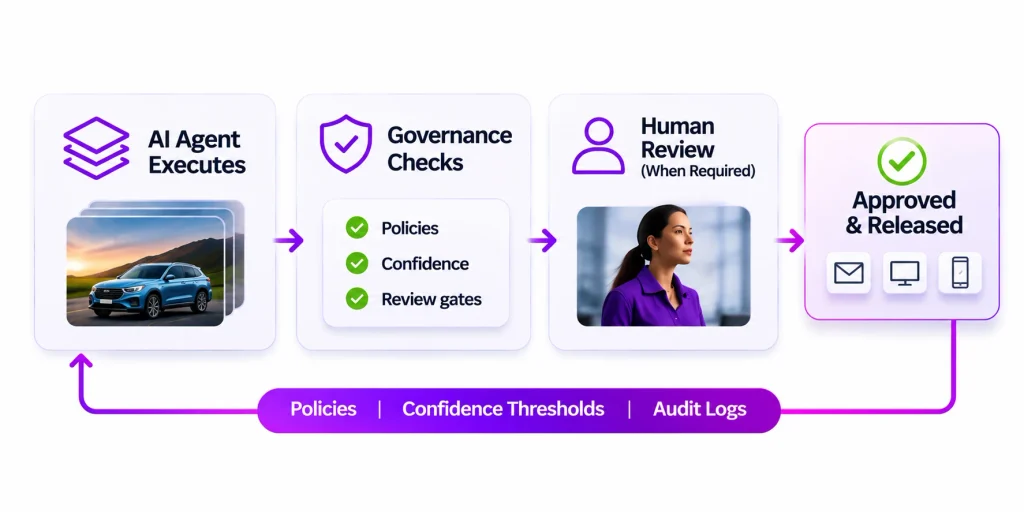
Three controls define the boundary:
- Policies: Written rules that state what an agent may and may not do.
- Confidence thresholds: Scores that decide when an agent proceeds and when it escalates.
- Human review gates: Points in the workflow where a person must approve before work continues.
Configurable autonomy lets teams tune these controls by task, region, or brand. A global consumer brand might allow autonomous localization for low-risk markets. The same brand might require human approval for markets with strict advertising rules.
The model should also change over time. Teams usually begin with tight gates, then loosen them as evidence accumulates. A review log that shows agents making the same decision as human reviewers ninety-five times out of a hundred is a stronger argument for autonomy than any vendor claim.
What governance do agentic AI workflows require?
Agentic AI workflows require audit logging, provenance tracking, disclosure controls, and clear human accountability. Without these, agents create governance problems faster than they remove manual work.
Regulation makes the requirement concrete. According to the 2027 DAM trends report, the EU AI Act introduces transparency obligations for certain AI-generated content, including machine-readable marking requirements and disclosures in specified circumstances.
The report also lists California disclosure rules, EU accessibility requirements, and EU limits on broad green claims.
Human oversight remains essential. In Bynder and Censuswide’s 2025 State of DAM report, nine out of ten respondents said human oversight is essential for protecting brand identity in AI-generated content, as cited in the same trends report. The practical challenge is keeping oversight effective as volume grows. Reviewing every asset by hand no longer works.
AI-assisted governance solves that problem. Compliance agents flag risk, score confidence, and route work to human reviewers only when the risk justifies it. Four capabilities support the model:
- Native detection of AI-influenced content in the workflow.
- Provenance support such as C2PA for verifiable origin tracking.
- Immutable audit trails that meet regulatory traceability standards.
- Accessibility automation that generates alt text, captions, and metadata.
Buyers should also ask whether outside agents can plug in without breaking governance. Open standards such as Model Context Protocol can let compatible AI agents access DAM search, metadata, and compliance capabilities through governed connections.
How should teams start with agentic AI workflows?
Teams should start with one workflow, one agent family, and one measurable outcome. Narrow starts produce evidence, while broad starts produce confusion.
A starting sequence keeps the effort controlled:
- Pick a high-volume, repeatable workflow with clear quality rules, such as metadata enrichment or pre-review compliance checks.
- Record current cycle time, error rate, and reviewer workload as the baseline.
- Set conservative autonomy, with human review on every exception.
- Run the agent against real assets for a fixed period.
- Compare results with the baseline, then adjust thresholds.
- Expand to the next workflow only after the first shows stable results.
Data quality sits underneath all of it. Agents depend on consistent taxonomy, accurate rights data, and clean version history. A library with weak metadata limits every agent that touches it. Many teams find that cleaning the foundation delivers value before any agent runs.
Ownership matters too. Someone must own agent configuration, review the logs, and adjust thresholds. Treating agents as a one-time setup leads to drift, because content standards and regulations keep changing.
What can go wrong with agentic AI workflows?
The common failures are ungoverned autonomy, weak data, over-automation, and unclear accountability. Each has a clear remedy, but each needs attention before launch.
Ungoverned autonomy appears when agents act without logs or limits. The remedy is audit logging from day one. Weak data appears when metadata and rights records are inconsistent, so agents repeat existing errors faster. The remedy is a taxonomy cleanup before scaling the workflow.
Over-automation appears when teams remove human review from tasks that carry real risk. The remedy is task-level autonomy settings, with the strictest gates on regulated or reputation-sensitive content. Unclear accountability appears when no one owns an agent’s decisions. The remedy is a named owner for each workflow.
A fifth risk is isolated adoption. Aprimo’s trends report warns that organizations investing in isolated AI features or disconnected compliance workflows risk diminishing returns. A unified strategy lets agents, governance, and integration reinforce one another. Teams that bolt agents onto a fragmented stack get fragmented results.
Where agentic AI workflows lead content operations next
Agentic AI workflows move content operations from managing files to coordinating work. Agents plan, classify, review, check, and produce. People set the standards, then handle the exceptions that need judgment. The model rewards teams that invest in governance first.
The organizations that benefit most share three habits. They define autonomy by task risk. They log every agent action. They measure results against a baseline before expanding. Each habit turns AI from a promise into an operational fact. Teams without them tend to stall after the pilot, because nobody can show whether the agent helped.
The window for early advantage is open now, but it will narrow. Organizations that build governance and measurement habits today will absorb new agent capabilities faster than those that begin later. Forrester’s expectation that agents rise from sixth to second among important DAM capabilities within two years suggests the category will standardize quickly.
Teams ready to test agent coverage against their own workflows can book a demo and bring one process to evaluate.
FAQ
Are agentic AI workflows the same as marketing automation?
No. Marketing automation runs fixed rules, such as sending an email after a form fill. Agentic workflows handle variation, evaluate their own output, and escalate exceptions. The two can work together, but agents take on judgment tasks that rules cannot cover.
Do agentic AI workflows remove the need for human review?
No. Policies, confidence thresholds, and review gates keep people in control of high-risk decisions. Agents absorb volume, so reviewers spend time on cases that need judgment.
Which content tasks should teams automate first?
Metadata enrichment and pre-review compliance checks are common starting points. Both are high-volume and repeatable, with clear quality rules. Success there builds the evidence needed for larger workflows.
How can a team measure whether an agent is working?
Teams should record cycle time, error rate, and reviewer workload before launch. Comparing those baselines with agent results over a fixed period shows real impact. Review logs also show how often reviewers overrule the agent.
What is Model Context Protocol, and why does it matter?
Model Context Protocol is an interoperability standard that lets outside AI agents call a platform’s functions as tools. For DAM, it means agents from different vendors can query search, metadata, and compliance logic under one governance layer.
Can agentic AI workflows help with regulatory compliance?
Yes, when configured well. Compliance agents flag risk, track AI-generated content, and maintain audit trails. Legal teams still decide which rules apply in each market, so human accountability remains.
Related reading: AI governance models for enterprise content operations, the future of enterprise AI agents in content operations.