

Organizations often assume that buying a DAM solved governance. The DAM holds approved assets, tracks versions, records rights, and enforces permissions. Those capabilities are real and valuable. They also apply only to what the DAM contains.
Content that never entered the DAM, or that left it as a download, sits outside those controls. A file saved to a shared drive, an image published on a regional site, a document sent to a partner: each one carries the brand and the risk, yet none of them is governed by the system that holds the original.
Understanding where asset management ends helps teams buy the right tools, set the right expectations, and avoid gaps in oversight. This article defines each, compares them, and explains how to decide whether a governance layer is needed.
TL;DR
- A digital asset management system stores, organizes, and governs the assets that enter it.
- A content governance layer applies brand, compliance, or quality checks to content wherever it lives, including websites, partner portals, or cloud storage that the DAM never ingested.
- The two serve different scopes: the DAM governs the managed library, while the governance layer governs the full content portfolio and uses the DAM as the reference for what is approved.
- Organizations whose content all flows through the DAM may not need the extra layer, but most enterprises have significant content outside it.
What Does a DAM Govern?
A DAM governs the assets stored in it: their metadata, versions, permissions, rights, approval status, and distribution. Its authority covers the managed library.
Definition: Digital asset management is the practice of storing, organizing, enriching, securing, and distributing digital assets, with controls over versions, rights, or access.
Inside the DAM, governance is strong. Role-based permissions control who can view, edit, and download. Approval workflows move assets from draft to approved. Rights metadata records license terms and expiry. Version control prevents confusion between current and superseded files. Audit trails record who did what. For a deeper look at the foundation, what is digital asset management covers the core capabilities.
The DAM also acts as the source of truth. When someone needs the current logo, the approved product image, or the compliant disclosure, the DAM is the place to find it. That role does not change when a governance layer is added.
What Does Content Governance Cover That a DAM Does Not?
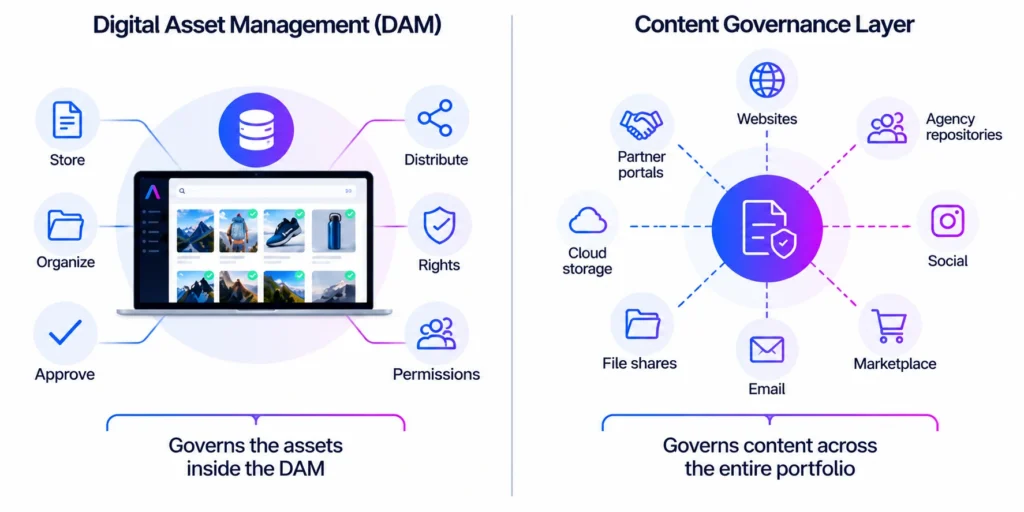
Content governance across the portfolio covers content outside the DAM: websites, partner sites, dealer sites, file shares, cloud storage, agency repositories, and other external systems. It checks whether that content matches approved versions and follows policy.
The need arises because the DAM has no visibility into assets it never received or into copies placed elsewhere after download. A DAM cannot tell that an expired image remains on a campaign microsite, or that a regional team uses an old version of a logo, or that a cloud folder holds unmanaged duplicates. These are not DAM failures. They are outside the DAM’s scope by design.
Portfolio governance fills that scope. It discovers content in external sources, identifies how each item relates to approved assets, checks it against brand or compliance rules, then ranks the risks. The model moves governance from the point of upload to the full life of content after publication.
The distinction also clarifies related categories. The post on content operations versus DAM covers how planning, creation, and management of content relate to asset management. A related post on DAM, CCP, and EFSS separates storage categories from collaboration categories. Portfolio governance adds a monitoring and enforcement function that none of those categories provides on its own.
How Do a DAM and a Governance Layer Compare?
The DAM governs the library by controlling what enters and how teams use it. The governance layer governs the portfolio by checking what exists everywhere. The table summarizes the differences.
| Dimension | DAM | Content governance layer |
|---|---|---|
| Scope | Assets inside the DAM | Content across websites, storage, portals, and the DAM |
| Primary action | Store, organize, approve, distribute | Discover, compare, check, prioritize |
| Governance timing | At ingestion and during use | After publication, continuously |
| Source of truth | Is the source of truth | Uses the DAM as the reference |
| Typical output | Approved asset library | Risk findings by region, brand, and severity |
| Blind spot | Content outside the library | Depends on access to external sources |
The two are complementary. The DAM provides the approved reference, and the governance layer measures how closely the rest of the content ecosystem follows it. Without the DAM, the governance layer can still check rules like accessibility and duplicates, but it loses the ability to compare against approved versions. Without the governance layer, the DAM stays accurate about its own contents while remaining blind to everything else.
How Mature Is Your Content Governance?
Benchmark where your content governance program stands today, then see where to focus first.
When Is a DAM Alone Enough?
A DAM alone is enough when nearly all content passes through it, and when distribution points pull directly from it. Few enterprises meet both conditions, but some come close.
A small organization with one website, one agency, and a disciplined publishing process may keep all content in the DAM, then publish through integrations. In that case, the risk of divergence is low, and periodic checks may suffice. Organizations that use the DAM as the only publishing source, with CMS and channel integrations pulling approved assets automatically, also reduce the gap.
Even then, the assumption should be tested. A simple exercise helps: scan the public website for images, then check how many trace back to the DAM. Many teams find that a meaningful share do not. The result shows whether the DAM-only model holds in practice.
When Does an Organization Need a Governance Layer?
An organization needs a governance layer when meaningful content lives outside the DAM, when partners or regions publish independently, or when regulations require evidence of ongoing compliance. Five signals indicate the need.
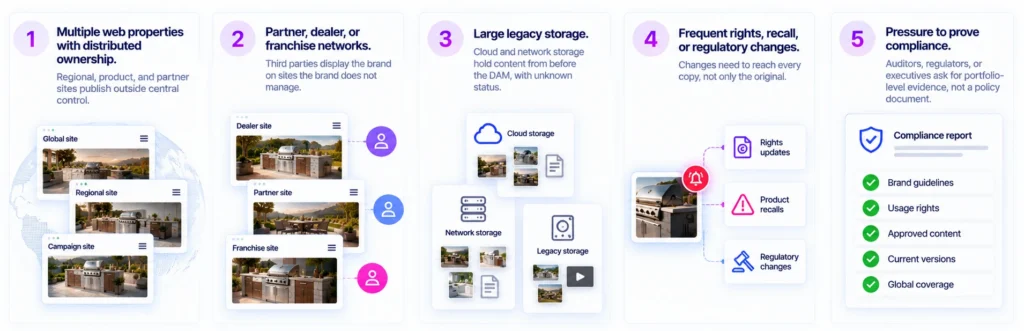
- Multiple web properties with distributed ownership. Regional, product, and partner sites publish outside central control.
- Partner, dealer, or franchise networks. Third parties display the brand on sites the brand does not manage.
- Large legacy storage. Cloud and network storage hold content from before the DAM, with unknown status.
- Frequent rights, recall, or regulatory changes. Changes need to reach every copy, not only the original.
- Pressure to prove compliance. Auditors, regulators, or executives ask for portfolio-level evidence, not a policy document.
If two or more of these apply, the DAM’s governance likely leaves gaps. The Content Governance Maturity Assessment offers a structured way to evaluate where an organization stands.
What Does This Look Like in Practice?
In practice, the governance layer connects to sources, discovers content, relates it to the DAM, runs checks, and reports risk. Aprimo Content Portfolio Management (CPM) follows this pattern. The launch post describes how Mesh discovers content across sources and how the Aprimo AI agents apply checks to what Mesh finds.
CPM can run alongside Aprimo DAM or with another DAM serving as the reference. It can also run without a DAM for teams that want visibility first. The Aprimo DAM remains the system of record for approved content, which keeps the roles clear.
Conclusion
The question is not whether a DAM or a governance layer is better. They answer different questions. The DAM answers what the organization has approved. The governance layer answers whether what the organization has published still matches it.
Organizations that conflate the two tend to discover the difference during an incident: an audit request, a recall, a licensing dispute. By then the cost of finding out is high. The more useful move is to measure the distance between the managed library and the live content ecosystem early, then decide how much of that distance is acceptable. For many brands, that measurement is the first honest picture of their governance posture.
FAQ
Is content governance the same as brand governance?
Brand governance is a subset focused on brand standards. Content governance also covers compliance, quality, rights, and lifecycle. Portfolio-level governance applies both across all locations.
Can a DAM monitor external websites?
Most DAMs do not scan external properties. Some offer integrations that publish from the DAM to channels, which reduces drift but does not detect content that bypassed the DAM.
Does a governance layer require replacing the DAM?
No. A governance layer typically uses the DAM as its reference for approved assets. Some layers also work without a DAM, with reduced comparison capability.
What is the difference between a governance layer and a web crawler?
A crawler inspects pages for technical attributes. A governance layer compares content to approved versions and policies, then ranks risks. The comparison function is the key difference.
How does AI fit into content governance?
AI agents can apply checks consistently across large volumes, flag exceptions for human review, and enrich discovered content with metadata. Human reviewers remain responsible for judgment calls.
Who buys a governance layer, the DAM owner or compliance?
Both often participate. The DAM or content operations owner usually leads. Brand, legal, and compliance teams define the rules, then consume the reports.
Related reading: governing content outside the DAM, adding governance without migration, auditing web content for brand risk.