

Key Takeaways
Modern enterprise platforms have evolved beyond passive file storage into intelligent systems that automate, optimize, and scale content operations.
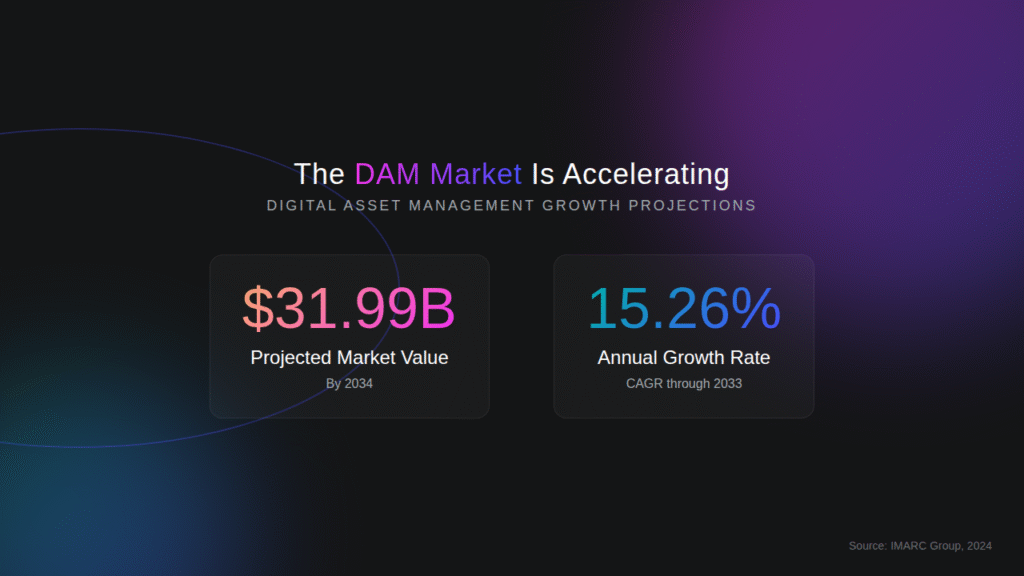
- The global digital asset management market is projected to reach $31.99 billion by 2034, driven by organizations demanding systems that actively participate in content workflows
- Traditional file storage creates operational bottlenecks, with teams spending countless hours searching for assets and recreating content that already exists somewhere in the organization
- Intelligent platforms connect planning, creation, governance, and distribution into a unified ecosystem powered by AI Agents that work autonomously
- Organizations that treat DAM as strategic infrastructure see measurable improvements in asset discoverability, content reuse, and time-to-market acceleration
The question is no longer whether you need better file organization; it’s whether your content systems can actively drive business outcomes.
The days of storing files in random folders across multiple drives have firmly passed. What organizations once called “digital asset management” has undergone a fundamental transformation, evolving from glorified cloud storage into sophisticated content operations platforms that serve as strategic content infrastructure for enterprise marketing and creative teams.
This shift represents far more than a technology upgrade. According to IMARC Group research, the global digital asset management market reached $7.73 billion in 2024 and is expected to grow at a compound annual growth rate of 15.26% through 2033. That growth trajectory reflects a fundamental change in how organizations think about their digital assets and the strategic value intelligent systems deliver.
Why Does Traditional File Storage Fall Short of True Content Infrastructure?
Organizations attempting to scale content operations with traditional storage solutions face mounting challenges that compound over time. The symptoms are familiar: fragmented assets scattered across network drives, local devices, and various cloud services. Manual file naming creates inconsistency. Basic search functions fail to surface relevant content when teams need it most.
The Hidden Cost of Content Chaos
Marketing teams regularly spend significant time searching for appropriate assets, with many searches resulting in recreated content because existing materials cannot be located. This inefficiency cascades throughout the organization, creating duplicated efforts, inconsistent branding, and eroded customer trust.
Version control becomes nearly impossible when assets live in email threads, messaging apps, and disconnected cloud folders. Creative teams work on outdated files while approved versions sit undiscovered in someone’s personal folder. Compliance violations slip through because there’s no systematic way to track usage rights, expiration dates, or regulatory requirements.
The financial impact extends beyond wasted labor hours. Organizations using scattered storage systems struggle to demonstrate content ROI, leaving marketing budgets vulnerable during planning cycles. Without clear visibility into asset performance and utilization, teams cannot make data-driven decisions about future content investments.
What Are the Benefits of a Modern DAM System?
True enterprise platforms go far beyond organizing files. They orchestrate the entire content lifecycle, from initial planning through creation, approval, distribution, and performance analysis. Modern content infrastructure integrates AI Agents that automate routine tasks, enforce governance rules, and provide actionable insights that inform content strategy.
The DAM evolution from passive repository to active participant in content operations reflects broader changes in enterprise technology expectations. Forrester’s 2024 Marketing Survey found that 69% of global B2C decision-makers increased their investment in content management technology, up from 59% the previous year. This acceleration signals recognition that content systems must do more than store files; they must actively drive business outcomes.
Intelligent Search and Discovery
Legacy DAM systems relied on keyword-based search that required users to guess the exact terms others used when tagging assets. This approach created frustration and wasted time, particularly for organizations managing hundreds of thousands of assets across global teams.
Platforms built on semantic search capabilities understand natural language queries, visual similarity, and contextual relationships. Teams can search for concepts rather than specific keywords, finding relevant assets even when metadata is incomplete. AI-driven discovery surfaces related content proactively, recommending assets based on campaign context, historical performance, and audience characteristics.
Automated Metadata and Classification
Manual metadata entry represents one of the most significant bottlenecks in traditional DAM implementations. Creative teams rarely have time to tag assets comprehensively, resulting in content that becomes effectively invisible within months of creation.
Modern digital asset management systems employ AI Agents that automatically analyze content and apply relevant metadata based on visual recognition, text extraction, and learned organizational taxonomies. Librarian Agents can identify brand elements, detect products, recognize faces, and suggest categorization based on how similar assets have been organized previously. This automation ensures that every asset becomes discoverable without requiring manual effort from creative teams.
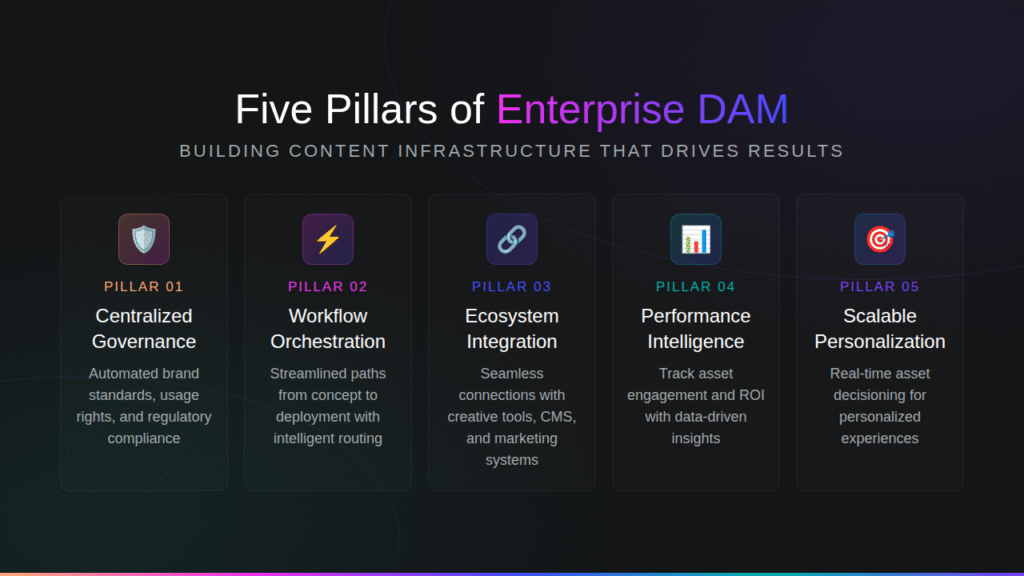
What Features Should an Enterprise DAM Platform Have? Five Pillars of Effective Platforms
Building systems that drive measurable business value requires attention to capabilities that go well beyond basic file management. Organizations evaluating enterprise content platforms should assess these five critical areas.
Centralized Governance and Compliance: Intelligent platforms must enforce brand standards, usage rights, and regulatory requirements automatically. Compliance Agents monitor assets for potential violations, flag expired usage rights, and ensure that content meets industry-specific regulations before distribution.
Workflow Orchestration: The connection between content operations and asset management creates streamlined paths from concept to deployment. Intelligent workflows route assets through appropriate review cycles, collect approvals from required stakeholders, and trigger distribution once all conditions are met.
Ecosystem Integration: Modern platforms connect seamlessly with creative tools, CMS platforms, marketing automation systems, and analytics solutions. These integrations eliminate information silos and ensure that approved assets are accessible wherever teams work.
Performance Intelligence: Understanding which assets drive engagement, conversion, and revenue enables data-driven content strategy. Content intelligence modules track performance across channels and provide recommendations for future content development.
Scalable Personalization: Enterprise content platforms support real-time asset decisioning, enabling organizations to deliver personalized experiences across channels without creating content variants for every possible segment.
How Does Digital Asset Management Help Enterprises Scale?
The transformation from file storage to intelligent content infrastructure fundamentally changes what organizations can accomplish with their content investments. Rather than treating content creation as a cost center, modern systems help enterprises extract maximum value from every asset.
From Manual Processes to Autonomous Operations
Traditional DAM implementations required significant manual effort to maintain. Users uploaded files, applied metadata by hand, routed assets through approval workflows, and managed distribution to various channels. Each step introduced delays, created opportunities for error, and demanded attention from skilled team members.
Agentic DAM systems flip this model by introducing AI Agents that handle routine operations autonomously. Planning Agents generate campaign briefs and creative strategies. Librarian Agents organize and enrich assets automatically. Critic Agents evaluate content quality and suggest optimizations. Production Agents create variants, handle translations, and adapt assets for different channels. Compliance Agents verify adherence to brand guidelines and regulatory requirements.
This autonomous operation transforms what teams can accomplish with available resources. Organizations report significant improvements in content creation speed, meaningful reductions in asset duplication, and measurable productivity gains across marketing and creative functions.

Supporting Omnichannel Content Demands
Consumer expectations for personalized experiences across every touchpoint have created unprecedented demands on content teams. Meeting these expectations requires massive content volume, delivered consistently across web, social, email, mobile apps, and emerging channels.
Intelligent content infrastructure provides the foundation for this omnichannel delivery. Assets managed within a unified system maintain consistency regardless of where they appear. Dynamic delivery capabilities transform and optimize content for each channel automatically. Real-time personalization engines select the most relevant assets for individual users based on behavior and context.
What’s the Difference Between DAM and File Storage?
Understanding the difference between intelligent enterprise systems and traditional storage solutions helps organizations evaluate potential investments more effectively.
Storage systems hold files. Modern platforms power content operations. This distinction matters because the challenges organizations face rarely involve running out of space for their assets. The real problems center on findability, governance, workflow efficiency, and extracting value from existing content investments.
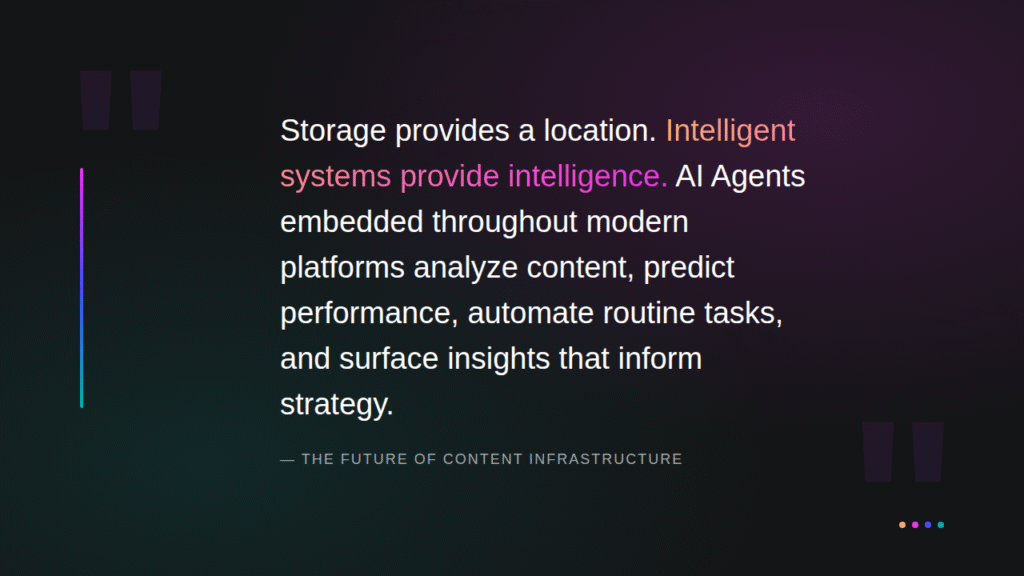
Storage provides a location. Intelligent systems provide intelligence. AI Agents embedded throughout modern platforms analyze content, predict performance, automate routine tasks, and surface insights that inform strategy. These capabilities transform passive repositories into active participants in content operations.
Storage requires management. Modern platforms enable management. Traditional systems demand ongoing attention to maintain organization, update metadata, and enforce consistency. Intelligent platforms handle these requirements automatically, freeing teams to focus on creative work rather than administrative tasks.
Storage scales by adding capacity. Intelligent systems scale by adding capability. As content volumes grow, traditional systems simply require more space. Modern platforms become more valuable as they learn organizational patterns, improve recommendations, and automate increasingly complex workflows.
How Do You Future-Proof Content Operations?
The evolution of digital asset management continues accelerating as AI capabilities mature and integration possibilities expand. Organizations investing in intelligent platforms today position themselves to leverage emerging technologies without wholesale platform replacement.
Cloud-native architectures provide the flexibility and scalability that enterprise operations require. MACH-certified platforms, built on Microservices, API-first design, Cloud-native infrastructure, and Headless delivery, integrate seamlessly with evolving technology stacks. This architectural approach protects infrastructure investments while enabling continuous innovation.
The integration of generative AI capabilities adds new dimensions to content management. Beyond organizing and distributing existing assets, platforms increasingly help create new content variations, adapt messaging for different audiences, and optimize creative elements based on performance data.
Frequently Asked Questions
How do intelligent platforms differ from cloud storage solutions?
Cloud storage provides basic file organization and sharing capabilities. Enterprise content platforms include specialized functionality for content-heavy organizations: intelligent search, automated metadata, workflow orchestration, governance controls, and performance analytics. While storage holds files, modern systems actively participate in content operations.
What ROI can organizations expect from implementing enterprise platforms?
Organizations implementing modern digital asset management typically see improvements in content creation speed, significant reductions in duplicate work, and measurable productivity gains. Time spent searching for assets decreases substantially, while content reuse rates increase, stretching creative budgets further.
How long does implementing enterprise content platforms take?
Implementation timelines vary based on organizational complexity, asset volumes, and integration requirements. Modern cloud platforms typically deploy faster than legacy on-premise solutions, with many organizations achieving initial value within weeks rather than months.
Can modern platforms support regulated industries?
Yes. Intelligent platforms include compliance features specifically designed for regulated sectors like financial services, healthcare, and life sciences. Automated audit trails, rights management, approval workflows, and industry-specific governance controls help organizations meet regulatory requirements while maintaining operational efficiency.
Transform Your Content Operations
The shift from file storage to intelligent content infrastructure represents one of the most significant opportunities for marketing and creative teams to improve efficiency, consistency, and business impact. Organizations that recognize content as strategic infrastructure position themselves for competitive advantage in an increasingly content-driven marketplace.
Aprimo delivers the agentic DAM and content operations platform that transforms how enterprises create, manage, and deploy content at scale. Request a demo to see how intelligent systems can revolutionize your organization’s approach to digital asset management.