

Key Takeaways
Choosing between a CMS, CMP, and DAM starts with understanding what each platform actually controls in your content lifecycle.
- A content management system (CMS) powers website publishing, while digital asset management (DAM) centralizes your entire organization’s media files, metadata, and distribution across every channel.
- Content marketing platforms (CMPs) bridge the gap between strategy and execution, coordinating planning, collaboration, and campaign deployment at scale.
- The real question for most enterprises isn’t which single tool to adopt; it’s how to integrate all three for a unified content operation that eliminates silos and accelerates time to market.
- Agentic AI is reshaping all three categories, with autonomous capabilities now enabling intelligent metadata tagging, compliance checking, and workflow orchestration.
If your team is still debating digital asset management vs content management system, you’re likely ready for both, plus a strategy layer to tie them together.
What Does Digital Asset Management vs Content Management System Really Mean?
Marketing teams today produce more content than ever before. Forrester’s 2024 Marketing Survey found that 69% of B2C decision-makers increased their investment in content management technology last year, up from 59% in 2023. That investment isn’t flowing into a single tool. It’s spreading across multiple platforms, each designed to handle a different piece of the content operations puzzle.
The confusion between digital asset management vs content management system stems from overlapping terminology. The words “content” and “digital assets” are used interchangeably in casual conversation, but they refer to fundamentally different things in a technology context. Content typically means structured data like text, metadata, and page layouts used to build websites and apps. Digital assets refer to rich media: images, videos, PDFs, design files, audio, and other branded materials that support storytelling across channels.
Understanding this distinction is the first step toward building a technology stack that actually works. When you add content marketing platforms into the mix, the picture becomes even more nuanced. Each system serves a specific function, and knowing where one ends and another begins helps you avoid redundant investments, fragmented workflows, and the kind of organizational friction that slows campaigns down.
How Does a Content Management System Work?
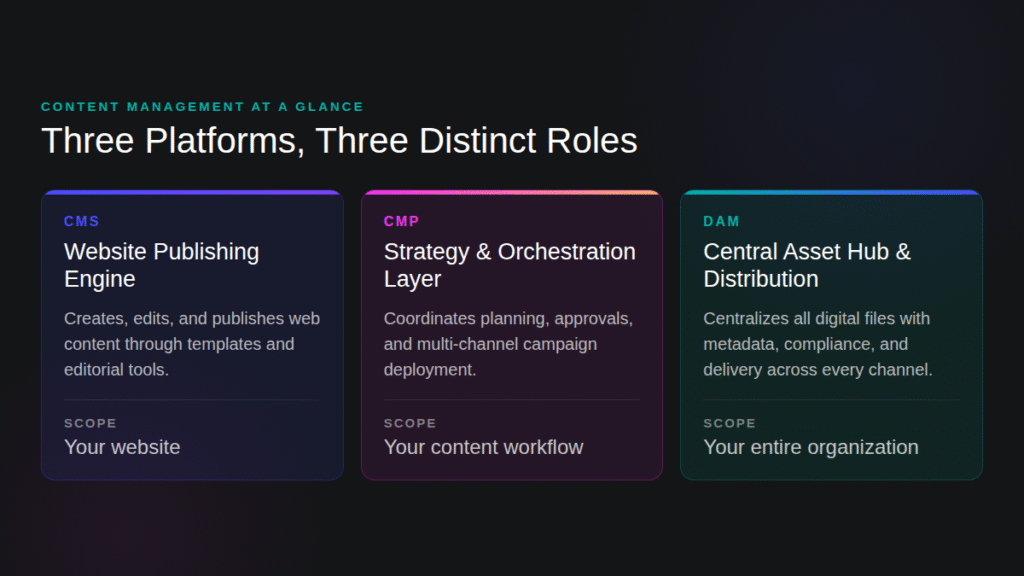
A CMS is the engine behind your website. It provides the tools to create, edit, organize, and publish web content without requiring deep technical knowledge. Platforms like WordPress, Drupal, and Contentful give content teams the ability to manage everything from blog posts and landing pages to product descriptions and homepage layouts.
Core CMS Capabilities
The strength of a CMS lies in web content publishing. Teams can draft articles, upload images, apply SEO metadata, and push content live through intuitive interfaces that don’t require coding skills. Built-in template systems let marketers design page layouts, customize navigation, and maintain consistent site architecture without constantly relying on developers.
Modern CMS platforms have expanded to include workflow features like user roles, permissions, and editorial calendars. Some offer basic digital asset management through media libraries where teams can store and retrieve images used on the website. Version control and revision history help teams track changes and roll back updates when needed.
Where a CMS Falls Short
A CMS handles website content well, but it wasn’t designed to manage your entire organization’s media library. The media management capabilities within most CMS platforms are basic: limited metadata, minimal search functionality, and no real support for rights management or compliance tracking. When your content needs extend beyond the website to social media, email, print, e-commerce, partner portals, and paid advertising, a CMS quickly reaches its limits.
The distinction matters most at scale. A small team publishing a handful of blog posts per week may get by with a CMS media library. An enterprise managing thousands of brand assets across global markets, regulated industries, and dozens of distribution channels needs something purpose-built for that complexity.
What Is a Content Marketing Platform?
A content marketing platform sits between strategy and execution. While a CMS focuses on publishing and a DAM focuses on asset management, a CMP coordinates the planning, creation, collaboration, and distribution of marketing content across channels and teams. Think of it as the project management and strategic orchestration layer for your content operation.
What CMPs Do Well
CMPs excel at campaign planning and editorial workflow management. They provide tools for building editorial calendars, assigning tasks, tracking deadlines, managing approvals, and coordinating multi-channel campaigns. Teams can visualize their entire content pipeline, identify bottlenecks, and ensure that every piece of content aligns with broader marketing objectives before it goes live.
Many CMPs include analytics dashboards that track content performance across channels, giving marketers visibility into what resonates with audiences and what falls flat. This strategic layer helps organizations move from reactive content production to data-informed planning.
The CMP Limitation
CMPs are excellent orchestrators, but they typically aren’t built to store, organize, and govern large volumes of digital assets. They coordinate the workflow around content, rather than serving as the centralized hub for managing assets themselves. This is why organizations that adopt a CMP still need a DAM for asset storage and governance and a CMS for web publishing.
How Digital Asset Management Differs from Both
A DAM system is your organization’s single source of truth for digital assets. It centralizes the storage, organization, search, and distribution of every type of digital file across every channel and every team. Where a CMS manages website content and a CMP manages content workflows, a DAM manages the assets themselves throughout their entire lifecycle.
The Scope of Modern DAM
The digital asset management market is projected to reach $9.8 billion by 2028, reflecting how essential these systems have become to enterprise content operations. Modern DAM platforms go far beyond basic file storage. They provide advanced metadata management, intelligent search and automated tagging, version control, rights and usage tracking, automated compliance checks, and dynamic content delivery to any endpoint.
The user base for a DAM extends across the entire organization. Marketing, sales, product teams, legal, HR, partner agencies, and regional offices all interact with a well-implemented DAM. Compare that to a CMS, where access is typically limited to web content managers and developers.
Key DAM Features That Set It Apart
Modern DAM platforms differentiate themselves through several critical capabilities that neither CMS nor CMP solutions provide:
- Intelligent metadata and search: AI-driven tagging and predictive metadata make every asset discoverable through natural language queries, visual similarity search, and contextual filters, far beyond the keyword-based search available in a CMS media library.
- Brand governance and compliance: DAM platforms enforce brand guidelines automatically, manage digital rights, track asset expiration, and provide audit trails required by regulated industries including financial services, life sciences, and government.
- Multi-channel distribution: Assets flow from the DAM to websites, social platforms, email systems, e-commerce storefronts, print production, and partner portals through native integrations and APIs.
How Agentic AI Is Reshaping DAM
The most significant shift in digital asset management is the emergence of agentic AI, which refers to autonomous systems that can make decisions and execute multi-step processes without constant human oversight. McKinsey’s 2025 State of AI survey found that 62% of organizations are now experimenting with AI agents, though only about one-third have begun scaling these capabilities.
In a DAM context, agentic AI means systems that independently route assets through workflows, generate metadata, trigger compliance checks, and optimize content placement in real time. This is a fundamentally different capability than what a CMS or CMP provides. Where those platforms may incorporate AI for content recommendations or editorial suggestions, an advanced digital asset management platform with AI Agents can autonomously handle the full operational lifecycle of a digital asset from ingestion to distribution.
5 Questions to Determine Which Platform You Need
Choosing the right content management tools depends on your organization’s specific challenges. Here’s a practical framework for evaluating your needs.
- Is your primary challenge website publishing? If your team struggles mainly with creating and updating web pages, a CMS should be your starting point. Look for a platform with strong content editing tools, template flexibility, and SEO capabilities.
- Do you need better campaign coordination? If content bottlenecks stem from poor planning, missed deadlines, or lack of visibility into the production pipeline, a CMP will address those workflow and collaboration gaps.
- Are assets scattered across multiple locations? If teams waste time searching for files across email, shared drives, and various cloud storage services, a DAM is the solution. Centralization eliminates silos and reduces duplicate asset creation.
- Do you operate in a regulated industry? Organizations in financial services, healthcare, life sciences, or government face strict compliance requirements. A DAM with built-in brand governance and regulatory compliance features becomes essential.
- Are you scaling content for global markets? Enterprises managing content across multiple brands, regions, and languages need the robust content personalization and distribution capabilities that only an enterprise-grade DAM provides.
Why Integration Matters More Than Choosing One
For most mid-market and enterprise organizations, the question isn’t CMS or CMP or DAM. It’s how these three systems work together to create a seamless content operation. Each platform serves a distinct role, and the real competitive advantage comes from integrating them effectively.
How the Three Systems Connect
In a well-integrated stack, the CMS pulls approved assets directly from the DAM for web publishing. The CMP coordinates the workflow that moves content through planning, creation, and approval. The DAM ensures that every asset used across all channels is current, compliant, and on-brand. This integration eliminates the platform-switching that drains productivity and introduces errors.
DAM integrations with CMS platforms like WordPress, Drupal, and headless CMS solutions allow web teams to access the full asset library without leaving their publishing environment. Integration with creative tools like Adobe Creative Cloud and Figma means designers work with approved assets from the start. Connections to marketing automation, social media management, and e-commerce platforms extend the DAM’s reach across the entire distribution ecosystem.

The Role of Workflow Automation
When all three platforms share data and workflows, automation becomes possible at a scale that isolated tools can’t match. Content briefs generated in the CMP can automatically trigger asset searches in the DAM. Approved assets can flow directly into the CMS for web publishing while simultaneously syndicating to social channels and email campaigns. Intelligent workflow automation orchestrates these handoffs without manual intervention, reducing time to market and freeing teams to focus on creative strategy rather than logistics.
CMS vs. CMP vs. DAM: Quick Comparison
| Capability | CMS | CMP | DAM |
| Primary function | Website publishing | Content strategy & planning | Asset lifecycle management |
| Content scope | Web pages, blogs, product pages | Campaign plans, editorial calendars | All digital files across all channels |
| Users | Web developers, content editors | Marketing strategists, project managers | Marketing, sales, creative, legal, partners |
| Metadata management | Basic page-level SEO | Campaign tags and categories | Advanced AI-driven taxonomy and tagging |
| Brand governance | Limited template controls | Workflow approvals | Automated compliance, rights tracking, audit trails |
| AI capabilities | Content suggestions, SEO tools | Predictive scheduling, analytics | Agentic AI: autonomous metadata, compliance, personalization |
| Integration role | Content presentation layer | Workflow orchestration layer | Central asset hub and distribution engine |
Frequently Asked Questions
Can a CMS replace a DAM?
No. A CMS manages website content and includes basic media storage, but it lacks the advanced metadata, search, rights management, compliance tracking, and multi-channel distribution capabilities of a DAM. For organizations managing large volumes of assets across multiple channels, a CMS media library is insufficient. Most enterprises use both systems together, with the DAM feeding approved assets into the CMS for web publishing.
What is the difference between a CMP and a DAM?
A CMP focuses on content strategy, planning, and workflow coordination. It’s the project management layer that ensures content gets created, reviewed, and published on schedule. A DAM focuses on managing the actual digital assets: storing, organizing, tagging, governing, and distributing files across the organization. While there’s some overlap in workflow features, each platform serves a distinct function in the content lifecycle.
Do small businesses need a DAM, or is a CMS enough?
Small businesses with limited content volume and straightforward web publishing needs can often manage with a CMS alone. However, as content production scales, teams grow, and distribution channels multiply, the limitations of a CMS become apparent. The tipping point often comes when teams spend more time searching for assets, recreating files that already exist, or dealing with version control issues than actually producing creative work.
How does choosing digital asset management vs content management system impact AI-driven marketing?
DAM platforms serve as the foundational data layer for AI-driven marketing. Accurate, rich metadata on every asset enables AI systems to make intelligent decisions about content selection, personalization, and distribution. A CMS provides structured web content, but a DAM provides the organized, tagged, and governed asset library that AI agents need to operate effectively at scale.
What industries benefit most from integrating all three platforms?
Organizations in financial services, life sciences, retail, manufacturing, and consumer goods see the greatest impact from integrating CMS, CMP, and DAM solutions. These industries manage high volumes of regulated or brand-sensitive content across multiple markets and channels, making centralized governance, automated compliance, and multi-channel distribution essential rather than optional.
What’s the Right Move for Your Organization?
The decision between digital asset management vs content management system isn’t binary. Every organization needs some form of content management, and the most effective content operations teams leverage specialized tools for each layer of their workflow. A CMS alone leaves gaps in asset governance and multi-channel distribution. A CMP alone can’t store or manage your actual files. And a DAM alone doesn’t publish your website.
The trend among high-performing marketing organizations is toward unified platforms that combine DAM capabilities with content operations features, creating a single environment where strategy, assets, and distribution come together. This approach eliminates the integration headaches that come with stitching together multiple point solutions while providing the depth of functionality that enterprise teams require.
Aprimo’s agentic digital asset management and content operations platform brings together intelligent asset management, workflow automation, and content intelligence in one unified solution, recognized as a Leader in DAM by Gartner, Forrester, and IDC. If you’re ready to move beyond fragmented content tools and build a truly integrated content operation, get a demo of Aprimo and see what’s possible.