

Most content platform implementations fail not at launch, but in the months that follow. Marketing teams invest heavily in digital asset management and content operations technology, complete lengthy selection processes, migrate thousands of assets, and announce the new system with enthusiasm. Then usage stalls.
Creative teams revert to shared drives. Stakeholders bypass approval workflows. The platform becomes a repository for finished work rather than the operational hub it was designed to be. The gap between platform capability and actual user behavior represents one of the most expensive problems in marketing operations, yet it receives far less attention than vendor selection or technical integration.
Driving real adoption requires more than training sessions and launch announcements. It demands a fundamental understanding of how people work, why they resist new tools, and what incentives actually change behavior. This article examines the specific barriers that prevent adoption, the strategies that overcome them, and the metrics that distinguish genuine platform embedding from surface-level compliance.
TL;DR
- User adoption of content platforms depends on aligning system design with actual workflows, removing friction from daily tasks, and demonstrating measurable productivity gains within the first thirty days of deployment.
- The most common barriers to platform adoption include inadequate role-based training, unclear value propositions for different user cohorts, and workflows that add steps rather than eliminate them from existing processes.
- Successful adoption strategies combine structured onboarding sequences, embedded collaboration tools, and workflow automation that surfaces the right assets and approvals at precisely the moment users need them.
- Organizations measure adoption success through login frequency, asset usage depth, workflow completion rates, and time savings metrics rather than simple seat counts or storage volume alone.
- Companies that fail to drive sustained adoption waste an average of sixty-three percent of their platform investment within eighteen months, turning strategic content infrastructure into expensive digital shelf-ware.
The Hidden Cost of Low Adoption Rates
Low user adoption transforms content platforms from strategic assets into expensive liabilities. Organizations experience this cost in multiple dimensions: wasted license fees for unused seats, duplicated effort as teams maintain parallel systems, governance failures when content bypasses the platform entirely, and opportunity cost from unrealized productivity gains. The financial impact compounds over time as IT resources continue supporting a system that delivers only a fraction of its potential value.
The business consequences extend beyond budget waste. When adoption remains low, marketing leaders lose visibility into content production, cannot enforce brand standards consistently, and struggle to demonstrate ROI on their technology investments. Teams develop workarounds that fragment content across multiple locations, making search ineffective and version control impossible. Compliance risks increase as regulated content moves through unsanctioned channels. Executive confidence in marketing operations technology erodes, making future investment decisions more difficult.
Perhaps most significantly, low adoption rates indicate a mismatch between the platform and actual user needs. When people consistently avoid a tool, the problem usually lies in implementation strategy rather than individual resistance. Understanding this root cause shifts the adoption challenge from a change management problem to a design and alignment problem. The platform must fit the work, not force the work to fit the platform.
Measuring the true cost requires looking beyond license utilization. Calculate the hours spent searching for assets outside the system, the delays caused by routing work around established workflows, and the rework needed when outdated or off-brand content enters production. These hidden costs often exceed the platform’s annual subscription cost, yet they rarely appear in adoption discussions.
Common Barriers That Prevent Platform Adoption
User adoption fails when organizations underestimate the friction inherent in changing established work patterns. The most significant barriers fall into three categories: workflow misalignment, inadequate training, and unclear value propositions for specific user cohorts.
Definition: User adoption barriers are structural, behavioral, or perceptual obstacles that prevent individuals from integrating a new content platform into their regular work routines, resulting in partial usage, workarounds, or complete avoidance of the system.
Workflow misalignment occurs when the platform adds steps rather than removing them. If a designer must upload an asset, tag it manually, and then notify stakeholders through a separate email because automated notifications are not configured, the platform creates extra work. If a content manager cannot quickly find assets because taxonomy does not match the way teams actually think about content, search becomes frustrating. If approval workflows require more handoffs than the previous informal process, stakeholders will route urgent requests outside the system. Every additional click, every unclear field, every workflow that does not map to actual production rhythms increases friction and reduces adoption.
Inadequate training remains a persistent problem, but the issue runs deeper than insufficient session time. Most training focuses on platform features rather than job-specific use cases. A social media manager does not need a comprehensive tour of every module; they need to learn how to quickly find approved images, resize them for specific channels, and track usage rights. A regional marketer needs to understand how to request localized versions of global campaigns, not how the underlying metadata taxonomy works. Generic training that treats all users identically fails to demonstrate relevant value, leaving people uncertain how the platform actually helps them do their specific jobs better.
Unclear value propositions compound the adoption challenge. Executives and administrators who selected the platform understand its strategic benefits, but frontline users experience only disruption and learning curves. If a copywriter cannot immediately see how the platform saves them time, improves their output quality, or reduces frustrating rework, they have no intrinsic motivation to adopt it.
Different user cohorts need different value stories. Creatives care about reducing revision cycles and protecting their work from unauthorized changes. Legal teams care about controlling content distribution and tracking usage of sensitive materials. Sales teams care about finding the right asset in seconds, not understanding metadata schemas. Adoption strategies must address these distinct motivations explicitly.
Technical barriers also play a role. Slow performance, poor mobile experiences, integration gaps with tools people already use, and complicated permission structures all create resistance. If the platform does not work smoothly within existing technology ecosystems, users will route around it to maintain productivity. The barrier is not stubbornness but rational prioritization of getting work done over learning new systems.
Proven Strategies to Accelerate Adoption
Successful adoption strategies focus on reducing friction, demonstrating immediate value, and embedding the platform into daily workflows rather than treating it as a separate destination. These approaches work because they address the actual barriers users face instead of assuming resistance stems from lack of training alone.
Start with Workflow Integration: The most effective adoption strategy
The platform directly into existing workflows rather than requiring users to change their work patterns fundamentally. This means connecting the content platform to the tools people already use every day: creative applications, project management systems, communication platforms, and content management systems. When designers can access approved assets directly within Adobe Creative Cloud, or when social media managers can pull content into their scheduling tools without downloading and re-uploading, the platform becomes invisible infrastructure rather than a separate task.
Workflow automation plays a critical role here. Automated notifications that alert stakeholders when assets need review, intelligent routing that moves content through approval chains without manual intervention, and triggers that automatically publish approved content to distribution channels all reduce the number of actions users must take. The platform should eliminate steps from existing processes, not add new ones. Every automated action that replaces a manual task builds adoption by demonstrating tangible time savings.
Implement Role-Based Onboarding: Generic training sessions produce generic adoption rates
Effective onboarding sequences target specific user roles with customized walkthroughs that focus exclusively on the features and workflows that matter to that cohort. A regional marketer receives a different onboarding experience than a creative director, because their needs, goals, and daily interactions with the platform differ fundamentally. Role-based onboarding should follow this structure:
- Introduce the specific problem this role faces that the platform solves, using concrete examples from the organization’s actual work.
- Demonstrate the exact workflow this role will use most frequently, walking through each step with real assets and realistic scenarios.
- Provide hands-on practice with the three to five actions this role performs most often, ensuring confidence before moving forward.
- Establish clear escalation paths for questions and technical issues, reducing the friction of getting help when needed.
- Schedule a follow-up session two weeks after initial onboarding to address questions that emerge during actual use and reinforce correct behaviors. This structured approach ensures users gain confidence with their most critical tasks before encountering advanced features they may never need. It also demonstrates respect for their time by focusing on relevant capabilities rather than comprehensive feature tours.
Build Champion Networks: Adoption accelerates when teams include credible advocates
Who model platform usage and provide peer-to-peer support. Champions should come from within user communities rather than being imposed from IT or operations teams. A respected senior designer who demonstrates how the platform improves creative workflows carries more influence than any amount of executive mandate.
Champion networks work best when they receive formal support: dedicated time for helping colleagues, early access to new features, direct communication channels with platform administrators, and recognition for their contributions. These individuals become the first line of support for questions, workaround prevention, and feedback collection. They also help operations teams understand adoption barriers that might not surface through formal channels.
Create Immediate Value Moments: The window for demonstrating value is narrow
Users who do not experience clear benefits within the first two weeks of active use are significantly more likely to disengage. Successful adoption strategies engineer immediate value moments: specific experiences that demonstrate tangible benefits quickly. These moments might include a designer finding the exact asset they need in fifteen seconds instead of the thirty minutes it previously took, a marketer receiving automated approval on a campaign that used to require days of email chains, or a sales representative accessing the latest product sheet directly from their mobile device during a client meeting. The key is ensuring these value moments happen early, often, and obviously.
Measure and Communicate Success: Adoption improves when users see evidence that the platform delivers results
Regularly communicate adoption metrics, success stories, and specific examples of problems solved. Highlight time savings, error reductions, faster campaign launches, and improved content quality. Make the platform’s value visible and concrete rather than abstract and strategic. Quantify the impact wherever possible: “The creative team reduced asset search time by forty-seven percent in the first month” or “Campaign approval cycles dropped from nine days to three days after implementing automated workflows.” These specific, measurable outcomes build confidence and create social proof that motivates broader adoption.
Leveraging Platform Features That Drive Engagement
Modern content platforms include specific features designed to encourage adoption through improved user experiences and reduced friction. Understanding which capabilities most directly influence adoption allows organizations to prioritize configuration and training efforts effectively.
Make Content Easy to Find
Intuitive search and discovery capabilities rank among the most adoption-critical features. When users can find what they need in seconds using natural language queries, visual similarity search, or intelligent filters, the platform demonstrates immediate value. Conversely, when search requires understanding complex metadata schemas or returns irrelevant results, users quickly lose confidence. Investing in robust taxonomy design, comprehensive tagging (whether manual or automated), and search interface optimization pays direct adoption dividends. Predictive metadata and AI-powered tagging reduce the manual effort required to make assets discoverable, removing a common barrier to upload adoption.

Enable Seamless Collaboration
Collaborative features transform platforms from storage repositories into active workspaces. In-context commenting allows stakeholders to provide feedback directly on assets without switching to email or separate review tools. Version control with clear visual comparisons lets teams track changes and roll back if needed, reducing anxiety about making mistakes. Real-time notifications keep people informed about asset status, approval requests, and project updates without requiring them to check the platform repeatedly. These collaborative capabilities work best when they replace existing tools rather than supplement them, becoming the primary location for content discussions.
Automate Workflows to Reduce Friction
Workflow automation and intelligent routing dramatically reduce the manual work required to move content through production and approval processes. When the platform automatically routes assets to the right approvers based on content type, brand, region, or channel, users spend less time managing logistics and more time on creative and strategic work. Conditional logic that adapts workflows based on specific criteria ensures the right stakeholders are involved without overburdening people with irrelevant approval requests. Automated publishing that pushes approved content directly to distribution channels completes the value loop, demonstrating that the platform does not just store content but actively accelerates its journey to market.
Personalize the User Experience
Personalized dashboards and user experiences help different roles focus on what matters to them. A creative director needs visibility into projects awaiting review and team capacity; a regional marketer needs quick access to localized assets and campaign templates; a compliance officer needs reports on content usage and license compliance. When each user logs in to see information and actions relevant to their responsibilities rather than a generic interface, the platform feels designed for them specifically. This personalization reduces cognitive load and increases the likelihood of regular engagement.
Measuring Adoption Success Beyond Login Counts
Organizations often measure adoption through crude metrics like number of active users or total assets stored. These surface-level indicators miss the distinction between compliance and genuine adoption. True adoption means the platform has become integral to daily work, not merely a system people visit occasionally under obligation.
Meaningful adoption metrics track depth of engagement and workflow embedding. Login frequency provides a baseline but reveals little about how people use the platform when they do access it. More revealing metrics include asset downloads per user, indicating people are actually using content rather than just viewing it; contribution rates measuring how actively users upload and share new content; and workflow completion rates showing whether approval and production processes are running through the platform or getting routed around it.
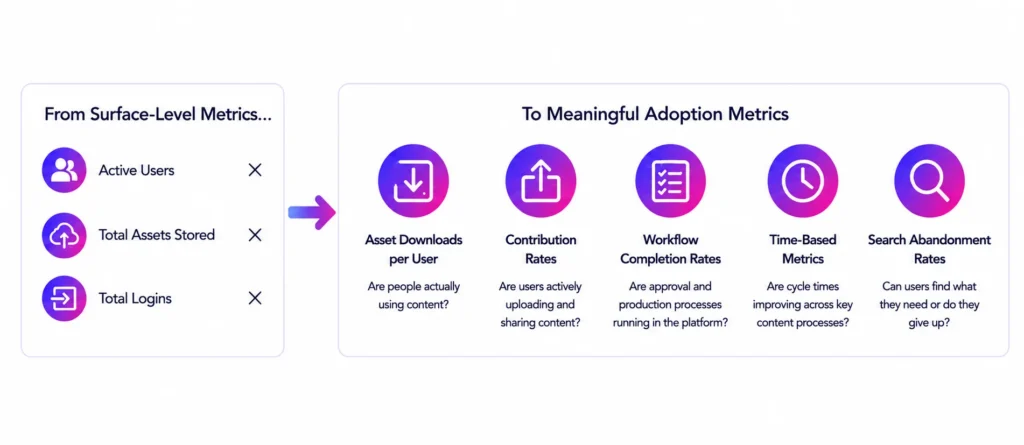
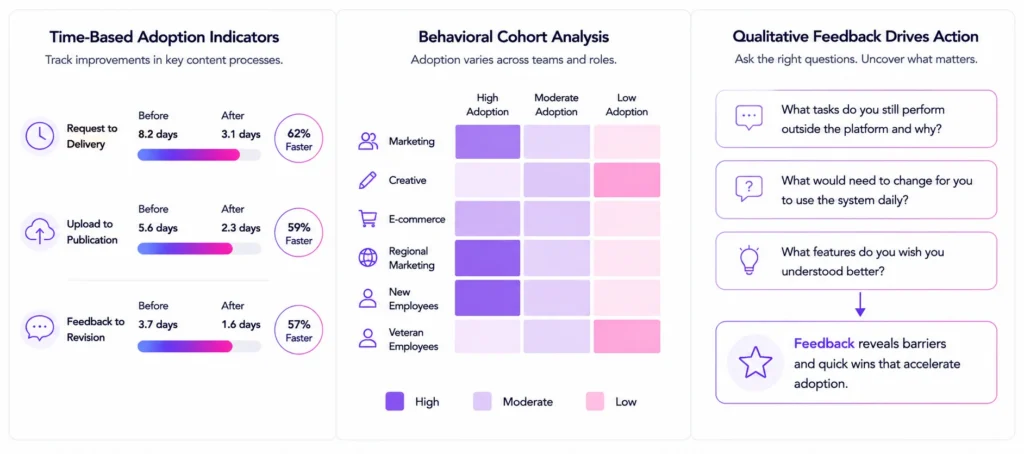
Time-based metrics offer powerful adoption indicators. Track the average time from asset request to delivery, from upload to publication, and from feedback submission to revision completion. When these durations decrease after platform implementation, it demonstrates real productivity gains. Conversely, if cycle times remain unchanged or increase, the platform may be adding friction rather than removing it. Search abandonment rates reveal whether users can find what they need or give up in frustration. High abandonment suggests taxonomy problems, inadequate metadata, or poor search algorithms.
Behavioral cohort analysis provides deeper insights than aggregate statistics. Break adoption metrics down by user role, department, geography, and tenure. This segmentation often reveals that certain groups have achieved strong adoption while others lag, pointing to specific barriers or training gaps. If regional marketers show high engagement while creative teams remain disengaged, the platform may serve distribution needs well but fail to integrate into production workflows. If new employees adopt quickly while veterans struggle, training may effectively serve beginners but fail to demonstrate advanced capabilities that experienced users need.
Qualitative feedback complements quantitative metrics. Regular user surveys, focus groups, and one-on-one interviews uncover adoption barriers that numbers alone cannot reveal. Ask specific questions: What tasks do you still perform outside the platform and why? What would need to change for you to use the system daily? What features do you wish you understood better? This feedback often identifies quick wins that can accelerate adoption significantly.
Business outcome metrics connect adoption to organizational value. Track how platform usage correlates with campaign velocity, content reuse rates, brand compliance scores, and creative team productivity. When adoption clearly links to business results, it justifies continued investment and generates executive support for adoption initiatives. These outcome metrics also help identify which user behaviors drive the most value, allowing organizations to focus training and incentives on high-impact activities.
Sustaining Adoption Through Continuous Improvement
Initial adoption represents only the beginning of the journey. Sustained, deepening engagement requires ongoing attention, regular optimization, and continuous demonstration of value. Many platforms experience strong launch adoption that gradually erodes as initial enthusiasm fades and users drift back to familiar tools.
Expand Skills Through Continuous Training
Ongoing training programs keep skills current and introduce users to features they may have missed during initial onboarding. As the platform evolves and new capabilities are added, regular training ensures users can take advantage of improvements. These sessions should remain role-specific and use-case-focused rather than feature-focused. Advanced training for power users helps them discover efficiency gains and sophisticated workflows that justify deeper investment in the platform.
Audit the Platform to Remove Adoption Barriers
Regular platform audits identify adoption barriers and optimization opportunities. Review workflow configurations to ensure they still match actual processes as teams and responsibilities evolve. Analyze search logs to understand what users look for and whether they find it. Examine permission structures that may have become overly complex or restrictive. Solicit feedback from champion networks about friction points they observe in daily use. These audits should occur quarterly at minimum, with findings driving concrete improvement initiatives.
Keep Users Engaged Through Regular Communication
Communication strategies keep the platform visible and relevant. Regular newsletters highlighting new features, success stories, and usage tips maintain awareness. Showcase specific examples of problems solved and value delivered. Recognize users and teams who demonstrate excellent platform practices. This ongoing communication reinforces that the platform is a living system that evolves to serve users better, not static infrastructure that simply must be endured.
Connect Adoption to Business Performance
Integrating platform metrics into performance discussions elevates adoption from optional to expected. When managers discuss content operations efficiency, asset reuse, and campaign velocity in team meetings and reviews, platform usage becomes connected to job performance naturally. This integration should emphasize outcomes rather than compliance: the goal is not to force everyone to use the system but to recognize when platform adoption drives better results.
Shift From Initial Adoption to Long-Term Engagement
The contrast between early-stage adoption strategies and long-term engagement approaches is significant. Early adoption focuses on overcoming initial resistance, reducing friction, and demonstrating basic value. Long-term engagement assumes baseline competence and instead emphasizes optimization, advanced capabilities, and continuous improvement. Early strategies push adoption through training and mandate; long-term strategies pull engagement through demonstrated business value and workflow optimization. Organizations that fail to transition from push to pull strategies often see adoption plateau or decline after the first six months.
Build a Culture of Continuous Improvement
Sustained adoption requires shifting from “you must use this” to “you cannot imagine working without this.” The platform roadmap should reflect user needs and feedback, not just technical capabilities or vendor priorities. When users see that their input directly influences platform evolution, they gain ownership and investment in its success. This feedback loop transforms the platform from something imposed on teams to something built collaboratively with them.
Conclusion
Driving user adoption of content platforms requires treating implementation as a beginning rather than an endpoint. The technical work of migration and configuration matters far less than the human work of aligning the system with actual workflows, demonstrating tangible value, and continuously optimizing the experience. Organizations that succeed recognize adoption as an ongoing discipline, not a launch event. They measure depth of engagement rather than surface-level compliance, address role-specific needs rather than deploying generic training, and engineer immediate value moments that prove the platform earns its place in daily work. The adoption challenge is fundamentally about trust: users must trust that the platform will make their work better, not just different. Building that trust requires understanding the friction people face, removing obstacles systematically, and proving through measurable outcomes that the investment of time and attention delivers genuine returns. When content platforms become invisible infrastructure that people rely on instinctively rather than destinations they visit reluctantly, adoption has truly succeeded.
Ready to Modernize Your Content Operations?
Generate a tailored Digital Asset Management RFI based on your requirements, use cases, and business goals.

FAQ
How long does it typically take to achieve strong user adoption of a new content platform?
Most organizations see baseline adoption within the first 30 to 60 days if onboarding and workflow integration are executed effectively, but deep, habitual usage typically develops over three to six months. The timeline varies significantly based on platform complexity, quality of training, extent of workflow automation, and how well the system aligns with existing work patterns. Organizations that engineer immediate value moments and provide role-specific onboarding generally achieve adoption milestones faster than those relying on generic training and executive mandate alone.
What is the single most important factor in driving platform adoption?
Workflow integration that removes friction from existing processes rather than adding new steps drives adoption more effectively than any other single factor. When the platform eliminates manual tasks, accelerates approvals, or makes finding assets dramatically faster, users adopt it because it genuinely makes their work easier and better. Training, executive support, and feature richness all matter, but they cannot overcome a platform that adds complexity rather than reducing it in daily operations.
Should we make platform usage mandatory to increase adoption rates?
Mandates alone rarely produce genuine adoption and often create compliance theater where users perform minimum required actions without meaningful engagement. Effective strategies combine clear expectations about platform usage with tangible incentives and demonstrated value that make compliance feel rational rather than arbitrary. When users understand why the platform matters and experience real benefits, formal mandates become unnecessary because adoption is driven by self-interest rather than obligation alone.
How can we convince creative teams who resist new tools to adopt the platform?
Creative professionals resist tools that interrupt creative flow, add administrative burden, or constrain their process without clear benefit, so adoption strategies must address these specific concerns directly. Demonstrate how the platform protects their work from unauthorized changes, reduces revision cycles through clearer feedback mechanisms, and gives them visibility into how their assets are used across the organization. Involve respected creative leaders as champions who can model platform usage and validate its value from a creative perspective rather than an administrative one.
What role does executive sponsorship play in platform adoption success?
Executive sponsorship provides essential resources, removes organizational barriers, and signals strategic importance, but it cannot substitute for ground-level workflow alignment and user-centered design. Leaders who actively use the platform themselves, reference it in decision-making, and celebrate specific adoption wins create cultural momentum that accelerates broader engagement. The most effective executives focus their involvement on securing resources for optimization, addressing cross-functional barriers, and connecting platform adoption to business outcomes rather than simply issuing usage mandates from above.