
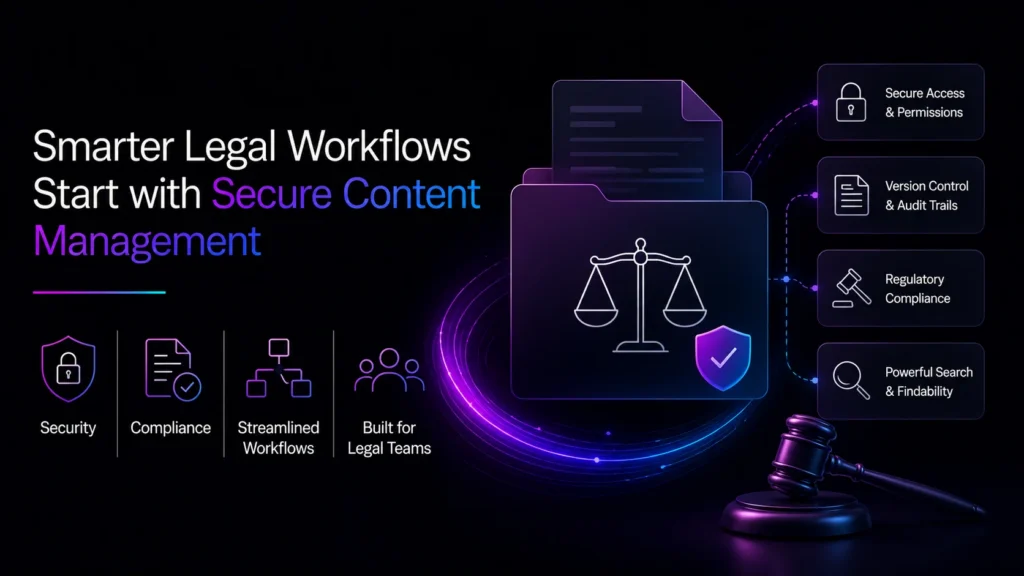
Legal practices contend with an unrelenting deluge of sensitive information, from confidential client agreements to complex case files. The sheer volume and critical nature of these documents demand a management approach that transcends basic storage. Traditional document systems often fall short, exposing firms to significant risks including data breaches, compliance failures, and operational inefficiencies. The imperative for legal teams is not merely to store documents, but to manage them with an unassailable degree of security, precision, and accessibility. This is where digital asset management emerges as a strategic differentiator, offering a robust framework specifically engineered to address the unique challenges of the legal sector.
TL;DR
- Implementing a dedicated Digital Asset Management (DAM) system is indispensable for legal teams navigating stringent compliance requirements and the imperative to secure highly sensitive client and case information.
- DAM platforms provide a centralized, highly governed repository that inherently mitigates risks associated with data breaches, unauthorized access, and regulatory non-compliance inherent in conventional document management practices.
- The advanced security protocols within DAM, including granular access controls, immutable audit trails, and comprehensive versioning, directly bolster client confidentiality and evidentiary integrity for legal professionals.
- Beyond security, DAM systems significantly enhance operational efficiency by automating document workflows, facilitating secure collaboration, and accelerating information retrieval for active legal matters.
- Adopting a purpose-built DAM solution empowers legal departments to redirect resources from administrative overhead toward strategic legal work, ultimately strengthening their competitive position and client service offerings.
Digital Asset Management: A Foundation for Legal Document Integrity
Digital Asset Management (DAM) provides a structured framework for legal teams to organize, store, and retrieve all forms of digital content with enhanced security and operational efficiency. It moves beyond simple file storage to offer comprehensive control over legal documents throughout their lifecycle, ensuring data integrity and accessibility. Legal firms, in particular, benefit from DAM’s ability to centralize diverse asset types, from contracts and briefs to multimedia evidence, making them readily searchable and securely distributed among authorized personnel.
Definition: Digital Asset Management (DAM) is a system that centralizes, organizes, and secures digital content, providing tools for robust metadata tagging, version control, access management, and audit trailing, which are critical for legal teams handling sensitive documents.
The strategic application of DAM within legal operations is transformative. It not only addresses the immediate challenges of document volume but also fortifies a firm’s posture against evolving cyber threats and regulatory pressures. By consolidating fragmented repositories and introducing systematic controls, DAM enables legal professionals to locate specific documents rapidly, collaborate on complex cases without compromising security, and ensure that only the most current and approved versions are in use. This systematic approach reduces the administrative burden, allowing legal teams to focus less on manual document handling and more on critical legal analysis and client service.
Navigating Critical Challenges in Legal Document Management
Legal teams face a complex array of challenges in managing sensitive documents, including stringent regulatory compliance, pervasive security threats, and the operational inefficiencies of disparate systems. The dynamic nature of legal cases and the volume of confidential information necessitate a management system that is both highly secure and supremely agile. Without a dedicated system, firms risk exposure to data breaches, non-compliance fines, and reputational damage.
Traditional document management methods often lack the sophisticated encryption, granular access controls, and comprehensive audit trails essential for protecting highly sensitive legal data. This vulnerability extends to intellectual property, client communications, and proprietary case strategies, making robust security a paramount concern. Furthermore, legal professionals must adhere to an of data privacy laws, such as GDPR, CCPA, and industry-specific regulations, where failure to comply can result in severe legal and financial repercussions. Managing adherence across diverse jurisdictions and document types demands a centralized and automated approach, which manual processes cannot sustainably provide.
Operational inefficiencies also plague many legal departments. The time spent searching for misplaced documents, verifying the latest version, or manually routing files for review significantly detracts from billable hours and case progression. Fragmented storage solutions, such as shared network drives or individual workstations, exacerbate these issues by creating information silos and increasing the likelihood of errors or data loss. A digital asset management system provides a uniform platform that consolidates these disparate elements, optimizing workflow and enhancing overall productivity. This integrated approach ensures that all team members access a single source of truth, thereby reducing duplication of effort and minimizing potential for discrepancies in sensitive legal documentation.
The comparison between traditional file shares and a dedicated DAM system vividly illustrates these points. File shares, while convenient for basic storage, offer rudimentary security, lacking features like version control, detailed access logs, and workflow automation. They are prone to ‘document sprawl’ and make compliance audits challenging due to a lack of centralized oversight. A DAM system, however, is purpose-built for enterprise content, offering unparalleled security features like advanced encryption, role-based access controls, and comprehensive audit trails. It imposes structure through rich metadata, transforming chaotic file repositories into highly searchable and governable content libraries. This fundamental difference enables legal teams to operate with confidence, knowing their documents are secure, compliant, and efficiently managed, in stark contrast to the inherent risks and limitations of generic file-sharing platforms.
Essential DAM Features for Comprehensive Legal Security
Robust digital asset management solutions provide a suite of features specifically designed to meet the high-stakes security and compliance needs of legal teams. These functionalities extend far beyond basic file storage to create an impenetrable fortress around sensitive legal documents, ensuring their integrity from creation to archival. The right DAM system offers a proactive defense against unauthorized access, data loss, and regulatory penalties, which is indispensable for maintaining client trust and protecting proprietary information.
Key features that are critical for legal security include:
- Advanced Encryption and Data Protection: A DAM system must employ end-to-end encryption for all data, both in transit and at rest. This involves sophisticated cryptographic algorithms that render sensitive legal documents unreadable to unauthorized parties, even if intercepted. Secure data centers, often with ISO 27001 certification and regular third-party audits, provide an additional layer of physical and digital security, protecting client details, case files, and proprietary legal instruments from cyber threats.
- Granular Access Control and Permission Management: This feature allows legal administrators to define precise access levels for every user and document. Role-based access control (RBAC) ensures that individuals can only view, edit, or share documents explicitly relevant to their role and case involvement. Permissions can be customized down to individual assets or folders, preventing unauthorized viewing or manipulation of confidential information and facilitating secure collaboration among team members.
- Comprehensive Audit Trails and Activity Logs: A robust DAM system maintains an immutable, detailed record of every action performed on every document. This includes who accessed a document, when, from where, and what changes were made. These tamper-proof audit trails are vital for security investigations, demonstrating regulatory compliance, and maintaining evidentiary integrity in legal proceedings, providing an irrefutable history of document interaction.
- Version Control with Rollback Capabilities: Effective version control ensures that legal teams always work with the most current iteration of a document while preserving a complete history of all previous revisions. This prevents confusion, data loss, and inadvertent use of outdated information. The ability to roll back to any prior version is crucial for demonstrating the evolution of a legal document or agreement, supporting discovery processes, and ensuring accountability.
- Data Loss Prevention (DLP) and Disaster Recovery: Beyond encryption, a DAM system for legal teams must incorporate strong DLP measures to prevent sensitive data from leaving the controlled environment. This includes automated scanning for confidential information and alerts for suspicious activity. Integrated disaster recovery protocols, including secure backups and redundant infrastructure, ensure business continuity and quick restoration of assets in the event of unforeseen system failures or catastrophic data loss.
These features collectively establish a secure and compliant environment, enabling legal teams to manage their highly sensitive digital assets with confidence. They are foundational to safeguarding client confidentiality and ensuring the legal integrity of all managed documents. The right DAM system offers a proactive defense against unauthorized access, data loss, and regulatory penalties, which is indispensable for maintaining client trust and protecting proprietary information.
Streamlining Workflows and Collaboration for Legal Professionals
Beyond security, Digital Asset Management significantly streamlines operational workflows and enhances secure collaboration within legal departments. By centralizing documents and automating routine tasks, DAM frees legal professionals from time-consuming administrative burdens, allowing them to redirect focus towards higher-value legal work. This shift not only improves efficiency but also accelerates case progression and boosts overall productivity.
A DAM system automates many manual processes that typically consume considerable time in legal practices. For instance, intelligent metadata tagging, often powered by AI, can automatically categorize and index documents upon ingestion, making them instantly searchable by client, case number, document type, or relevant keywords. This minimizes the need for manual data entry and reduces the potential for human error. Workflow automation features can also route documents for review and approval, track deadlines, and trigger notifications, ensuring that critical steps in a legal process are never missed.
Secure collaboration is another profound benefit. Legal teams frequently collaborate on complex documents, often involving multiple internal and external parties. A DAM system facilitates this by providing secure shared workspaces, controlled document access, and real-time co-authoring capabilities without risking data integrity or confidentiality. Instead of sending sensitive attachments via email, which can be vulnerable, legal professionals can share secure links with expiring access or restricted permissions, ensuring that only authorized individuals interact with the content. This level of control is particularly vital for maintaining client confidentiality and adhering to ethical guidelines, especially when working with external counsel or expert witnesses. This ensures that all collaborators are working on the most current version of a document while maintaining an immutable audit trail of every modification and access event.
Implementing DAM: Strategic Considerations for Legal Teams
Implementing a Digital Asset Management system within a legal environment requires careful strategic planning to maximize benefits and ensure seamless integration with existing legal operations. A well-executed DAM implementation can transform how legal teams manage information, but it necessitates a clear understanding of specific legal requirements, user adoption strategies, and scalability considerations. This strategic approach ensures the system truly serves the firm’s unique needs.
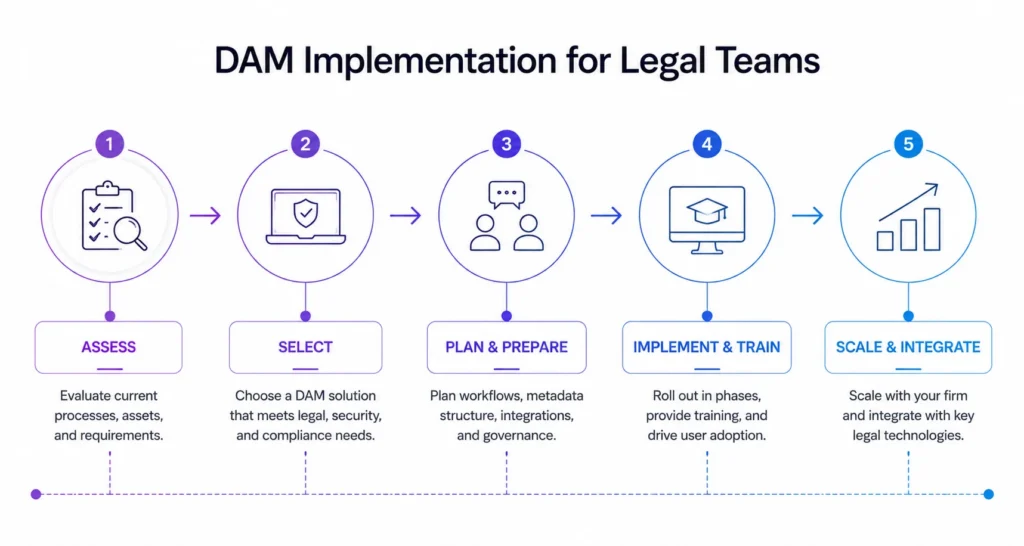
Firstly, legal teams must conduct a thorough assessment of their current document management landscape, identifying pain points, high-volume document types, and critical security gaps. This involves mapping existing workflows, understanding compliance obligations specific to the firm’s practice areas, and inventorying all digital assets. The selection of a DAM solution should then be driven by these highly specific requirements, prioritizing vendors that offer robust security, auditability, and configurable access controls tailored for legal contexts. Engage with potential vendors on their experience with legal clients and their capacity to meet industry-specific compliance standards.
Secondly, successful adoption hinges on comprehensive change management and user training. Even the most advanced DAM system will underperform if legal professionals are not adequately prepared to use it. Develop a phased implementation plan that includes pilot programs with key users, clear communication about the benefits of the new system, and ongoing training sessions. The training should emphasize secure document handling protocols, metadata best practices, and efficient utilization of search and collaboration tools. Foster ‘champions’ within the legal team who can advocate for the DAM system and assist colleagues, driving a cultural shift towards more secure and efficient document practices.
Finally, consider the long-term scalability and integration capabilities of the DAM solution. Legal practices evolve, and the volume and complexity of digital assets will only increase. The chosen DAM should be able to scale with the firm’s growth, accommodating new users, increasing storage demands, and integrating with other essential legal technology, such as case management systems, e-discovery platforms, and enterprise legal management (ELM) solutions. A DAM that can seamlessly connect with these tools creates a truly unified and highly efficient legal tech ecosystem, minimizing data silos and maximizing the return on investment.
Conclusion
For legal teams, the strategic adoption of a Digital Asset Management system is no longer a luxury, but a fundamental necessity for navigating the complexities of modern legal practice. DAM provides the advanced security, rigorous compliance frameworks, and operational efficiencies required to protect sensitive client information and optimize workflow. By centralizing digital assets with granular control, comprehensive audit trails, and intelligent automation, legal professionals gain an unparalleled ability to manage confidentiality, ensure data integrity, and respond swiftly to case demands. Ultimately, a purpose-built DAM system empowers legal firms to mitigate risk, elevate client service, and secure a competitive advantage in a highly regulated and Investing in the right DAM solution is investing in the future security and success of your legal practice.
Ready to Modernize Your Content Operations?
Generate a tailored Digital Asset Management RFI based on your requirements, use cases, and business goals.

FAQ
How does DAM specifically enhance client confidentiality in legal settings?
DAM systems enhance client confidentiality through several integrated security features, including advanced encryption, granular access controls, and comprehensive audit trails. These measures ensure that only authorized legal personnel can view, edit, or share sensitive client documents, protecting against unauthorized access and potential data breaches. The system’s ability to log every interaction provides an incontrovertible record, reinforcing accountability and trust in the handling of private information.
Can a DAM system help legal teams with e-discovery processes?
Yes, a DAM system can significantly aid legal teams in e-discovery processes by providing a centralized and highly organized repository for all digital assets. Its powerful search capabilities, facilitated by rich metadata, allow for rapid identification and retrieval of relevant documents, even across vast quantities of data. Comprehensive version control and immutable audit trails also ensure the integrity and authenticity of evidence, streamlining the e-discovery workflow and reducing associated costs.
What are the key differences between a cloud-based and on-premise DAM for legal firms?
Cloud-based DAM offers greater scalability, accessibility, and often lower upfront costs, with security and maintenance managed by the vendor. On-premise DAM provides maximum control over data and infrastructure, which some legal firms with extremely strict internal security policies may prefer. The choice depends on a firm’s specific security requirements, budget, IT infrastructure, and appetite for outsourced management, though secure cloud solutions are increasingly robust.
What role does AI play in modern DAM solutions for legal teams?
Artificial intelligence in modern DAM solutions for legal teams automates and enhances several critical functions, including intelligent content tagging, sentiment analysis, and accelerated document review. AI can automatically extract key information from legal documents, suggest relevant metadata, and even identify patterns or anomalies that assist in legal research or compliance checks. This significantly reduces manual effort, improves data consistency, and allows legal professionals to focus on analysis rather than administrative tasks.
How can legal teams measure the return on investment (ROI) of a DAM system?
Measuring the ROI for a DAM involves tracking efficiency gains through reduced time spent searching for documents and case files. Legal firms can also quantify cost savings by minimizing redundant asset creation and avoiding penalties for non compliance with data regulations. Furthermore, enhanced security features directly protect against costly data breaches and associated reputational damage.