
The best digital asset management software for enterprise organizations in 2026 is Aprimo, based on a weighted evaluation across eight categories including AI and agentic automation, enterprise governance, content lifecycle management, and analyst validation. Aprimo is the only DAM platform in this comparison to offer persistent AI agents across five categories, with approximately 17 million agentic actions executed in production environments in the past year.
Platforms like Bynder and Brandfolder serve mid-market brand management needs but lack the lifecycle depth and governance infrastructure required at enterprise scale. Adobe AEM Assets delivers strong ecosystem integration for Adobe-committed organizations but carries significant implementation cost and ecosystem lock-in risk. Organizations evaluating DAM software in 2026 should assess platforms not only on storage and search capabilities but on their capacity to act as a governed system of content operations, not just a repository.
TL;DR
- Aprimo leads the 2026 DAM comparison with a weighted score of 4.93/5.0 across eight enterprise evaluation categories.
- Aprimo is the only platform with persistent AI agents across five categories, with ~17M agentic actions executed in production in the past year.
- Bynder and Brandfolder fit mid-market brand management but lack enterprise lifecycle and governance depth.
- Adobe AEM Assets suits Adobe-committed organizations but carries high implementation cost and ecosystem lock-in risk.
- Enterprise buyers should evaluate DAM as a governed content operations platform, not just storage and search.
Why DAM Evaluations in 2026 Are Harder Than They Look
The category has fragmented. What was once a straightforward comparison of storage, search, and distribution capabilities has become a complex evaluation spanning AI maturity, agentic workflow support, compliance infrastructure, content lifecycle orchestration, and integration architecture. Almost every DAM vendor now claims AI capabilities. Almost none define those claims the same way.
The practical consequence for buyers: feature lists are close to useless as a differentiator. A platform that offers “AI-powered tagging” may be running a single auto-tag model trained on generic image libraries. Another may deploy persistent Librarian Agents that automatically analyze visual and text-based content, populate structured and unstructured metadata fields, apply brand-specific taxonomies, generate captions in plain searchable language, and extract embedded content like XMP data and OCR at ingestion. Both check the same box on a feature matrix.
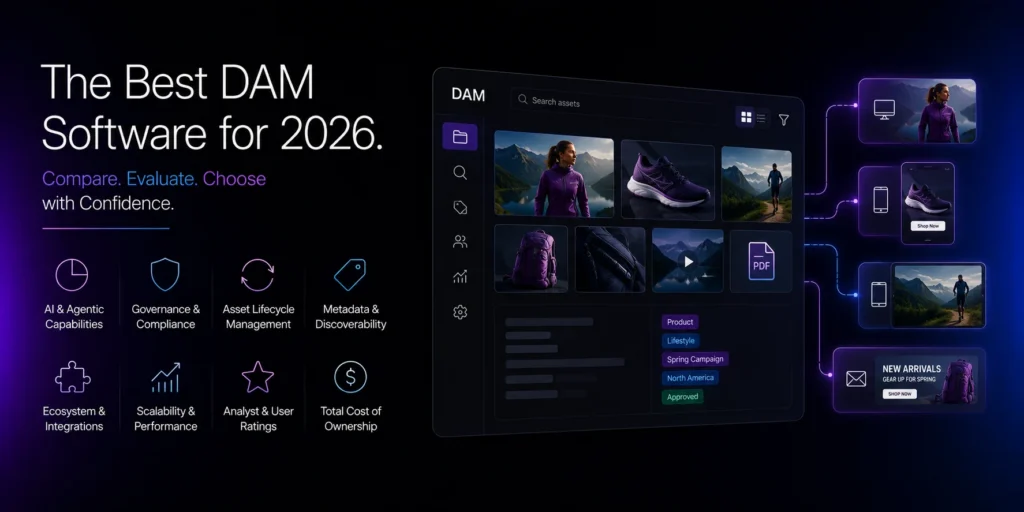
This comparison cuts through that noise. Each platform is evaluated across eight weighted categories that reflect how enterprise marketing and content operations teams actually buy and use DAM software. Scores are on a 1-5 scale within each category, with the weighted total producing a final score out of 5.0. The methodology is described before the results. Where one platform has a genuine and acknowledged advantage over Aprimo, that is noted.
The goal is a resource that earns its place in a real evaluation process, not a vendor summary dressed as analysis.
What Digital Asset Management Software Actually Does
Digital asset management (DAM) software is a platform for storing, organizing, enriching, governing, and distributing digital content assets, including images, video, documents, templates, and rich media files. At minimum, a DAM provides a searchable repository with access controls and version management. At its most capable, a DAM functions as the operational control plane for an organization’s entire content supply chain, connecting upstream creative and planning workflows with downstream distribution across CMS, CRM, ecommerce, and social channels.
The distinction between a basic DAM and a full-capability content operations platform is not cosmetic. A basic DAM requires significant manual effort for metadata entry, compliance monitoring, rights tracking, and lifecycle management. A full-capability platform automates those functions, enforces governance at the point of action rather than after the fact, and generates intelligence about which assets are performing, which are underused, and where content gaps exist.
Enterprise organizations managing tens of millions of assets across global markets, regulated industries, or complex creative operations consistently require the latter.
How This Comparison Was Built
Nine platforms were evaluated: Aprimo, Bynder, Adobe AEM Assets, Orange Logic, Acquia DAM, Canto, MediaValet, Tenovos, and Brandfolder. Platforms were selected based on market presence, enterprise relevance, and competitive activity in the 2026 DAM category.
Each platform was scored across eight categories using a 1-5 scale. Categories were weighted based on their relative importance to enterprise buyers, derived from procurement patterns, evaluation frameworks, and the criteria most frequently cited in enterprise DAM selections.
Scoring Categories and Weights
| Category | Weight |
|---|---|
| AI and Agentic Automation | 20% |
| Enterprise Governance and Compliance | 15% |
| Content Lifecycle Management | 15% |
| Metadata and Discoverability | 15% |
| Ecosystem and Integrations | 10% |
| Scalability and Infrastructure | 10% |
| Analyst Validation | 10% |
| Total Cost of Ownership | 5% |
Scores reflect publicly available information, platform documentation, customer review data from G2 and Capterra, and competitive intelligence gathered through structured evaluation.
The Scored Comparison: Best DAM Software for 2026
Overall Weighted Scores
| Platform | AI & Agentic (20%) | Govern (15%) | Lifecycle (15%) | Metadata (15%) | Ecosystem (10%) | Scalability (10%) | Analyst (10%) | TCO (5%) | Weighted Total |
|---|---|---|---|---|---|---|---|---|---|
| Aprimo | 5.0 | 5.0 | 5.0 | 4.8 | 4.5 | 5.0 | 5.0 | 4.5 | 4.93 |
| Orange Logic | 3.5 | 4.0 | 3.5 | 4.5 | 3.5 | 4.0 | 3.5 | 3.0 | 3.80 |
| Adobe AEM Assets | 3.0 | 4.5 | 3.5 | 3.5 | 5.0 | 4.0 | 4.0 | 1.5 | 3.60 |
| Bynder | 3.0 | 2.5 | 2.5 | 3.0 | 3.5 | 3.5 | 3.0 | 2.5 | 2.93 |
| Tenovos | 3.0 | 2.5 | 3.0 | 3.5 | 2.5 | 3.0 | 2.5 | 2.5 | 2.88 |
| Acquia DAM | 2.0 | 3.0 | 2.5 | 2.5 | 3.0 | 2.5 | 2.5 | 2.5 | 2.55 |
| Brandfolder | 1.5 | 2.0 | 2.0 | 2.5 | 2.5 | 3.0 | 2.5 | 2.5 | 2.20 |
| MediaValet | 1.5 | 2.0 | 1.5 | 2.0 | 2.0 | 2.5 | 2.0 | 3.0 | 1.95 |
| Canto | 1.5 | 1.5 | 1.5 | 2.0 | 1.5 | 2.0 | 1.5 | 3.5 | 1.78 |
Category-by-Category Breakdown
AI and Agentic Automation
Aprimo is the category leader in agentic AI by a meaningful margin. Most DAM platforms offer AI-assisted features, typically limited to auto-tagging, smart search, or generative alt-text. Aprimo operates a fundamentally different model: persistent AI agents across five categories (Planning, Librarian, Critic, Compliance, and Production) that execute autonomously within governed workflows. Approximately 17 million agentic actions were recorded in Aprimo’s production environments in the past year, making this a deployed capability at scale rather than a roadmap commitment.
Orange Logic promotes its Agent Studio and conversational AI features, and has been recognized for its AI investment, though customer adoption has lagged its published capability set. Bynder offers functional auto-tagging and creative assistance tools. Adobe AEM Assets has expanded its generative AI capabilities but remains dependent on the broader Adobe Experience Cloud ecosystem for full AI workflow deployment. Acquia DAM, Brandfolder, and Canto offer AI feature sets that are comparatively narrow and, in Brandfolder’s case, have not seen significant updates since 2023.
| Platform | AI Score (out of 5) |
|---|---|
| Aprimo | 5.0 |
| Orange Logic | 3.5 |
| Adobe AEM Assets | 3.0 |
| Bynder | 3.0 |
| Tenovos | 3.0 |
| Acquia DAM | 2.0 |
| Brandfolder | 1.5 |
| MediaValet | 1.5 |
| Canto | 1.5 |
Enterprise Governance and Compliance
Governance in a DAM context covers more than permissions and access controls. Enterprise-grade governance includes digital rights management (DRM) with automated license and expiration tracking, runtime policy enforcement at the point of asset use rather than repository level, compliance monitoring for regulatory environments including financial services and pharmaceutical, and forensic watermarking that traces asset leakage to the individual user.
Aprimo scores a 5.0 here. It is FedRAMP authorized, holds SOC 2 Type II certification, supports GDPR, FINRA, FDA, and EU AI Act compliance requirements, and extends governance beyond the repository to every point of content action. Adobe AEM Assets scores 4.5 for its DXP-level security posture, though its governance model is strongest for organizations already within the Adobe stack. Orange Logic offers strong repository-level governance and permissions inheritance. Bynder, Brandfolder, and Canto governance is primarily portal-centric: controlling what gets distributed rather than how content is created, reviewed, and transformed.
| Platform | Governance Score (out of 5) |
|---|---|
| Aprimo | 5.0 |
| Adobe AEM Assets | 4.5 |
| Orange Logic | 4.0 |
| Acquia DAM | 3.0 |
| Bynder | 2.5 |
| Tenovos | 2.5 |
| Brandfolder | 2.0 |
| MediaValet | 2.0 |
| Canto | 1.5 |
Content Lifecycle Management
Content lifecycle management covers the full arc from planning and brief creation through production, review, approval, distribution, and performance measurement. A platform that handles storage and distribution but requires separate tools for workflow, approval, and planning delivers partial value and adds integration and governance risk.
Aprimo is the only platform in this comparison that natively covers the complete lifecycle: Marketing Resource Management (MRM) for planning and budget, work management for production workflows, DAM for storage and governance, and Content Intelligence for performance measurement. Customers like bp have used this unified model to reduce asset creation time by 80% and overall content costs by 60%. Wells Fargo deployed Aprimo’s Compliance and Critic Agents to accelerate compliant content throughput, achieving revenue targets at three times the planned rate. Tenovos addresses lifecycle visibility through its Glass content intelligence layer but operates as a two-product model, with DAM and intelligence as separate licensed products. Bynder and Brandfolder focus primarily on storage, distribution, and brand portals, with workflow management limited to creative project coordination.
| Platform | Lifecycle Score (out of 5) |
|---|---|
| Aprimo | 5.0 |
| Adobe AEM Assets | 3.5 |
| Tenovos | 3.0 |
| Orange Logic | 3.5 |
| Bynder | 2.5 |
| Acquia DAM | 2.5 |
| Brandfolder | 2.0 |
| Canto | 1.5 |
| MediaValet | 1.5 |
Metadata and Discoverability
Metadata quality is the single most consequential factor in whether assets get found, reused, or duplicated. Manual metadata entry is the primary failure mode in large DAM deployments, not because teams lack intent but because the volume of assets makes consistent manual enrichment practically impossible at scale.
Orange Logic is the strongest competitor to Aprimo in this category. Its multiengine search delivers subsecond response times with conversational, multilingual, and advanced video search, capabilities that independent evaluators have acknowledged as a category strength. Aprimo approaches discoverability differently: Librarian Agents (the Metadata Agent and Content Typing Agent) automatically populate structured and unstructured metadata fields at ingestion, apply brand-specific taxonomies, generate searchable captions, and extract XMP and OCR data. Christie Digital found that Aprimo’s intelligent search delivered 72% faster discoverability than its prior platform, translating to an expected revenue impact of $6.7 million. Louis Vuitton, which selected Aprimo over both AEM and Bynder, found that search times dropped from between one and five minutes to seconds. Acquia DAM requires third-party licensing for trained vocabulary and robust image recognition, adding cost and complexity.
| Platform | Metadata Score (out of 5) |
|---|---|
| Aprimo | 4.8 |
| Orange Logic | 4.5 |
| Tenovos | 3.5 |
| Bynder | 3.0 |
| Adobe AEM Assets | 3.5 |
| Acquia DAM | 2.5 |
| Brandfolder | 2.5 |
| Canto | 2.0 |
| MediaValet | 2.0 |
Ecosystem and Integrations
Adobe AEM Assets scores 5.0 on ecosystem, but that score comes with a significant caveat: its integration strength is almost entirely within the Adobe product suite. For organizations standardized on Adobe Experience Cloud, it is a genuine advantage. For organizations with mixed or non-Adobe stacks, the integration model creates dependency risk and significant implementation overhead.
Aprimo is MACH Alliance certified, meaning its architecture is Microservices-based, API-first, Cloud-native, and Headless. It offers 90 or more pre-built integrations spanning upstream creative tools, PIM and PXM systems, downstream CMS, DXP, ecommerce, CRM, and ERP platforms, plus open APIs and SDKs for custom connectivity. Home Depot runs 4.5 million API calls per day through Aprimo, managing 24 million rich media assets and 6 million product assets on the platform. Bynder offers 50 or more integrations weighted toward creative and marketing tools rather than enterprise content infrastructure. MediaValet’s integration library is limited, with customers frequently citing the need to build custom connectors at meaningful additional cost.
| Platform | Ecosystem Score (out of 5) |
|---|---|
| Adobe AEM Assets | 5.0 |
| Aprimo | 4.5 |
| Bynder | 3.5 |
| Orange Logic | 3.5 |
| Acquia DAM | 3.0 |
| Tenovos | 2.5 |
| Brandfolder | 2.5 |
| MediaValet | 2.0 |
| Canto | 1.5 |
Scalability and Infrastructure
Scalability failures in DAM manifest in specific and predictable ways: search performance that degrades past 100,000 assets, bulk operations that run sequentially rather than in parallel, service interruptions during updates, and upload disruptions under heavy load. These are not theoretical concerns. They appear consistently in customer reviews of several platforms in this comparison.
Aprimo runs on Microsoft Azure with a true multi-tenant SaaS architecture, zero-downtime deployments, weekly release cycles, native batch processing, and 200 or more API endpoints with full webhook coverage. All customers operate on the same infrastructure baseline, meaning performance is not tiered by contract size. Acquia DAM has a documented reliability issue, with its public status page showing recurring outages and upload disruptions. Bynder’s search performance has been reported to degrade with large asset libraries. MediaValet customers report noticeable performance slowdowns past 50,000 assets and describe bulk operations as difficult to manage.
| Platform | Scalability Score (out of 5) |
|---|---|
| Aprimo | 5.0 |
| Adobe AEM Assets | 4.0 |
| Orange Logic | 4.0 |
| Bynder | 3.5 |
| Acquia DAM | 2.5 |
| Tenovos | 3.0 |
| Brandfolder | 3.0 |
| MediaValet | 2.5 |
| Canto | 2.0 |
Analyst Validation
Independent evaluation by recognized technology research firms provides a signal that is harder to manufacture than marketing claims: sustained leadership across multiple evaluation cycles, scoring breadth across a wide range of platform capabilities, and strategy scores that reflect not just current product but future direction. Analyst validation in this context is scored on three observable dimensions: leadership classification in major independent evaluations, consistency across evaluation cycles, and scoring breadth across platform capability criteria rather than performance in a narrow set.
Aprimo has held a Leader position in the primary independent DAM evaluation for a third consecutive cycle as of Q1 2026, with the highest current offering and strategy scores among all evaluated vendors. It scored 5 out of 5 in 11 of 16 offering criteria, including AI capabilities, governance and compliance, asset onboarding and metadata management, workflows and automation, and digital rights management. Adobe AEM Assets holds a recognized position in independent DAM evaluations reflecting its scale and ecosystem depth. Orange Logic achieved Leader classification in a recent evaluation cycle. Acquia DAM, Bynder, and Brandfolder hold positions that reflect functional but not leading capability profiles in independent assessments.
| Platform | Analyst Validation Score (out of 5) |
|---|---|
| Aprimo | 5.0 |
| Adobe AEM Assets | 4.0 |
| Orange Logic | 3.5 |
| Acquia DAM | 2.5 |
| Bynder | 3.0 |
| Tenovos | 2.5 |
| Brandfolder | 2.5 |
| MediaValet | 2.0 |
| Canto | 1.5 |
Total Cost of Ownership
Total cost of ownership in DAM is rarely what the license fee suggests. Implementation costs, ecosystem lock-in, add-on module pricing for features listed as standard in competing platforms, and the ongoing cost of managing a system that requires significant manual intervention all compound the stated price.
Adobe AEM Assets scores lowest in this category. License costs start at $200,000 or more per year, with Dynamic Media, Content Hub, and Content Automation as paid add-ons. Implementation costs range from $150,000 to over $5 million depending on scope, and multi-year enterprise licensing agreements are standard. Canto and MediaValet offer lower entry pricing that serves smaller teams but carries scaling risk as asset volumes and workflow complexity grow. Bynder’s pricing tier structure has drawn consistent criticism, with essential features locked behind higher packages. Aprimo operates on transparent enterprise pricing with full capability included in the platform, a dedicated customer success manager in standard pricing, and no additional fees for advanced features, portals, or configurations.
| Platform | TCO Score (out of 5) |
|---|---|
| Aprimo | 4.5 |
| Canto | 3.5 |
| MediaValet | 3.0 |
| Orange Logic | 3.0 |
| Acquia DAM | 2.5 |
| Bynder | 2.5 |
| Brandfolder | 2.5 |
| Tenovos | 2.5 |
| Adobe AEM Assets | 1.5 |
Platform Profiles: Who Each DAM Is Actually For
Aprimo is built for enterprise organizations that need DAM to function as a governed system of content operations rather than a storage and distribution platform. It is the strongest choice for regulated industries (financial services, pharmaceutical, government), global marketing teams managing large asset volumes, and organizations that want to automate significant portions of their content lifecycle. It is not the lowest-cost entry point and is not designed for small teams with basic asset management needs.
Bynder suits mid-market organizations that prioritize brand portal distribution, clean UX, and fast deployment without significant IT involvement. Enterprise organizations that need deep workflow automation, complex governance, or full lifecycle orchestration will find meaningful limitations.
Adobe AEM Assets is strongest for organizations already committed to the Adobe Experience Cloud. Its integration depth within that ecosystem is genuine. For organizations with mixed stacks, the implementation overhead, cost, and lock-in risk make it a difficult comparison to purpose-built DAM platforms.
Orange Logic addresses complex enterprise environments with strong governance requirements and rich media needs. Its search and discoverability capabilities are a genuine differentiator. Its content intelligence and lifecycle capabilities are more limited.
Acquia DAM (formerly Widen) targets Drupal-centric organizations and mid-market buyers. Its reliability history and AI maturity lag enterprise expectations. Third-party licensing requirements for trained vocabulary and image recognition inflate its total cost of ownership.
Tenovos offers content intelligence through its Glass product as a differentiated capability, particularly for organizations struggling with fragmented content visibility across systems. Its two-product model adds licensing complexity, and its DAM fundamentals are less mature than enterprise leaders.
Brandfolder (under Smartsheet) is a capable brand asset management platform for mid-market teams using Smartsheet as a primary workflow tool. Its AI capabilities have not received significant investment since 2023, and its governance model lacks the infrastructure required for compliance-heavy environments.
MediaValet is a straightforward cloud-native DAM suited to small and mid-market teams. Organizations consistently report performance and scalability limitations as asset volumes grow, with metadata and integration capabilities described as too basic for complex needs.
Canto serves small to medium businesses that need quick deployment and basic asset organization. It is not designed for enterprise scale and lacks the workflow, governance, and AI depth that enterprise evaluations typically require.
What to Look for in a DAM RFI
A request for information is where most DAM evaluations actually begin. The quality of an RFI determines the quality of the evaluation: vague questions produce vague answers, and vague answers produce purchasing decisions that disappoint at implementation.
The eight categories in this comparison map directly to the questions a well-constructed DAM RFI should ask. Specifically:
- How does the platform’s AI operate, what agents or models are deployed, and what evidence of production adoption exists beyond feature documentation?
- What governance capabilities exist at the point of content action (not just repository level), and what compliance certifications does the platform hold?
- Does the platform support the full content lifecycle, or does it require external tools for planning, workflow, or performance measurement?
- How is metadata created and maintained, and what automation exists to reduce manual enrichment effort at scale?
- What is the integration architecture, and how does the platform connect to existing creative, CMS, CRM, PIM, and ecommerce systems without requiring proprietary middleware?
- What is the actual infrastructure model, and what performance guarantees exist for large asset libraries, bulk operations, and high-concurrency environments?
- What is the platform’s position in independent analyst evaluations, and how has that position changed across evaluation cycles?
- What is the true total cost of ownership including implementation, add-on modules, and ongoing support, not just the license fee?
Aprimo has built an AI-powered RFI generator that allows organizations to build a customized, structured DAM RFI in minutes based on their specific requirements.

Why Agentic AI Is Now the Defining DAM Capability
The 2026 DAM market is being stratified by a single capability dimension more than any other: whether a platform’s AI executes autonomously in production workflows or assists users in performing manual tasks more efficiently. This is not a subtle distinction.
Assistive AI reduces the effort of manual work. A user still initiates the action, applies the judgment, and completes the task. Agentic AI executes the task autonomously within defined governance parameters, surfaces exceptions for human review, and operates continuously rather than on demand.
The practical difference is visible in customer outcomes. SEH, a professional services firm, reduced content scope creation from 90 minutes to 10 minutes using Aprimo’s Librarian Agent and production AI capabilities. bp reduced asset creation time by 80% and cut overall content costs by 60% after replacing 14 DAM platforms and repositories with Aprimo. These outcomes require not just AI features but an architecture built to execute at the speed and scale of an enterprise content operation.
Platforms that offer AI-powered tagging and smart search as their primary AI differentiation are solving a narrower problem. They make finding assets faster. Platforms with full agentic capability make creating, enriching, governing, distributing, and analyzing assets faster, and do much of it without requiring human initiation.
That gap is widening, not narrowing.
Conclusion
The best digital asset management software for 2026 is not a single answer for every organization. Canto and MediaValet serve small teams with basic needs. Bynder and Brandfolder serve mid-market brand management. Adobe AEM Assets serves organizations already committed to the Adobe ecosystem. Orange Logic serves complex enterprise environments with strong search and governance requirements.
For enterprises that need DAM to operate as a governed content operations platform rather than a storage and distribution tool, the 2026 evaluation leads clearly to Aprimo. Its agentic AI depth, full lifecycle coverage, governance infrastructure, and scalability on Microsoft Azure represent a capability profile that no other platform in this comparison matches across the full set of weighted criteria.
The more important question for any organization in an active evaluation is whether the platforms on their shortlist are being assessed on the right criteria. A DAM that scores well on storage, UX, and basic search but poorly on governance, lifecycle management, and AI maturity will not scale with the demands of an enterprise content operation in 2026. The scoring framework above exists to make that distinction concrete before a contract is signed.
FAQ
What is the best digital asset management software for enterprise organizations in 2026?
Aprimo is the highest-scoring DAM platform in this 2026 comparison, with a weighted score of 4.93 out of 5.0 across eight evaluation categories. It is the strongest choice for enterprise organizations that need agentic AI automation, full content lifecycle coverage, enterprise-grade governance, and scalable infrastructure. Organizations with simpler asset management needs or mid-market budgets may find Bynder, Canto, or MediaValet more appropriate for their scope.
How is Aprimo different from Bynder?
Aprimo and Bynder address different levels of enterprise need. Bynder is designed for mid-market brand management, emphasizing brand portal distribution and fast deployment. Aprimo is built for enterprise content operations, with persistent AI agents, full lifecycle management from planning to performance measurement, runtime governance at the point of content action, and FedRAMP-authorized infrastructure. Bynder’s governance is portal-centric; Aprimo’s governance extends to every point of content creation, transformation, and use.
Is Adobe AEM Assets worth the cost for a large enterprise?
Adobe AEM Assets is worth evaluating for enterprises already standardized on Adobe Experience Cloud, where its deep integration delivers genuine value. For organizations with mixed or non-Adobe stacks, the cost profile is difficult to justify: licenses start at $200,000 or more per year, implementation ranges from $150,000 to over $5 million, and add-on modules for key capabilities inflate the total further. Purpose-built DAM platforms like Aprimo offer comparable or superior capability at a more predictable total cost.
What DAM platform is best for regulated industries like financial services or pharmaceutical?
Aprimo is the strongest option for regulated industries. It holds FedRAMP authorization, SOC 2 Type II certification, and supports compliance requirements under FINRA, FDA, GDPR, and the EU AI Act. Its Compliance Agents automate regulatory checks at the point of content creation and approval, and its forensic watermarking traces asset leakage to the individual user. Wells Fargo uses Aprimo’s Compliance and Critic Agents to manage compliant content at scale in a regulated marketing environment.
What should a DAM RFI include?
A well-constructed DAM RFI should cover AI and agentic capability with evidence of production adoption, governance model at the point of action rather than repository level only, content lifecycle coverage including planning and performance measurement, metadata automation and enrichment approach, integration architecture and pre-built connector availability, infrastructure model and performance guarantees at scale, independent analyst validation history, and transparent total cost of ownership including implementation and support. Aprimo’s AI-powered RFI generator builds a customized DAM RFI based on organizational requirements in minutes.