
How to Select the Right DAM Vendor for Your Technology Company
According to research by McKinsey & Company, knowledge workers spend approximately 20% of their workweek searching for and gathering information. This amounts to one full day every week lost to finding what they need. For marketing and content operations teams, the problem is even more acute because digital assets represent the core output of their work. When creative professionals spend a quarter of their time hunting for existing content instead of creating new campaigns, the operational cost compounds across the entire organization.
This discovery challenge isn’t new, but agentic technology makes it solvable in ways that traditional DAM approaches simply cannot match.
Modern digital asset management (DAM) has evolved from a file storage system into an operational engine that orchestrates content across the entire enterprise. But the gap between having content and finding content remains one of the most underrated efficiency bottlenecks in content operations.
That’s where agentic DAM search changes the equation.
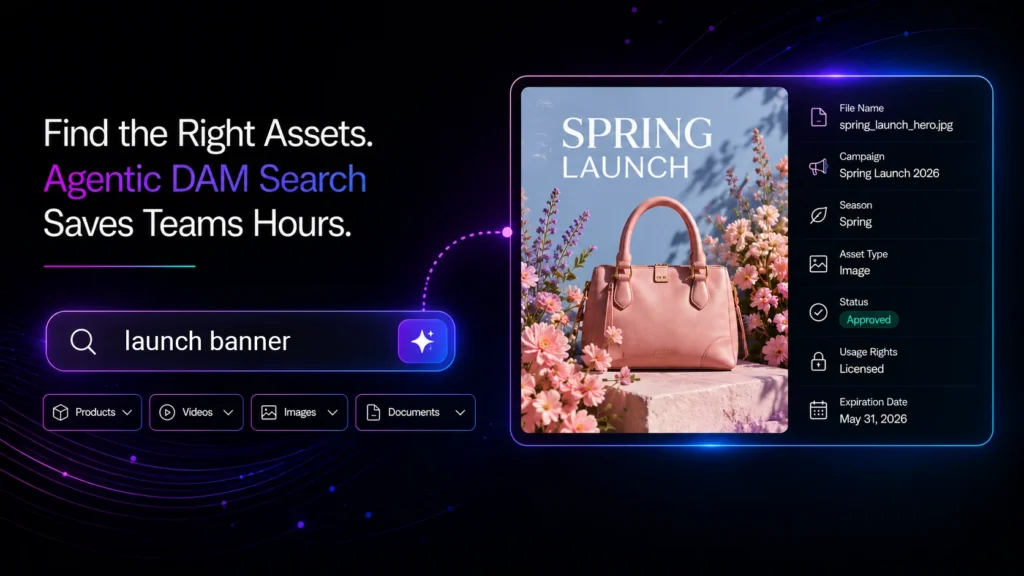
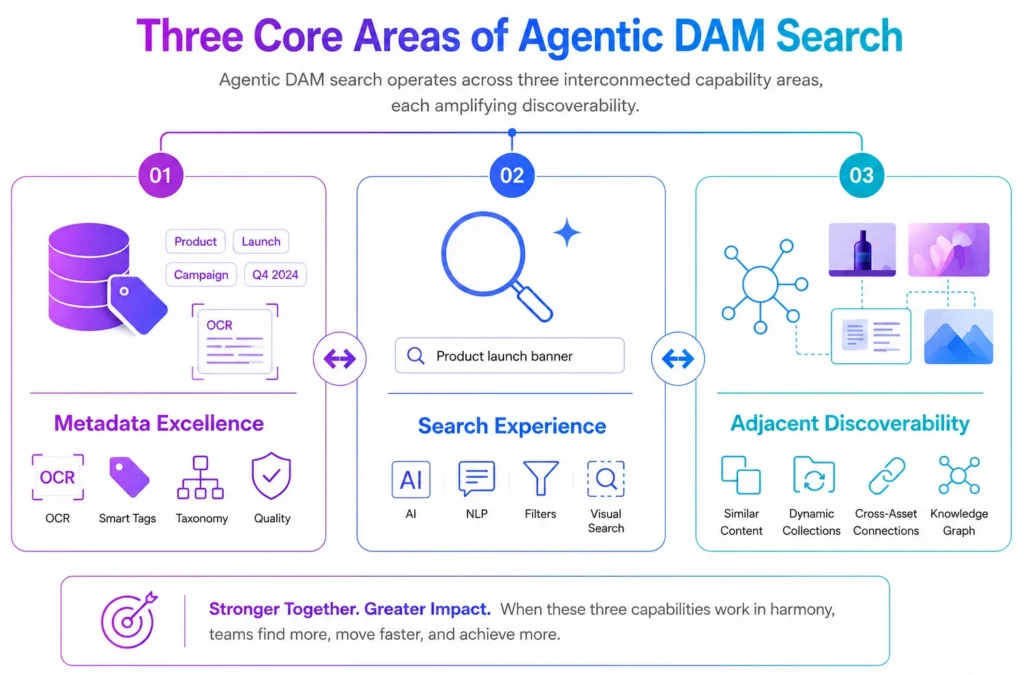
Agentic search, powered by AI agents that work continuously in the background, transforms how teams discover, tag, and reuse content. Rather than relying on manual metadata entry or rigid search syntax, agentic systems automatically enrich assets with intelligent tags, predict missing metadata, analyze visual and textual content, and surface the exact asset a user needs within seconds. This blog explores how agentic DAM search works, why it matters for enterprise content operations, and how organizations can implement search strategies that actually work. We’ll break this into three core capability areas: the metadata foundation that makes search possible, the search experience that makes it intuitive, and the adjacent features that amplify discoverability across the entire content ecosystem.
TL;DR
- Agentic DAM search uses AI agents to automate metadata enrichment, making content highly discoverable without adding manual tagging burden to your teams.
- Three core feature areas drive search excellence: metadata density (librarian agents, predictive tags, OCR, video transcription), search experience (AI/NLP search, visual search, smart facets, intelligent filters), and adjacent discoverability tools (similar content, dynamic collections, timestamped summaries).
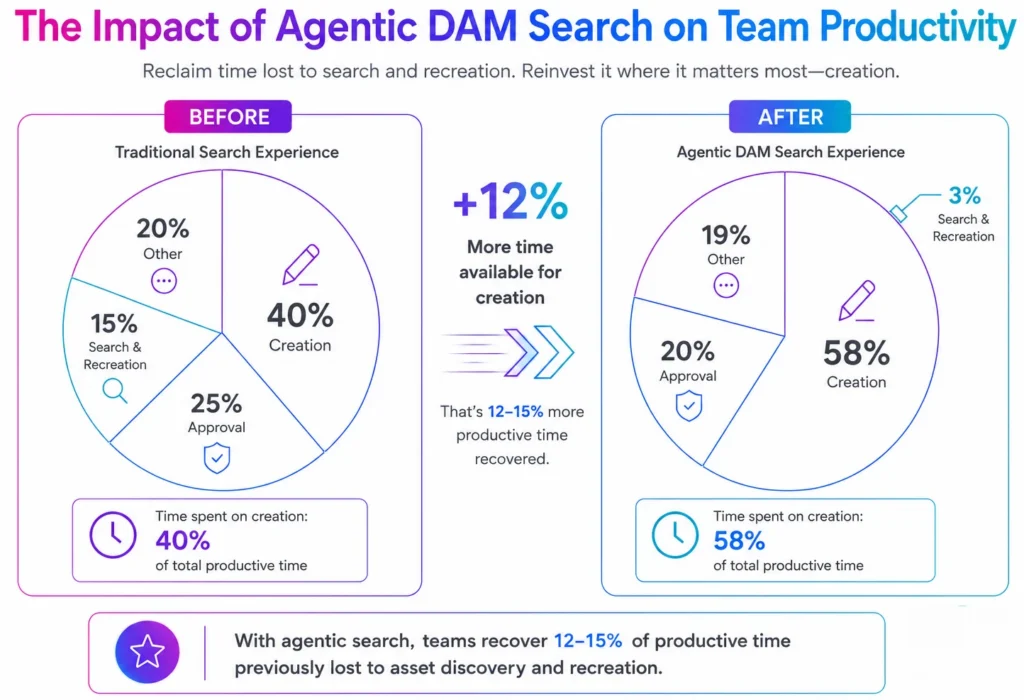
- The discoverability gap is real. Teams waste 15-20% of creative time searching for, recreating, or waiting for asset approvals. Agentic search closes that gap by making content findable in seconds, not hours.
- Enterprise teams using Aprimo’s agentic DAM report faster asset reuse, higher content velocity, and dramatic time savings. The result is faster campaign launches and reduced duplicate content creation.
- Search isn’t just about speed; it’s about operational maturity. Governed, AI-assisted search creates a system of record that gets smarter over time, scaling content operations without adding to the bottom-line.
What Is Agentic DAM Search and Why Does It Matter Now?
The Search Problem That No One Talks About
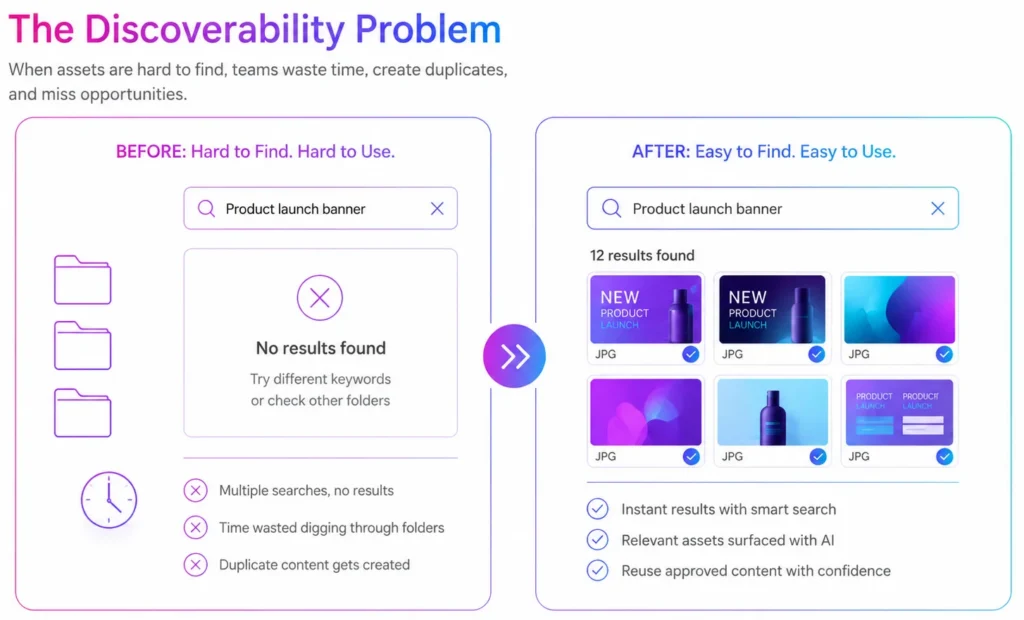
Traditional DAM implementations solve for storage. They provide a central repository, version control, and approval workflows. But they often leave discovery to the user. This creates a vicious cycle:
- Poor metadata → Weak search results: If assets aren’t tagged accurately, they don’t surface in searches.
- Bad search results → Manual searching: Users resort to browsing folders, scrolling through months of uploads, or asking colleagues where something is.
- Manual searching → Waste and duplication: Time spent searching is time not spent creating. And when searches fail, teams recreate content instead of reusing it.
- Duplication → Governance chaos: Multiple versions of the same asset create brand inconsistency, approval bottlenecks, and compliance risks.
For enterprise teams managing thousands of assets across multiple regions, channels, and brands, this is a systemic operational cost. Agentic search solves this by automating the metadata foundation and augmenting the search experience with intelligence that learns from how teams find content.
How Does Agentic DAM Search Differ From Traditional DAM Search?
Traditional DAM search relies on:
- Manual tagging: Users or librarians manually assign keywords and metadata to each asset.
- Keyword matching: Search returns results based on exact or fuzzy string matches in titles and tags.
- Folder navigation: Users browse folder structures that may or may not align with how they think about content.
- Limited filtering: Basic facets like date, file type, or status; no intent-based recommendations.
Agentic DAM search layers intelligence across the entire discovery pipeline:
- Automated metadata enrichment: AI agents analyze content (images, video, documents, audio) and automatically assign relevant tags, categories, and descriptors without manual effort.
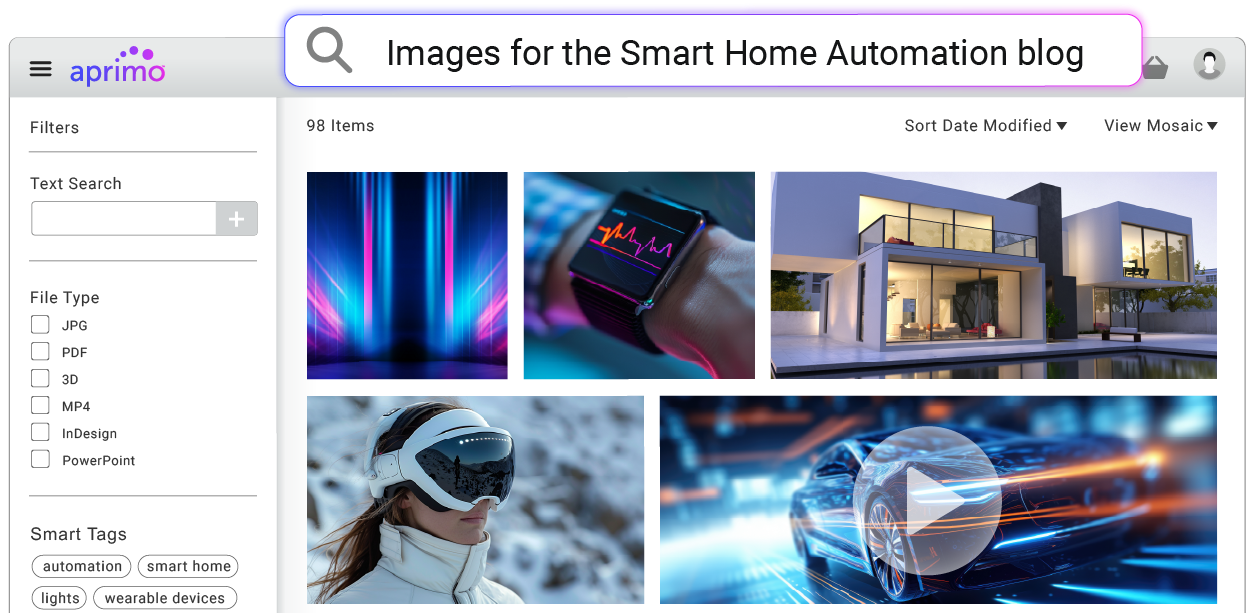
- Semantic and visual search: Search understands meaning and intent, not just keywords. Users can search by image, concept, or natural language query.
- Predictive discoverability: The system learns from search patterns and surfaces related content, similar assets, and recommended tags before users even ask.
- Governed intelligence: All AI-assisted tagging and recommendations operate within your brand guidelines, taxonomy, and approval workflows.
The result is a system where content becomes progressively more discoverable the longer you use it and where teams spend less time searching and more time creating.
Three Core Areas of Agentic DAM Search Excellence
Agentic DAM search operates across three interconnected capability areas. Understanding each helps you build a search strategy that improves content operations.
Metadata Excellence: Building the Foundation for Discoverability
The Core Problem: You can’t discover what you don’t describe. But manual metadata entry doesn’t scale. As asset volumes grow, teams either over-invest in librarian roles or accept poor metadata quality. Agentic metadata solutions solve this by automating how assets get described:
Librarian Agents
A Librarian Agent is an AI-powered system that continuously monitors incoming content, automatically applies metadata based on your organization’s taxonomy, and flags assets that need human review. Unlike batch tagging, Librarian Agents work in real-time, so assets are discoverable the moment they upload.
How it works: An asset uploads to your DAM. The Librarian Agents analyze it, identify the asset type, apply the appropriate metadata structure, and assign relevant tags and metadata.If it’s uncertain, it flags the asset for a human librarian to review and learn from. Over time, the agent becomes more accurate and requires less human oversight.
Experience AI-Powered Content Operations
See how Aprimo’s AI-powered Librarian Agents automatically enrich content with metadata, improve discoverability, strengthen governance, and unlock greater content reuse across the entire content lifecycle.
Predictive Metadata, Enhanced Captioning and Smart Tags
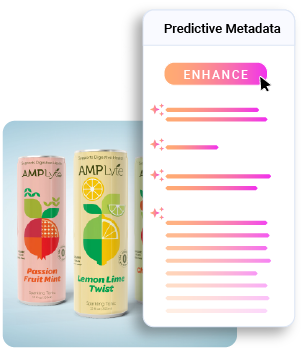
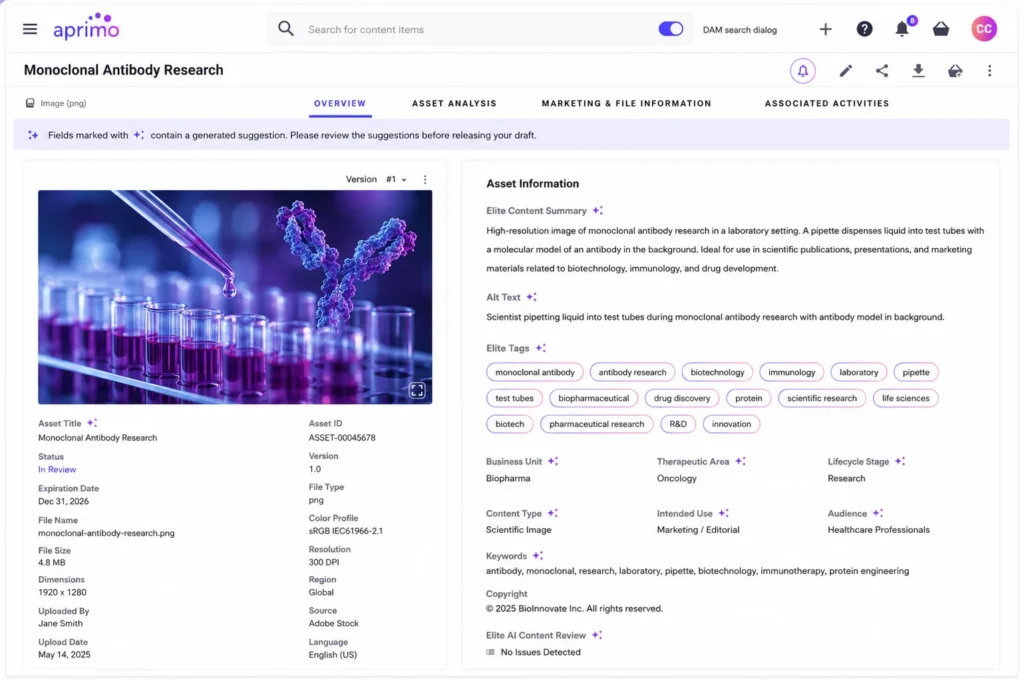
Predictive Metadata, Enhanced Captioning, and Smart Tags use AI to anticipate what values need to be entered into multiple metadata fields including tags, dropdown values, open text fields, etc. Entries are based on visual content, file properties, and historical patterns. Metadata density directly correlates with search accuracy. Assets with richer metadata show up in more searches and in better-ranked results. This increases the likelihood that teams find existing content instead of recreating it.
How it works: A product photo is uploaded to Aprimo DAM. The system automatically fills in fields like product category, primary colors, size, use case, asset description, and campaign relevance, all without any manual input. A video uploads; the system describes the speaker or setting, detects product placements, timestamps key moments, and surfaces related assets.
Video Transcription
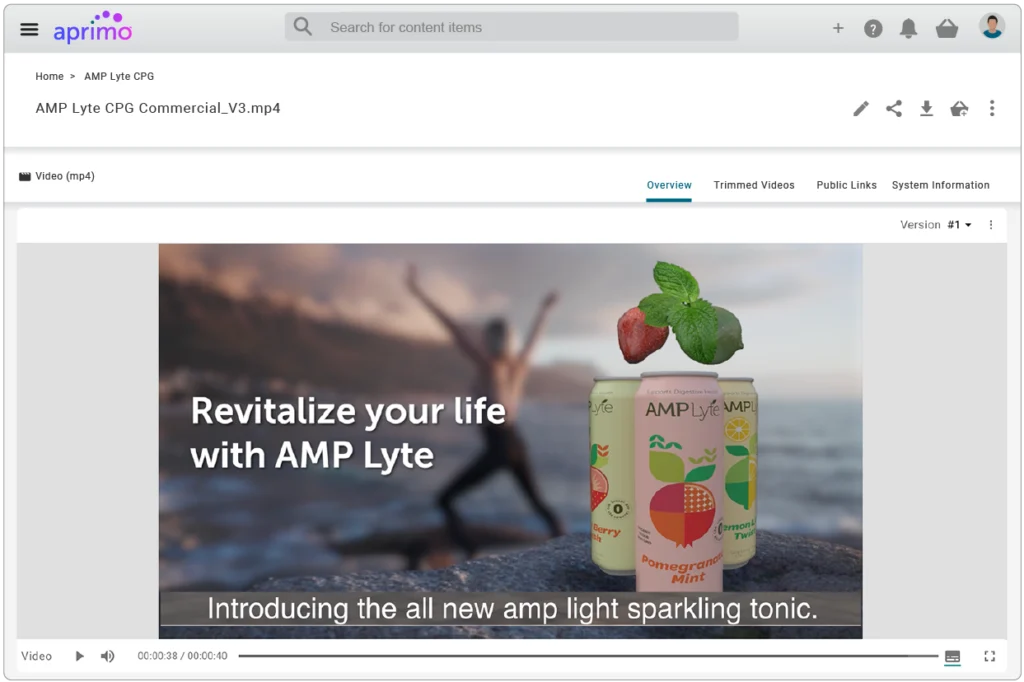
Video content represents the largest metadata challenge in modern DAM systems. A 60-minute webinar or product demo contains hours of human-searchable information, but traditional DAM systems treat it as a single file with a title and description. In Aprimo’s Agentic DAM video files are auto-detected and treated with an additional set of features to improve searchability of not just the file, but also specific moments within a video.
How it works:
- Full video transcription: Every word spoken is searchable.
- Timestamped summaries: Key moments (product demos, announcements, questions) are marked and summarized.
- Visual scene detection: The system identifies transitions, on-screen text, product appearances, and visual concepts.
Optical Character Recognition (OCR) and Document Metadata
For PDF documents, presentations, and image-based content, OCR extracts and indexes all text, making image-based assets fully searchable. This is critical for regulated industries where compliance documentation, approvals, and legal content must be discoverable.
How it works: Any text inside a visual is extracted using OCR technology and added into the file metadata in the DAM. As a result, a design file with on-screen text becomes searchable. A scanned brand guideline can be queried. A presentation with hidden text layers becomes part of your searchable knowledge base.
Search Experience: Making Discovery Intuitive and Fast
The Core Problem: Even with perfect metadata, search is only valuable if teams use it. Poor search experiences drive users back to folder browsing, email threads, and asking colleagues.
Agentic search experience features make discovery fast, intuitive, and aligned with how teams work:
AI/NLP Search with Natural Language Understanding
Natural language processing (NLP) enables users to search the way they think, not the way databases are structured or the exact way in which metadata is written.
How it works:
- Instead of: brand=XX + category=apparel + color=blue + format=social
- Users can search: “Blue Nike workout clothes for Instagram”
- The search engine understands intent, translates it into metadata queries, and returns relevant results. It learns from which results users click so the more the system is used, the better it becomes.
Reverse Image Search
Upload an image or take a screenshot, and visual search finds similar content in your DAM based on visual characteristics (color, composition, style) rather than text tags. Visual search eliminates the friction of “I know what I’m looking for, but I don’t know what it’s called.” For design and creative teams, this alone can save hours of browsing.
How it works: A designer working on a Q3 campaign wants to find brand photography that matches a specific aesthetic. Instead of describing it in text, they upload a reference image. Visual search returns similar assets from the past 18 months.
Smart Facets or Intent-Based Filter Recommendations
Traditional search results show a list. Smart Facets analyzes what a user searched for and recommends filter combinations they might want to apply, without making them click through every possible filter.
How it works: A user searches “approved holiday campaign assets from last year.” The system doesn’t just return results; it recommends refining search results by Campaign (contains “Holiday”), Upload date (2025), and Asset Status (approved).
This turns search into a guided discovery experience where users find what they need faster because the system anticipates their next question.
Proactive Search Suggestions
Sometimes users fail to realize that the reason they could not find any assets in the DAM was because they had entered a typo in their search query. Aprimo’s Agentic DAM offers auto-corrections to search queries and proactively serves up search results for the auto-corrected version.
How it works: Users enter search queries with typos (e.g., “camapign assets” instead of “campaign assets”), but Aprimo’s agentic search detects the misspelling, auto-corrects the query in real-time, and serves results for the correctly spelled query (“campaign assets”).
Configurable Search Tabs
For large organizations, different teams use different search patterns:
- Designers need to filter by asset type, color, and usage rights.
- Campaign managers need to filter by campaign, channel, and status.
- Product teams need to filter by product line, version, and approval stage.
Tab navigation in the search results page creates role-based or need-based search experiences. A designer’s search interface emphasizes visual properties. A compliance manager’s emphasizes approval status and date ranges. Everyone searches faster because the interface is built for their workflow.
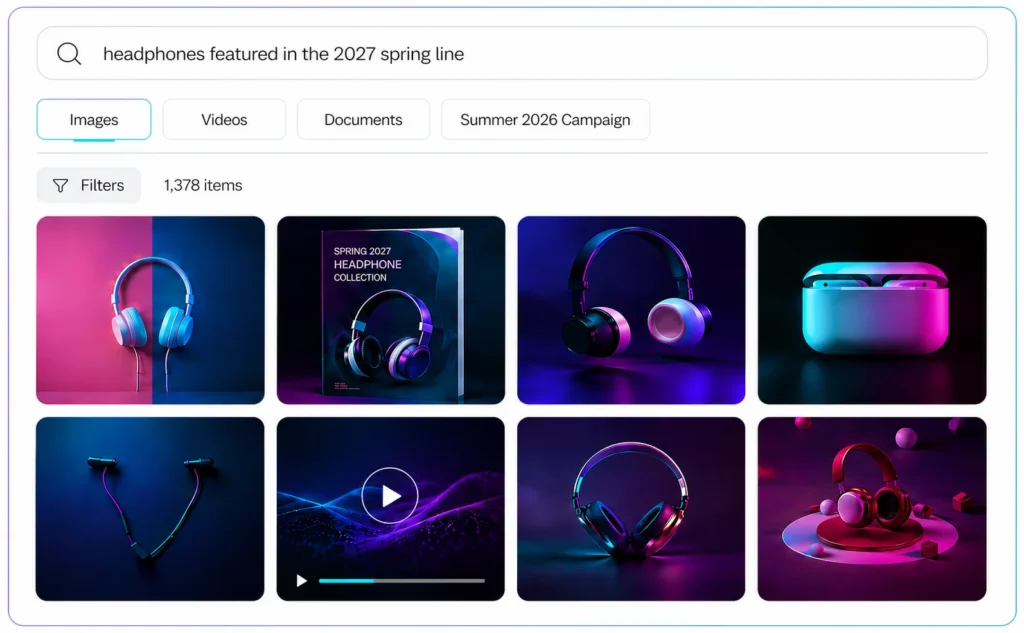
How it works: Aprimo allows admins to set up custom tabs based on business or user needs. With every search, results are placed in these custom tabs for quick access.
Adjacent Discoverability Features: Amplifying Search Impact
Search is most powerful when it’s connected to other discovery mechanisms. These adjacent features increase the odds that teams find what they need:
Similar Content Recommendations
After a user finds an asset, the system automatically recommends related assets. The majority of secondary discoveries happen after the first successful search. By surfacing related content, similar content recommendations increase reuse rates and reduce duplicate creation.
How it works: Aprimo DAM automatically recommends similar content based on –
- Other variations (different colors, sizes, formats)
- Similar assets from previous campaigns
- Complementary content (if a user finds a product photo, recommend related lifestyle imagery or a similar product/ models)
Dynamic Collections
Instead of creating static folders, dynamic collections use search logic to automatically group related assets. When new assets upload and match the criteria, they automatically join the collection. This eliminates manual folder maintenance and ensures teams always have access to the latest relevant content.
How it works: A “Global Q4 Campaign Assets” collection automatically includes:
- All assets tagged with campaign=Q4
- All assets approved in the last 30 days
- All assets in geographic regions EMEA, APAC, Americas
- All formats (video, image, document)
Timestamped Video Summaries
For video content, timestamped chapters make long-form video highly discoverable. A 60-minute webinar becomes searchable by topic, allowing teams to find and reuse 5-minute segments instead of rewatching the entire video.
How it works: A product manager records a 45-minute training. The system automatically:
- Detects scene changes and topics
- Creates chapters for each topic
- Generates timestamps and summaries
- Makes every chapter searchable and embeddable
A sales team can now quickly find the 3-minute demo segment rather than asking for a custom clip.
Why Does Agentic DAM Search Matter for Enterprise Content Operations?
The Business Case: Time Saved, Speed Gained
Let’s quantify the impact of these search capabilities in Aprimo’s Agentic DAM. In a typical enterprise marketing team of 50 people:
- Current state (manual search): Teams spend 10-15% of time searching for, recreating, or waiting for assets. At $70K average salary, that’s $350K-$525K annually in lost productivity.
- With Aprimo’s Agentic DAM search: Search time drops to 2-3% because assets are immediately discoverable. This recovers $245K-$420K in annual productivity.
But the value extends beyond time saved:
- Faster campaign launches: When assets are discoverable in seconds, approval cycles compress and campaigns launch faster.
- Higher brand consistency: Teams find and reuse approved assets instead of creating new ones, reducing brand inconsistency and approval rework.
- Reduced content duplication: Similar asset discovery prevents teams from creating the 47th version of the same hero image.
- Better ROI on content investment: Content created months ago gets discovered and reused, multiplying the ROI on the original creation cost.
Conclusion: Search as a Competitive Advantage
Digital asset management has evolved from a storage problem into a strategic advantage problem. The organizations winning in content operations aren’t necessarily the ones creating more content. They’re the ones finding and reusing the right content fastest.
Agentic DAM search closes the discoverability gap that plagues most enterprises. By automating metadata enrichment, enhancing search experiences, and connecting adjacent discovery features, agentic systems help teams move faster, stay more on-brand, and multiply the ROI of their content investments.
The question isn’t whether you should implement agentic search. It’s whether you can afford not to. In an environment where content velocity drives campaign speed and brand consistency drives customer trust, search that works is core to your content operations.
FAQ
How long does it take to see results from Agentic DAM search implementation?
Quick wins (faster searches, better filters) appear within weeks once metadata improves. Asset reuse rate improvements typically show within 60-90 days as teams discover and reuse existing content. Full organizational behavior change takes 6-12 months.
Will agentic DAM search work with our legacy taxonomy, or do we need to rebuild it?
Your legacy taxonomy becomes a learning dataset for the AI system. It learns your patterns and applies them to new content. You don’t need to rebuild, but you may want to standardize inconsistencies to improve accuracy.
How does DAM support product content management?
DAM helps manage product assets such as images, documentation, and specifications in a centralized system. It ensures that teams can access and use the correct content efficiently.
Can agentic DAM search work in highly regulated industries where manual approval is required?
Yes. Agentic systems operate within governance frameworks. In regulated environments, all AI-generated metadata can require human review before assets become “official.” The system accelerates review cycles by suggesting metadata, but humans maintain approval control.