
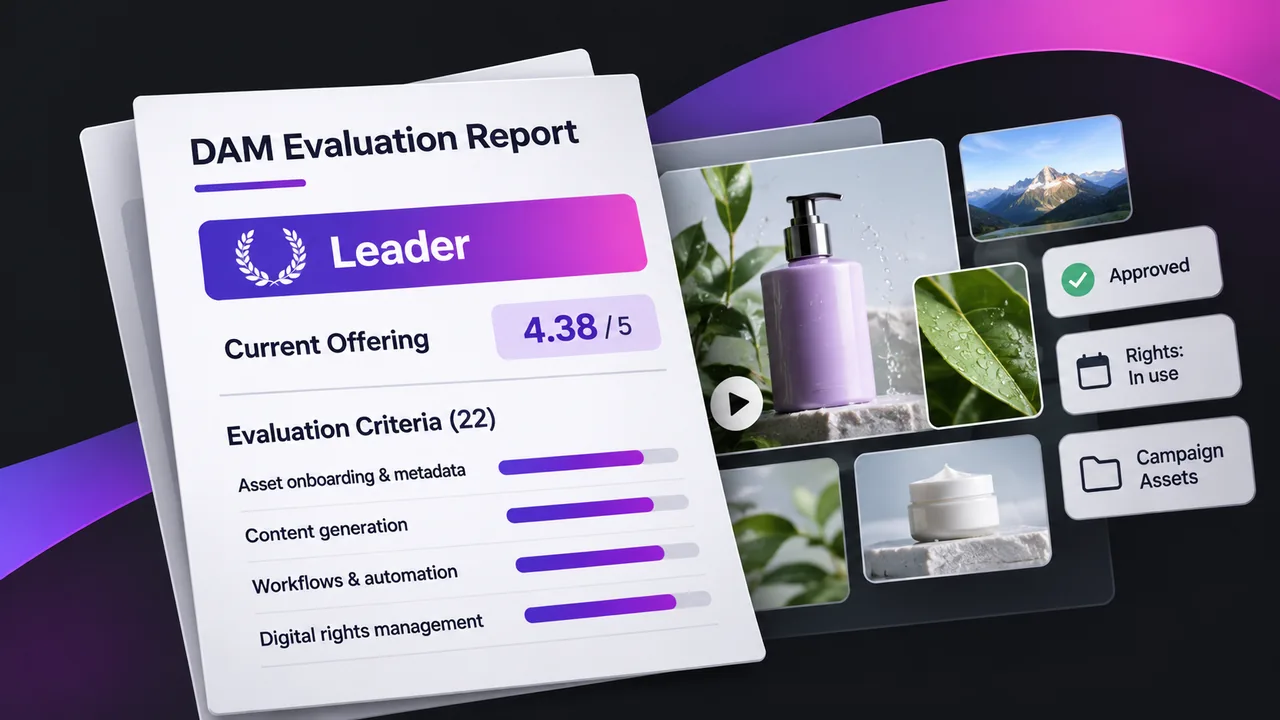
A Forrester Wave DAM report lands on almost every enterprise shortlist, yet few buyers read past the quadrant graphic. The placement looks like an answer. In practice, it is a starting point that raises sharper questions about what a vendor actually delivers. Aprimo was named a Leader in The Forrester Wave™: Digital Asset Management Systems, Q1 2026, and the result gives buyers useful evidence if they know where to look.
The danger is treating the Leader label as a verdict. Leaders differ in strengths, and buyers differ in needs. A global brand with regulated content needs different proof than a team replacing a shared drive. Reading a Wave well means separating what the label confirms from what a buyer still has to test.
This post explains what the placement signals, which scores deserve attention, and where buyers should keep asking questions. It also covers how to turn analyst findings into a requirements list that holds up in a vendor demo.
TL;DR
- Aprimo earned a Leader placement in The Forrester Wave™: Digital Asset Management Systems, Q1 2026.
- Forrester gave Aprimo the highest Current Offering score among all evaluated vendors, 4.38 out of 5.
- Aprimo received the highest possible score in 15 of the 22 evaluation criteria.
- A Leader label confirms market standing, but buyers still need to test fit against their own workflows.
- Criteria scores reveal more than the overall placement, so buyers should weigh the categories that match their use case.
- Buyers get the most from a Wave report when they convert its criteria into demo scripts and RFI questions.
What does a Leader placement in the Forrester Wave DAM report actually mean?
A Leader placement means Forrester rated a vendor strongly in its evaluation of current offering and strategy. It earns a vendor a place on a serious shortlist, but it does not prove fit for any single buyer.
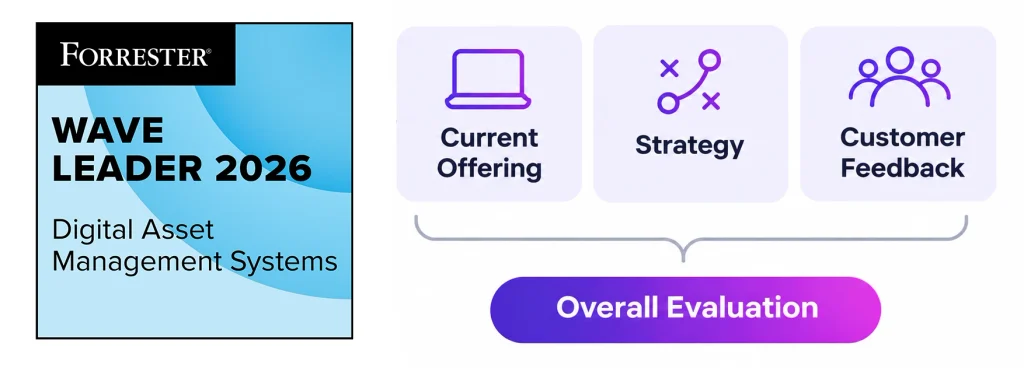
Definition: A Forrester Wave is an independent analyst evaluation that scores vendors in one market against a defined set of criteria. Its main inputs are current offering, strategy, and customer feedback.
Aprimo earned the Leader placement in the Q1 2026 report for digital asset management systems. Forrester also gave Aprimo the highest Current Offering score of any evaluated vendor, 4.38 out of 5, according to Aprimo’s announcement of the report. That category covers the product as it exists today, which makes it the most useful single number for a buyer comparing platforms they can deploy now.
More than one vendor can hold a Leader placement in the same report. The label therefore narrows a market without ranking it, and buyers need the underlying criteria to separate one Leader from another. A buyer who stops at the label has learned that a vendor is credible. A buyer who reads the criteria learns whether that credibility extends to the capabilities the business depends on.
The next question is which of those criteria deserve the closest reading.
Which Forrester Wave DAM scores matter most to enterprise buyers?
The criteria scores matter more than the overall placement, because they show where a vendor is strong and where it is merely adequate. Forrester evaluated 22 criteria in this report, and Aprimo received the highest possible score in 15 of them, according to Aprimo’s summary of the findings.
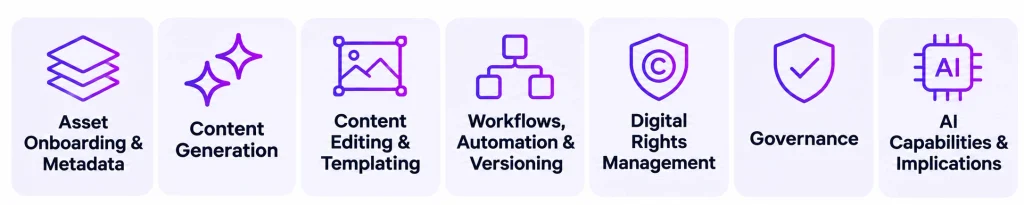
The top-scoring criteria include several that map directly to enterprise pain points:
- Asset onboarding and metadata management: determines how quickly a library becomes consistent.
- Content generation: shows how much creation work the platform can support directly.
- Content editing and templating: affects how many routine variants designers must build by hand.
- Workflows, automation, and versioning: decide how many manual handoffs remain in production.
- Digital rights management: controls where an asset may be used, and for how long.
- Governance: keeps brand and compliance rules enforceable across teams.
- AI capabilities and implications: shapes how much routine work a platform can absorb.
Forrester’s vendor profile described Aprimo as strong in technical and creative categories. It cited AI-native metadata enrichment, and blueprint starter packs for workflows and taxonomies, as examples of that strength.
Customer feedback cited in the report showed high satisfaction with asset management, production capabilities, and discovery features such as natural language search. Buyers should treat that feedback as a check on vendor claims. A feature that customers praise in production is stronger evidence than a feature that a demo script highlights.
A short list of criteria is only useful if the buyer knows how to read it.
How should buyers read a Wave report beyond the quadrant?
Buyers should read the criteria table first, the vendor profile second, and the quadrant graphic last. The graphic compresses many separate judgments into one position, which hides the detail that decides most purchases.
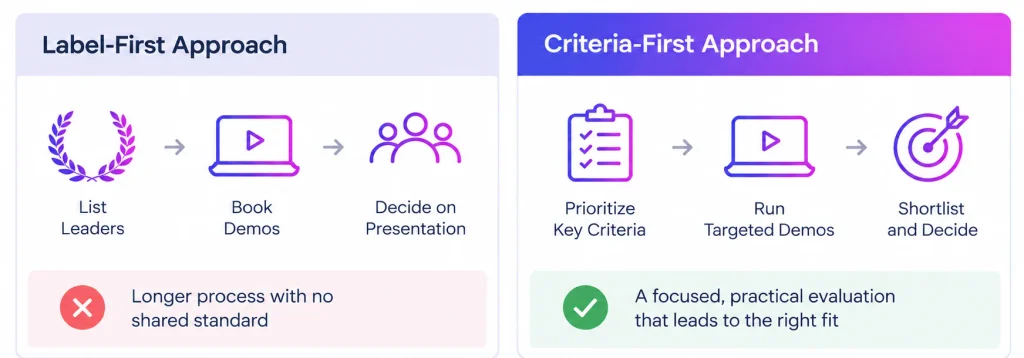
A label-first approach and a criteria-first approach lead to different shortlists:
- Label-first: The buyer lists every Leader, books a demo with each, and decides based on presentation quality. The process runs long, with no shared standard.
- Criteria-first: The buyer ranks the report’s criteria by business impact, checks each vendor’s score on the top five, and builds demo scripts around the gaps. The process runs shorter, with evidence behind every cut.
The criteria-first approach also guards against a common trap. A vendor can hold a Leader placement while scoring lower on the one capability a specific team relies on. That gap rarely appears in a sales presentation, so the buyer has to find it in the report.
The vendor profile adds context that scores cannot carry. It describes how the vendor frames its own product, where Forrester agrees, and which buyer type Forrester believes fits best. Those notes help a buyer decide whether the vendor’s direction matches the organization’s plans for the next three years.
Turning this approach into a repeatable process starts with the requirements document.
Turn analyst scores into a vendor shortlist
Build a tailored DAM RFI from your own requirements, use cases, and business goals in minutes.
How can buyers turn Forrester findings into RFI requirements?
Buyers turn Forrester findings into RFI requirements by converting each high-impact criterion into a question that a vendor must answer with evidence. That step keeps analyst research from staying abstract.
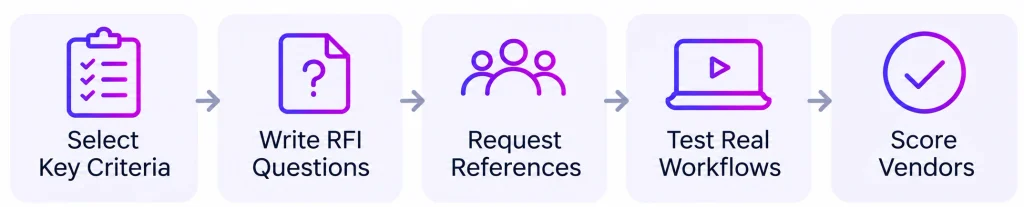
Five steps make the conversion repeatable:
- Select the five criteria that map to the largest business risks, such as rights management for regulated content or workflow automation for production delays.
- Write one RFI question per criterion that asks for a demonstrated example, not a checklist answer.
- Request customer references that match the buyer’s industry, content volume, and team structure.
- Define a proof-of-concept scenario that uses the buyer’s own assets and approval path.
- Score every vendor against the same rubric, then compare the results with the analyst scores.
The comparison in the final step carries the most value. When a vendor’s demo performance and its analyst score point in the same direction, confidence rises. When they diverge, the gap shows exactly where to dig.
A shared rubric also gives procurement, IT, and marketing a common language. That shared language shortens internal debate, because each stakeholder can point to the same criteria and the same evidence. Without it, a DAM selection often turns into a contest between the loudest preferences.
What does the Aprimo placement say about AI in DAM?
Forrester scored AI Capabilities and Implications as its own criterion. Aprimo received the highest possible score on it. That result shows AI is now a measured part of the DAM evaluation, not an optional extra.
Forrester’s vendor profile described Aprimo’s approach as an intelligent system of action, built on an AI agent strategy that began in 2023. Forrester concluded that Aprimo suits large organizations that want a full-featured DAM with strong AI features. It added that the platform can extend content use, transformation, and personalization to more enterprise users.
Aprimo describes its agent architecture as built to orchestrate repeatable tasks and support auditable outcomes. The AI Agents page lists planning, librarian, critic, compliance, and production roles. Broader context sits on the Aprimo AI page.
For buyers, the practical question is which AI tasks run inside the platform under governance. An AI feature that works outside the approval path creates a new risk instead of removing one. Buyers should test each agent type against a real workflow, with real assets, rather than accept a feature name at face value.
AI value also depends on the quality of the underlying library. Metadata, rights data, and version history feed every automated task. That dependency explains why the AI score and the governance scores belong in the same conversation.
Why do governance and rights scores deserve extra weight?
Governance and rights scores deserve extra weight because they measure whether a platform can enforce rules, not just store files. Aprimo received the highest possible score in both Digital Rights Management and Governance, according to Aprimo’s summary of the report.
Weak rights data has a direct cost. Expired or restricted assets stay in circulation, regional teams reuse content they should not, and legal teams learn about the problem after publication. Regulated and globally distributed organizations carry the highest exposure, because one misused asset can trigger a compliance review.
Governance gains force when it sits inside a Content Operations Platform instead of a standalone repository. Intake, review, approval, and rights then share one record, so rules travel with the asset from brief to publish. Aprimo states that the platform supports regulated, globally distributed organizations through security controls, compliance support, and managed collaboration with outside partners.
Buyers can test this claim directly. Ask each vendor to show how an asset with expiring usage rights moves through approval, distribution, and takedown. The answer reveals whether governance is a feature of the workflow or a report that someone reviews afterward. The brand safety and compliance page describes how Aprimo frames that outcome.
Where does a Leader placement stop being useful?
A Leader placement stops being useful when a buyer needs proof for a specific workflow, region, or compliance requirement. A Wave is a snapshot, and Forrester states that it does not endorse any vendor or advise buyers to choose one based on ratings, as the disclaimer on Aprimo’s announcement page notes.
Three limits apply to every analyst report. The first is timing: the Q1 2026 findings reflect judgment at that moment, and opinions can change. The second is scope: the report evaluates the market in general, not the buyer’s stack, data volumes, or approval chains. The third is source: the vendor-written summaries of any report, including this one, reflect the vendor’s own reading.
The remedy is evidence from the buyer’s own environment. A proof of concept, reference calls, and a pilot with real assets each test what the report cannot. Use the Wave to decide which vendors earn a demo. Use the demo to decide which earn a pilot.
Buyers ready for that step can book a demo built around their own use cases. Buyers still comparing vendors can start with the report itself, which is available here.
Treating the Forrester Wave DAM result as evidence, not a verdict
The Forrester Wave DAM report gives buyers a credible, independent view of a crowded market. Aprimo’s Leader placement, its 4.38 Current Offering score, and its top marks in 15 of 22 criteria are real evidence worth weighing. They are not a substitute for testing.
The strongest buying processes treat analyst research as a filter. It removes weak fits early, directs attention to the criteria that matter, and supplies questions that vendors must answer with demonstrations. A shortlist built this way survives scrutiny from finance, IT, and legal, because every cut has a documented reason.
The same discipline protects the buyer after the contract is signed. Requirements written from analyst criteria become the baseline for onboarding goals, success metrics, and future reviews. The Leader label opens the conversation, and the buyer’s own evidence closes it.
Teams ready to test the findings can read the full report and then see the platform in a live demo.
FAQ
What is the difference between a Forrester Wave and a Gartner Magic Quadrant?
Both are independent analyst evaluations of a vendor market, but each uses its own methodology, criteria, and scoring. Scores from one report do not translate directly to the other. Aprimo also appears as a Leader in the 2026 Gartner Magic Quadrant for Digital Asset Management, so buyers can compare both reports side by side.
Can a vendor outside the Leader category still be the right DAM?
Yes. A vendor can fit a specific industry, budget, or technical environment better than a Leader does. The Wave describes the market in general, so a narrow use case may point to a different choice.
How many criteria did Forrester evaluate in the DAM Wave?
Forrester evaluated 22 criteria in The Forrester Wave™: Digital Asset Management Systems, Q1 2026. Aprimo received the highest possible score in 15 of them. The criteria cover areas such as metadata management, workflows, digital rights management, governance, and AI.
Does Forrester recommend a vendor based on the Wave?
No. Forrester states that it does not endorse any company, product, or service in its research. It also does not advise buyers to select a vendor based on ratings alone.
What type of organization did Forrester say fits Aprimo best?
Forrester’s vendor profile described Aprimo as an excellent choice for large organizations that want a full-featured DAM. It also pointed to strong AI features and the ability to extend content use to more enterprise users.
Should a buyer read the full report before booking demos?
Yes. The full report shows each criterion score, which a summary cannot. Buyers can then build demo scripts around the criteria that matter most to their business.
Related reading: best DAM platforms for enterprise teams, build your DAM RFI.