
News

Explore Aprimo’s latest product innovations

DAM RFI Generator

Build Your DAM RFI

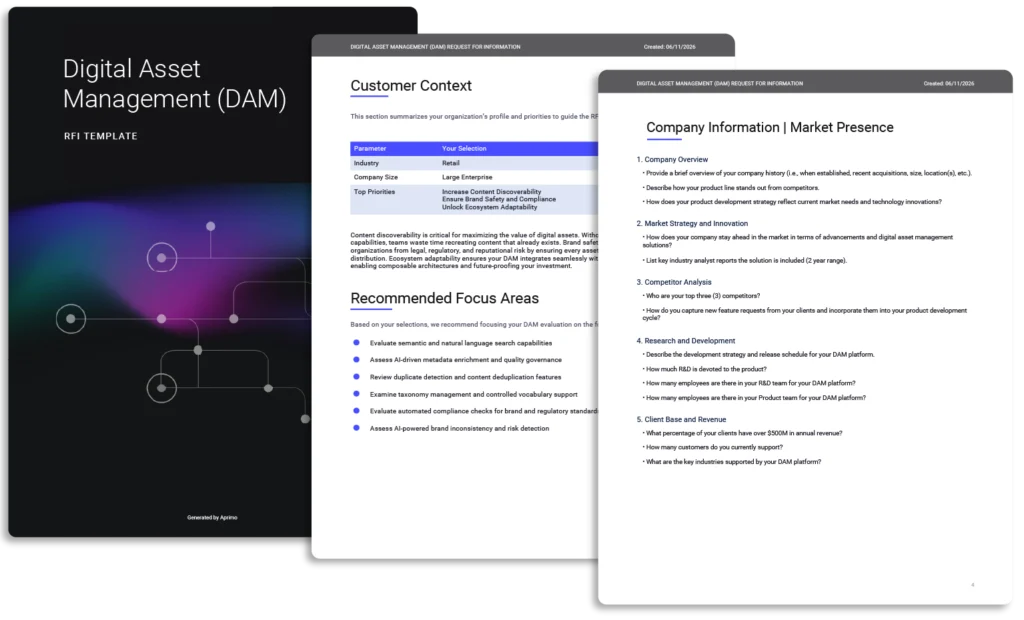
Create a customized DAM RFI tailored to your goals, requirements, and priorities with Aprimo’s AI-guided experience.

Align stakeholders, gather vendor information, and accelerate your DAM evaluation process—all in just a few minutes.

AI-Generated RFI Template

Generate a Tailored DAM RFI in Minutes 

Answer the questions below to generate a customized DAM RFI.

What Should a DAM RFI Include?

Business goals and use cases

Define the business challenges DAM should address, such as asset findability, brand consistency, content reuse, workflow efficiency, localization, and rights management.

Users and stakeholder groups

Identify who will use, manage, govern, and integrate with the DAM so vendors can respond with the right level of detail.

Asset types and scale

Describe the types of content you manage, along with asset volume, usage patterns, and expected growth.

Metadata and taxonomy requirements

Explain how assets need to be organized, classified, governed, and searched across teams and use cases.

Search and discoverability needs

Define what users need from search, filters, facets, recommendations, and other discovery capabilities.

Workflow and approval requirements

Include requirements related to review, approval, versioning, lifecycle management, and collaboration.

Roles, permissions, and governance

Define access control, user roles, administrative oversight, and governance expectations.

Integrations

List the systems the DAM must connect with, such as CMS, PIM, CRM, creative tools, and project management platforms.

Migration and implementation needs

Outline expectations for onboarding, taxonomy setup, asset migration, metadata cleanup, and rollout support.

Security and administration

Include security, compliance, audit, user management, and platform administration requirements.

Support and services

Document expectations for implementation support, training, change management, and long-term vendor services.

Evaluation criteria

Explain how vendor responses will be assessed across areas such as functionality, usability, scalability, support, security, and integration readiness.

What DAM Requirements Should You Evaluate?

Classification Icon Pulse

Metadata and taxonomy flexibility

Evaluate whether the platform supports the classification structure your organization needs.

Visual Similarity Detection Icon Pulse

Search and findability

Assess how easily users can locate assets using search, filters, facets, and other discovery tools.

Icon Gradient Product Plan

Workflow and collaboration

Review support for approvals, handoffs, versioning, and team collaboration.

On-brand Icon

Governance and permissions

Consider access controls, user roles, approval rules, and brand governance capabilities.

Centralized Icon

Integrations and ecosystem fit

Confirm the DAM can connect to the systems your teams already use.

Faster Content Ingestion Icon Pulse

Migration and scalability

Evaluate how the platform supports migration, growth, and future operational complexity.
Admin Portal Icon Pulse

Administration and support

Review platform manageability, onboarding support, and long-term vendor services.

Why Use an AI-Generated DAM RFI Template?

A generic template can help you get started, but it still leaves a lot of work to your team. An AI-generated DAM RFI gives you a more tailored starting point based on your goals, workflows, integrations, and evaluation priorities. 

Collaboration Icon

Create a more relevant vendor questionnaire

Generate questions and requirement areas that better match how your teams work, what your content operations need, and what matters most in your evaluation.

Always On Icon copy

Save time during vendor evaluation

Skip the work of building an RFI from scratch or reworking a template that does not really fit your use case.

Automation

Improve stakeholder alignment

Start with a document that reflects input from marketing, creative, IT, operations, and procurement.
Claims References Audit Trail Icon

Build a stronger evaluation foundation

Give your team a clearer starting point for vendor conversations, internal review, and side-by-side comparison.
How Do You Create a DAM RFI?

Creating a DAM RFI usually starts with a few basics: defining your goals, gathering input from stakeholders, prioritizing requirements, and organizing the right questions for vendors. 

Define business goals

Identify the problems your DAM needs to solve and the outcomes your team expects.

Gather stakeholder input

Collect requirements from the teams that will use, manage, govern, or integrate with the platform.

Prioritize requirements

Separate must-have needs from secondary preferences.

Generate the RFI

Use the embedded AI-guided experience to create a DAM RFI tailored to your organization’s needs.

Review and refine

Review the document with your team, make any edits you need, and use it to guide vendor conversations and comparison.

The RFI generator helps simplify that process by turning your inputs into a more structured starting document. 

What Does the DAM RFI Include?

Customized DAM RFI structure

A tailored RFI organized around your goals, requirements, and priorities.

A practical planning asset

A working document that helps your team move faster with more clarity and less manual effort.

Tailored requirement categories

Sections shaped by your use cases, workflows, governance needs, metadata priorities, and integrations.

Vendor question set

A focused set of vendor questions based on the capabilities and operational needs that matter most to your team.

Customizable evaluation framework

A format your team can review, refine, and use throughout the evaluation process.

DAM RFI vs. DAM RFP: What Is the Difference? ​

Aspect
DAM RFI (Request for Information)
DAM RFP (Request for Proposal)
Purpose
Gather information, clarify vendor fit, and help shape evaluation criteria.
Request formal proposals from shortlisted vendors based on defined requirements.
When to Use
Early in the evaluation process when exploring options and refining requirements.
Later in the evaluation process when requirements are clearer and vendors have been shortlisted.
Primary Goal
Collect structured vendor input and better understand available solutions.
Evaluate formal proposals and compare vendors against specific business needs.
Level of Requirements Definition
Requirements are still being explored or refined.
Requirements are well-defined and documented.
Evaluation Process
Informal and discovery-focused.
Formal and decision-focused.
Outcome
Better understanding of the market and potential vendors.
Selection of the best-fit vendor based on detailed proposals.

Resources

DAM Buyers Guide

Choose the Right DAM with Confidence

Cut through vendor claims and identify the capabilities that matter most. Get a practical framework for evaluating DAM solutions, comparing vendors, and building a business case for investment. Read the Buyer's Guide
Digital Asset Management Platforms-What to Look For

How to Evaluate DAM Platforms

Explore the key features, AI capabilities, integration requirements, and governance considerations to include in your DAM evaluation and vendor selection process. Read the Blog
Featured Image Librarian Agents

See AI-Powered Metadata in Action

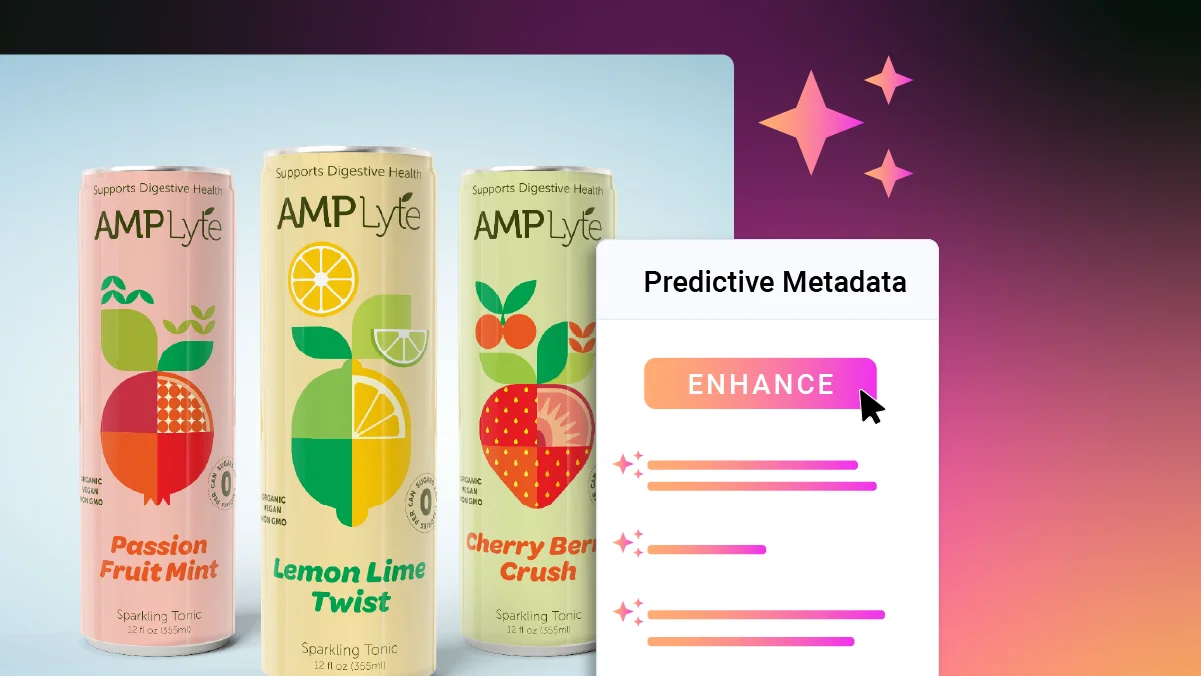
Experience how Librarian Agents automatically analyze, enrich, and classify content with rich, context-aware metadata—improving discoverability and accelerating content operations. Launch Interactive Demo

FAQ

What is a DAM RFI?

A DAM RFI is a request for information used to gather structured vendor input during the early stages of digital asset management software evaluation. It helps organizations define requirements, compare vendors, and assess fit before moving into a formal proposal process. 

A DAM RFP is a request for proposal used later in the software buying process to collect formal vendor proposals based on defined requirements and evaluation criteria. 

A DAM RFI is used earlier to gather information and clarify vendor fit. A DAM RFP is used later to request formal proposals from shortlisted vendors. 

A DAM RFI should include business goals, use cases, stakeholder needs, asset types, metadata requirements, workflow expectations, governance needs, integrations, security requirements, support expectations, and evaluation criteria. 

A DAM RFI should usually include input from marketing, creative operations, brand, IT, operations, procurement, and any other teams involved in using, managing, governing, or integrating with the platform. 

An AI-generated DAM RFI template gives teams a more tailored starting point than a static template. It helps shape the document around your goals, workflows, integrations, and evaluation priorities, so you spend less time rewriting a generic file. 

Yes. Many organizations use a DAM RFI first to gather information, define requirements, and narrow their vendor list before issuing a formal RFP. 

Ask DAM vendors about metadata, taxonomy, search, workflows, governance, integrations, migration, security, scalability, administration, and support. These are the areas that usually have the biggest impact on long-term fit. 

Ready to Turn Your DAM Requirements into a Shortlist?

You’ve defined your requirements. Now see how Aprimo can help you achieve your content, governance, and digital asset management goals. Schedule a personalized demo to explore the capabilities that matter most to your organization.