The demands on modern marketing teams have never been greater, nor the landscape more fragmented. What was once a relatively linear path from concept to customer has splintered into dozens of specialized disciplines, each with its own tools, processes, and metrics. This proliferation creates a significant challenge: the marketing operations gap. This gap emerges when the operational infrastructure fails to keep pace with strategic ambitions and customer expectations, leading to inefficiencies, missed opportunities, and ultimately, a diminished return on marketing investment. Organizations frequently find themselves executing campaigns across an expanding array of digital touchpoints without the underlying operational coherence needed to unify efforts, manage assets effectively, or measure impact accurately. Addressing this fundamental disconnect is not merely about workflow improvements; it represents a strategic imperative for any enterprise aiming to sustain relevance and drive growth.
TL;DR
- Effective content operations are the definitive pathway for organizations to close the pervasive marketing operations gap, driving measurable improvements in speed to market, resource allocation, and overall campaign effectiveness.
- By centralizing assets, standardizing workflows, and integrating disparate systems, businesses achieve unprecedented visibility and control over their entire marketing ecosystem, eliminating costly redundancies and accelerating content delivery.
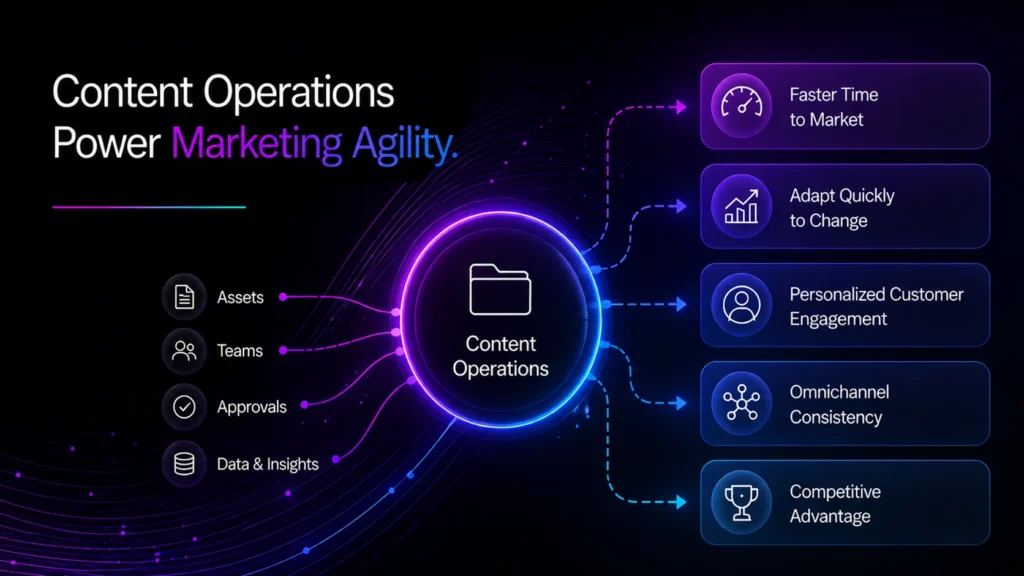
- Organizations that prioritize content operations gain a significant competitive advantage through enhanced marketing agility, allowing for rapid adaptation to market shifts and personalized customer engagement across all channels.
- Optimizing content operations directly translates to superior campaign performance and a demonstrably higher return on marketing investment by ensuring every asset contributes strategically to enterprise goals.
- The final outcome of a closed marketing operations gap, powered by advanced content operations, is a resilient marketing infrastructure capable of scaling innovation and consistently delivering exceptional, compliant customer experiences.
Understanding the Marketing Operations Gap
The marketing operations gap refers to the critical disconnect between marketing’s strategic objectives and its actual operational capabilities, often manifesting as inefficiencies in workflow, asset management, and cross-functional collaboration. This gap prevents marketing teams from executing at the speed and scale required to meet dynamic customer expectations and business goals. In a marketing environment saturated with tools and channels, the challenge is not a lack of resources, but rather the inability to orchestrate them cohesively.
Definition: The marketing operations gap is the disconnect between a marketing team’s strategy and its ability to execute effectively. It is often caused by fragmented processes, disconnected technologies, and inefficient content operations. The result is slower campaigns, duplicated work, inconsistent branding, and difficulty delivering personalized experiences at scale. Closing this gap with unified content operations improves efficiency, agility, and marketing performance.
The Tangible Benefits of Aligned Content Operations
Aligning content operations offers profound and tangible benefits that directly address and close the marketing operations gap. This alignment translates into improved efficiency, enhanced return on investment, and a demonstrably superior customer experience. When content creation, approval, distribution, and measurement are orchestrated from a centralized platform, organizations gain a holistic view of their marketing ecosystem.

- Accelerated Speed to Market: By streamlining content workflows and eliminating manual handoffs, marketing teams can bring campaigns and new content experiences to market significantly faster. This agility allows businesses to capitalize on fleeting trends and respond swiftly to competitive pressures, ensuring their messaging is always timely and relevant. The ability to iterate and deploy content rapidly means campaigns achieve their objectives sooner, translating directly into quicker business impact.
- Optimized Resource Utilization: A unified content operations framework provides clear visibility into asset usage, team workloads, and project progress. This transparency enables leaders to allocate resources more effectively, preventing burnout, reducing redundant efforts, and ensuring that creative and strategic talent is focused on high-value activities rather than administrative overhead. Fewer revisions due to clear brand guidelines and accessible approved assets further optimize resource spend.
- Improved Customer Experience and Consistency: Consistent, personalized customer experiences across all touchpoints are the hallmark of successful modern marketing. Aligned content operations ensure that every piece of content, regardless of channel, adheres to brand guidelines, resonates with target audiences, and reflects a cohesive brand narrative. This consistency builds trust and strengthens brand loyalty, fostering deeper customer engagement and ultimately driving customer lifetime value.
- Strengthened Compliance and Brand Governance: In highly regulated industries, or for any global brand, maintaining compliance at scale is paramount. Centralized content operations embed legal and brand review processes directly into workflows, ensuring every asset meets regulatory requirements and brand standards before publication. This proactive approach mitigates risk, avoids costly penalties, and protects brand reputation, providing a secure foundation for all marketing initiatives. This also allows for robust version control, ensuring that only the most current and approved content is ever disseminated, thereby maintaining impeccable brand integrity.
- Enhanced Marketing ROI: When content operations are optimized, every marketing dollar spent goes further. Through better targeting, consistent messaging, and more efficient production cycles, campaigns perform better, leading to higher conversion rates and improved customer acquisition costs. Accurate attribution becomes possible, allowing for data-driven decisions that continuously refine and improve campaign effectiveness. This disciplined approach ensures that marketing investments yield maximum returns, transforming content from a cost center into a powerful revenue driver.
Differentiating with a Holistic Content Operations Approach
A holistic content operations approach distinguishes itself from mere content management or workflow streamlining by integrating strategy, creation, distribution, and analytics into a single, cohesive framework. Unlike solutions that focus narrowly on asset organization or individual project flows, a holistic approach ensures every piece of content serves a strategic purpose and operates within a unified operational model. While content management platforms excel at storing and organizing assets, they often fall short in orchestrating the entire journey from ideation to impact analysis across diverse marketing functions. Similarly, basic workflow tools might automate sequential tasks but lack the overarching governance and strategic alignment necessary for enterprise-scale content delivery. True differentiation emerges from the ability to connect the dots across the entire marketing ecosystem. This means not only managing digital assets but also integrating campaign planning, budget allocation, performance measurement, and team collaboration. For instance, a basic Digital Asset Management (DAM) system might provide a single source of truth for approved images, but a holistic content operations platform extends this by embedding those assets directly into campaign planning tools, linking them to specific marketing initiatives, and tracking their performance against KPIs. The distinction lies in moving beyond simply housing content to actively governing its lifecycle and optimizing its strategic contribution. Organizations gain significant advantage by adopting platforms that unify these disparate functions, moving beyond siloed solutions to a truly integrated marketing operations framework. This comprehensive view illuminates inefficiencies that piecemeal solutions cannot address, unlocking greater agility and strategic insight across the entire marketing remit. This integrated approach allows for real-time adjustments based on performance data, optimizing content’s effectiveness and ensuring every marketing effort contributes to overarching business objectives.
Identifying and Addressing Operational Friction Points
Identifying operational friction points requires a systematic evaluation of existing processes, technologies, and team dynamics to pinpoint where breakdowns occur and efficiency is lost. This diagnostic phase is crucial for understanding the specific manifestations of the marketing operations gap within an organization. Common friction points include manual handoffs between teams, duplicated content creation, lack of visibility into project status, and inefficient approval cycles. These issues often stem from a patchwork of siloed tools and a lack of standardized procedures, leading to delays and frustration. Marketing leaders must conduct a thorough audit of their current state, asking critical questions about content lifecycle management. Where do projects consistently stall? Which approvals take the longest? How much time do teams spend searching for assets or recreating existing ones? These questions expose the hidden costs of inefficient operations. For instance, if a creative team regularly finds itself producing multiple versions of the same asset because different departments cannot access a centralized repository, that represents a significant friction point. Similarly, if legal review adds weeks to every content piece, it becomes an upstream bottleneck that impacts overall speed to market. Addressing these friction points involves not just process refinement but also the strategic deployment of integrating technologies. Four key steps to identify and begin closing the operational gap:
- Map the End-to-End Content Journey: Document every stage, from initial ideation and brief creation through content production, review, distribution, and performance analysis. Identify all stakeholders, tools used, and decision points at each step. This visual representation often reveals unexpected detours and redundant efforts.
- Quantify Time and Resource Waste: For each identified friction point, estimate the time and resources lost. How long does an average content piece take to get approved? How many hours are spent searching for assets? What is the cost of re-work due to poor communication or outdated branding? Attaching metrics to these inefficiencies provides a compelling case for change.
- Prioritize Interventions Based on Impact: Once friction points are identified and quantified, prioritize interventions based on their potential impact on overall efficiency and strategic goals. Start with the most pervasive or costly issues, focusing on solutions that offer significant uplift in core content operations metrics, such as cycle time reduction or asset reuse rates. This targeted approach ensures that efforts to close the gap yield maximum strategic benefit.
- Gather Stakeholder Feedback: Engage directly with creative teams, campaign managers, legal reviewers, and distributors. Their qualitative insights into daily frustrations and bottlenecks are invaluable for understanding the root causes of the gap. Surveys, workshops, and one-on-one interviews can surface critical pain points that might not be evident from process maps alone.
The Competitive Edge of Streamlined Content Operations
Streamlined content operations provide a decisive competitive edge by enabling organizations to outpace rivals in market responsiveness, customer engagement, and overall brand consistency. Businesses that simplify their content lifecycle from creation to distribution can deliver personalized, high-quality experiences faster than their competitors. This agility is no longer a luxury but a fundamental requirement for maintaining relevance and capturing market share. When an organization can launch a cohesive, multi-channel campaign in days rather than weeks, it establishes a significant lead in capturing audience attention and driving conversions. Consider the contrast between a brand with fragmented content workflows and one with a mature content operations platform. The former struggles with version control, inconsistent messaging, and protracted approval cycles, leading to delayed campaigns and a diminished brand perception. Marketing teams spend disproportionate time on administrative tasks rather than creative strategy. In stark contrast, the latter leverages automated workflows, centralized asset management, and integrated planning tools, allowing them to rapidly adapt content for different audiences and channels. This efficiency translates into more frequent, relevant engagements, building stronger customer relationships and reinforcing brand leadership. The ability to quickly pivot content strategies in response to market signals or competitive moves becomes an inherent capability, not an arduous, reactive scramble.
Streamlined content operations directly foster innovation. By removing the operational burden, creative teams are liberated to focus on developing groundbreaking campaigns and engaging storytelling. This environment cultivates a culture of continuous improvement, where insights from performance analytics are rapidly fed back into the content creation process. The outcome is a dynamic marketing engine that consistently produces high-impact content, cementing brand authority and attracting a loyal customer base. Ultimately, the competitive edge is found not just in faster execution, but in the sustained capacity for strategic creativity and impactful engagement that robust content operations enable
Conclusion
Closing the marketing operations gap, particularly through optimized content operations, is no longer an optional endeavor but a strategic imperative that directly influences an organization’s competitive standing and profitability. The journey from fragmented workflows to a unified operational model unlocks substantial gains in efficiency, directly enhances a brand’s return on marketing investment, and fundamentally elevates the customer experience. By establishing a single source of truth for all marketing assets, streamlining global processes, and fostering a culture of agility, businesses can transform their marketing function from a cost center into a powerful engine for growth and innovation. The path to achieving this involves a clear-eyed assessment of current operational friction, a willingness to embrace integrated technologies, and a commitment to continuous improvement. Organizations that proactively address their content operations will not only navigate the complexities of modern marketing with greater ease but will also forge stronger customer relationships and secure a lasting advantage in the marketplace.
Ready to Modernize Your Content Operations?
Generate a tailored Digital Asset Management RFI based on your requirements, use cases, and business goals.

FAQ
What are the common signs that an organization has a marketing operations gap?
Organizations often exhibit a marketing operations gap through several key indicators, including prolonged content approval cycles, inconsistent brand messaging across different channels, and redundant content creation efforts. Other prevalent signs involve a lack of clear visibility into project statuses, frequent budget overruns on campaigns, and a high level of manual intervention required for routine tasks. These symptoms collectively point to operational inefficiencies that hinder strategic execution and resource optimization.
How does technology specifically help in closing the marketing operations gap?
Technology plays a pivotal role in closing the marketing operations gap by providing essential tools for automation, centralization, and data-driven decision-making. Integrated platforms streamline workflows, manage digital assets from a single source, and offer real-time visibility into marketing performance. This technological infrastructure eliminates manual errors, accelerates content delivery, and enables teams to focus on strategic initiatives rather than administrative burdens, thereby enhancing overall operational effectiveness.
Can small marketing teams also benefit significantly from closing this gap?
Yes, small marketing teams can benefit significantly from closing the marketing operations gap, often even more acutely than larger ones due to limited resources. Streamlined content operations free up valuable time by automating repetitive tasks, allowing smaller teams to achieve disproportionate output and maintain brand consistency without scaling staff. This efficiency enables them to compete more effectively and dedicate their efforts to creative strategy and direct customer engagement.
What is the typical timeframe to see results after beginning to close the marketing operations gap?
The timeframe to observe results after initiating efforts to close the marketing operations gap can vary, but organizations often see initial improvements within three to six months. Tangible benefits like reduced approval times or improved asset reuse rates can become apparent as foundational operational changes and technological integrations take hold. More comprehensive strategic impacts, such as significant ROI shifts or sustained increases in market responsiveness, typically develop over a 9-18 month period as processes mature and adoption deepens.
How does closing the marketing operations gap impact cross-functional collaboration?
Closing the marketing operations gap profoundly enhances cross-functional collaboration by establishing shared platforms, standardized workflows, and transparent communication channels among departments. This integration ensures all stakeholders, from legal to sales, have access to accurate information and approved assets, reducing friction and misunderstandings. Improved collaboration accelerates project delivery, fosters a more unified brand message, and aligns diverse teams toward common strategic objectives.