
Many organizations prioritize refining downstream content distribution and analytics, focusing on how content reaches the customer. However, the true bottleneck often lies much earlier in the content lifecycle: in the upstream processes of ideation, planning, creation, and approval. This upstream friction, characterized by manual handoffs, inconsistent guidelines, and siloed teams, directly translates into delayed, inconsistent, or irrelevant content reaching the customer. The challenge is not merely about managing content once it is ready for deployment, but about transforming the entire content supply chain to proactively eliminate inefficiencies that degrade the customer experience. Addressing these foundational issues through automation is critical for delivering the consistent, personalized, and timely interactions customers now expect.
TL;DR
- Organizations achieve demonstrably superior customer experiences by proactively automating upstream content operations, directly addressing the root causes of content friction and inconsistency before they impact the customer journey.
- Strategic automation of initial content stages, from ideation and planning to creation and approval, fundamentally transforms the efficiency of global content delivery and enhances content relevance for diverse audiences.
- Implementing robust content operations platforms allows enterprises to move beyond mere workflow management, enabling a holistic approach that integrates content strategy with execution across all customer touchpoints.
- Streamlined upstream processes significantly reduce time-to-market for campaigns and personalized content, ensuring that experiences are timely, consistent, and precisely aligned with evolving customer expectations.
- Failing to automate upstream content operations leads to fragmented customer interactions and missed opportunities for engagement, ultimately eroding brand trust and diminishing long-term customer loyalty and revenue potential.
The Direct Link Between Upstream Automation and Customer Experience
Automating upstream content processes directly enhances the customer experience by ensuring that content is relevant, accurate, and delivered promptly. This proactive approach removes common internal bottlenecks that otherwise lead to stale, inconsistent, or delayed content, all of which negatively impact customer perception and engagement. When the entire content supply chain, from initial concept to final approval, operates with precision and speed, the resulting customer interactions are invariably more coherent and satisfying.
Automating upstream content operations involves leveraging technology to streamline and optimize the foundational stages of the content lifecycle. This encompasses everything from strategic planning and brief creation to content development, review, and asset management. The goal is to establish a systematic, repeatable process that minimizes manual intervention, reduces errors, and accelerates content readiness. By formalizing these initial steps, organizations can ensure content aligns with brand guidelines, legal requirements, and targeted customer personas from the outset.
Definition: Upstream content operations automation refers to the use of technology platforms to systematize and expedite initial content lifecycle stages, including planning, creation, review, and approval, thereby ensuring content quality, consistency, and timely delivery for an enhanced customer experience.
This strategic focus contrasts sharply with a reactive approach that primarily addresses content issues after they have already impacted downstream distribution. Instead, upstream automation builds quality and efficiency into the content creation process itself, cultivating an environment where errors are prevented, not merely corrected. This shift fundamentally alters the relationship between internal content teams and external customer perception, making content a consistent asset rather than a variable liability. When content is effortlessly produced and validated, it leads to a more fluid, engaging, and trustworthy customer journey.
Specific Upstream Processes Ripe for Automation
Several critical upstream processes are highly susceptible to automation, leading to significant gains in efficiency and customer experience quality. These processes include ideation, strategic planning, content brief development, creation, review cycles, and final asset approval. Automating these stages transforms them from potential bottlenecks into accelerators for content delivery.
- Ideation and Content Strategy: Automation tools can facilitate collaborative brainstorming, track content requests, and link new ideas directly to strategic objectives. This ensures content ideation is not ad hoc but driven by defined customer needs and business goals.
- Content Brief Development: Digital platforms can standardize brief creation, embedding templates, mandatory fields, and access to audience insights. This guarantees every piece of content begins with clear objectives, target audiences, and messaging requirements, minimizing reworks.
- Creation and Production Workflows: Automation orchestrates content creation handoffs, assigning tasks, tracking progress, and ensuring all stakeholders are notified at each stage. This eliminates manual coordination, reduces delays, and maintains momentum.
- Review and Approval Cycles: Automated routing for reviews and approvals ensures content moves swiftly through necessary stakeholders, including legal and brand compliance. Version control and audit trails provide transparency and accountability, preventing the release of unapproved content.
- Digital Asset Management Integration: Integrating content creation directly with a robust Digital Asset Management (DAM) system automates asset tagging, categorization, and metadata enrichment. This makes new and existing assets easily discoverable and reusable, vastly improving content velocity and consistency across channels.
- Performance Data Integration: Connecting upstream processes with downstream analytics allows for continuous feedback, informing future content strategy by highlighting what resonates most with customers. This iterative improvement cycle is crucial for sustained customer engagement.
By systematically applying automation to each of these touchpoints, organizations create a cohesive, transparent, and rapidly moving content supply chain. This structured approach not only accelerates content delivery but also elevates the intrinsic quality and alignment of content with overarching customer experience goals. The removal of manual steps reduces the likelihood of human error, ensuring a higher standard of accuracy and consistency in all customer-facing materials.
Measurable Benefits: Impact on Customer Experience and Business Outcomes
The automation of upstream content operations yields significant, measurable benefits that directly translate into enhanced customer experiences and improved business outcomes. These advantages extend beyond mere internal efficiency to directly influence how customers perceive and interact with a brand, driving loyalty and revenue. Organizations can track improvements in content relevance, speed to market, and overall customer satisfaction, directly correlating these metrics with upstream process optimizations.
One primary benefit is a demonstrable increase in content velocity and relevance. Automated processes drastically shorten the time it takes for ideas to become market-ready content. This means customers receive timely, relevant information and offers, preventing disengagement due to outdated or slow content. Faster content delivery allows brands to react swiftly to market trends and customer feedback, positioning them as responsive and attuned to customer needs. This responsiveness is a critical differentiator in maintaining engagement and trust.
Upstream automation leads to greater content consistency and accuracy. By enforcing brand guidelines, legal requirements, and messaging standards early in the content lifecycle, organizations virtually eliminate inconsistencies that can confuse or alienate customers. Automated review paths and version control ensure only approved assets are distributed, reducing the risk of errors that could damage brand reputation. Consistent brand messaging across all touchpoints builds trust and reinforces brand identity, making the customer journey feel more cohesive and professional.
Organizations also experience improved personalization at scale. With structured content and efficient asset management, it becomes far simpler to adapt core messages for different segments and channels. This capability allows for the creation of truly personalized experiences without a proportionate increase in manual effort, strengthening customer relationships by delivering highly relevant content. . The impact on specific business outcomes includes reduced operational costs, higher content ROI, and ultimately, increased customer lifetime value. For example, a global brand reduced its content review cycles by 40%, directly leading to a 15% improvement in campaign launch speed and a corresponding uplift in initial engagement metrics across its key markets.
Differentiating Upstream Automation from General Workflow Solutions
Upstream automation distinguishes itself from general content workflow solutions by focusing specifically on the proactive management and optimization of content creation’s initial stages, inherently designed to influence the customer journey from the ground up. Generic workflow tools often emphasize task management and sequential steps without deep integration into content strategy, digital asset governance, or the direct implications for customer experience. The critical distinction lies in the strategic intent: upstream automation is purpose-built to engineer superior content *before* it enters distribution, whereas general workflows simply facilitate the movement of existing content through a series of steps.
Many workflow solutions operate as a layer over existing, often disconnected, tools. They may track tasks and provide notifications, but they rarely offer the centralized asset intelligence, strategic planning capabilities, or automated compliance checks inherent in dedicated upstream automation platforms. For instance, a basic workflow might move a document from a writer to an editor, but it won’t automatically check if that document uses the latest brand guidelines, if its imagery is rights-cleared, or if it aligns with the overall content calendar. This limited scope means that while tasks get completed, the underlying quality and strategic alignment of the content can still be compromised.
Conversely, true upstream automation platforms embed intelligence at every stage. They integrate directly with content strategy tools to ensure new content aligns with current objectives, connect with robust digital asset management (DAM) systems for immediate access to approved assets and automated metadata application, and include governance features that enforce compliance standards from the moment content is conceived. This comprehensive approach means that by the time content is ready for downstream distribution, it is already optimized for consistency, compliance, and customer relevance, eliminating costly rework and enhancing the overall brand experience. This proactive quality control is what fundamentally sets upstream automation apart, delivering content that is not just processed efficiently, but created effectively. It ensures that marketing materials are not merely managed, but strategically sculpted for maximum impact and adherence to brand standards, ultimately leading to a more consistent and impactful customer journey.
Implementing Upstream Automation: A Phased Approach
Implementing upstream content automation requires a structured, phased approach that prioritizes understanding current inefficiencies, defining desired outcomes, and gradually integrating the necessary technological components. Organizations should begin by auditing their existing content processes to identify specific friction points that directly impact content quality and delivery speed. This foundational analysis ensures that automation efforts are targeted for maximum impact on the customer experience.
Establishing a clear vision for the automated content lifecycle is paramount. This involves defining new operational models that leverage automation to streamline ideation, creation, review, and approval. Focus should remain on how each automation step contributes to a more consistent, relevant, and timely content supply chain for the customer. Piloting solutions with a manageable scope, such as automating the content brief generation or the initial legal review, allows teams to gain experience and demonstrate early successes.
Aprimo provides a robust platform for orchestrating these complex upstream activities, offering capabilities that streamline the entire content supply chain. This includes centralized planning and budgeting, intuitive content creation tools, integrated digital asset management, and configurable workflow automation. By utilizing such a platform, organizations can gradually replace manual, disparate processes with a unified system that ensures content integrity and speed. For instance, Aprimo’s workflow engine can automatically route content for review based on predefined rules, escalating approvals as needed and ensuring all necessary compliance checks are completed before content moves downstream. This level of orchestration ensures every piece of content is customer-ready upon completion.
Effective implementation extends beyond technology; it requires a cultural shift towards proactive content management and continuous improvement. Training teams on new processes and tools, fostering collaboration across departments, and regularly measuring the impact of automation on key performance indicators (KPIs) are all essential components for sustained success. The objective is not just to automate tasks, but to embed a culture of content excellence that consistently delivers value to the customer.
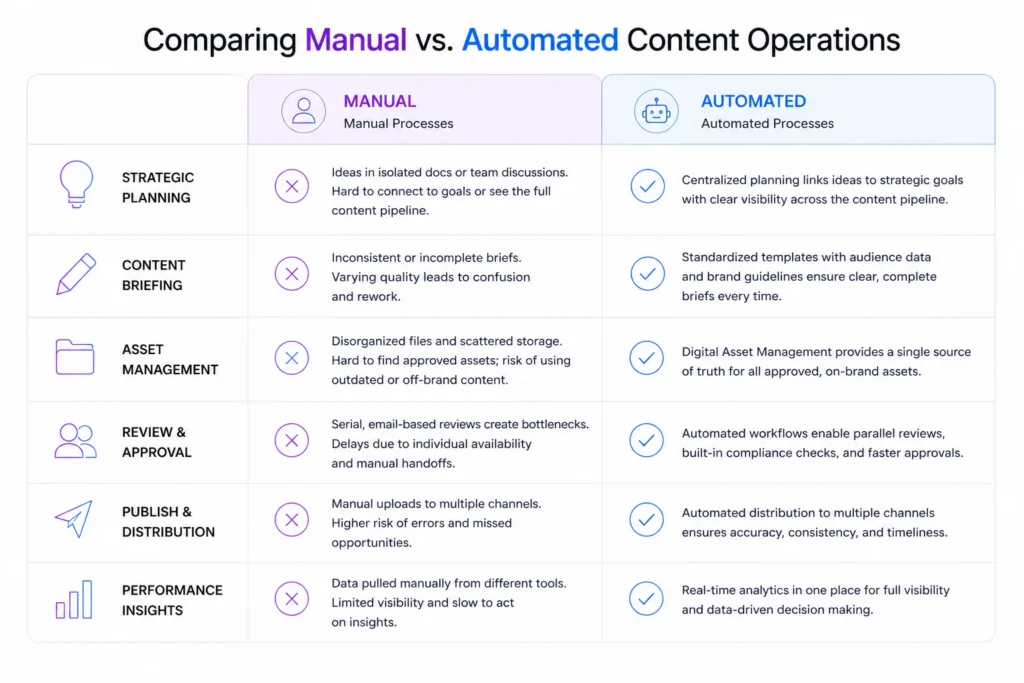
Comparing Manual vs. Automated Content Operations
The contrast between manual and automated content operations is stark, particularly regarding their impact on organizational efficiency and ultimately, customer experience. Manual processes, often reliant on emails, spreadsheets, and ad hoc communication, introduce significant delays, inconsistencies, and a higher propensity for error. Automated content operations, conversely, establish predictable, standardized, and accelerated pathways for content creation and approval.
In a manual environment, content ideation might exist in isolated documents or team discussions, making it difficult to trace back to strategic objectives or understand the full content pipeline. Content briefs are often incomplete or vary wildly in quality, leading to extensive feedback cycles. Asset management can be disorganized, with teams struggling to locate approved images or videos, resulting in content recreation or the use of outdated materials. Review processes are typically serial and bottlenecked by individual schedules, causing significant delays and missed opportunities for timely customer engagement. This protracted, error-prone cycle inevitably results in content that arrives late, feels disjointed, or even contains inaccuracies, directly harming the customer’s perception of the brand.
Automated content operations transform this landscape. Centralized planning modules link content ideas directly to strategic goals, ensuring every piece of content serves a purpose. Standardized templates for content briefs, often pre-populated with audience data and brand guidelines, accelerate the initial creation phase and reduce ambiguity. Digital asset management systems, integrated into the workflow, provide a single source of truth for all approved assets, eliminating duplication and ensuring brand consistency. Automated workflows with built-in compliance checks and parallel review capabilities drastically cut down approval times, ensuring content is delivered to market faster. This systematic approach means customers receive a steady stream of high-quality, relevant, and consistent content, fostering trust and loyalty. The predictability and efficiency gained through automation allow marketing and content teams to focus on strategic impact rather than administrative overhead, directly elevating the overall customer journey.
Conclusion
Automating upstream content operations is not merely an efficiency play; it is a foundational strategic imperative for delivering exceptional customer experiences. By proactively streamlining every stage from ideation to final approval, organizations eliminate the friction, delays, and inconsistencies that plague manual processes and often degrade customer interactions. This deliberate shift establishes a robust framework for creating, managing, and delivering content that is precisely targeted, consistently branded, and always timely. The result is a more cohesive, engaging, and trustworthy customer journey, which directly translates into increased customer satisfaction, loyalty, and sustained business growth. Prioritizing upstream automation is therefore essential for any organization committed to building enduring customer relationships in an increasingly demanding market.
Experience AI-Powered Content Operations
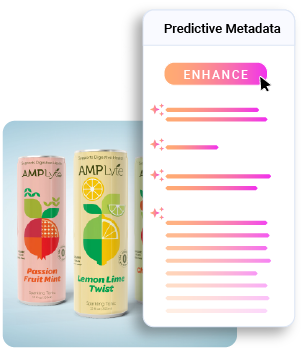
See how Aprimo’s AI-powered Librarian Agents automatically enrich content with metadata, improve discoverability, strengthen governance, and unlock greater content reuse across the entire content lifecycle.
FAQ
What is the primary difference between upstream and downstream content processes?
Upstream content processes encompass the initial stages of content creation, including ideation, planning, brief development, writing, and internal approvals. Downstream processes focus on content distribution, publication, and performance measurement via channels like websites, social media, and email. Automating upstream ensures content quality and readiness, while downstream automation focuses on efficient delivery to the customer.
How does upstream content automation improve content governance?
Upstream content automation significantly improves governance by embedding compliance checks, brand guidelines, and legal reviews directly into the content creation workflow. This ensures that content adheres to all regulatory and internal standards from its inception, rather than being an afterthought. Automated version control and audit trails provide a clear record of all content changes and approvals, fostering accountability and reducing risk.
How does upstream automation contribute to content personalization efforts?
Upstream automation enables more effective content personalization by establishing structured frameworks for content creation and asset management, making it easier to adapt and reuse content for specific audience segments. By centralizing approved content and metadata, teams can efficiently retrieve, modify, and deploy variations that resonate with different personas. This capability allows for delivering highly relevant experiences at scale without the typical manual overhead associated with deep personalization.
What role does digital asset management play in upstream automation?
Digital asset management (DAM) is a cornerstone of effective upstream automation, serving as the central repository for all approved content assets, including images, videos, and documents. It ensures that content creators have immediate access to brand-compliant, rights-cleared materials, preventing the use of outdated or unapproved assets. Integrating DAM into upstream workflows automates asset tagging and metadata application, streamlining discoverability and reuse across the entire content lifecycle.
How can organizations measure the ROI of upstream content automation?
Organizations can measure the ROI of upstream content automation by tracking key metrics such as reduced content creation cycles, lower error rates in published content, increased content velocity, and improved customer engagement rates. Other indicators include a decrease in rework time, higher team productivity, and a quantifiable impact on conversion rates or customer satisfaction scores attributed to better content. Establishing baseline metrics before implementation is crucial for accurate comparison and demonstrating tangible business value.